Maritime Vessel Detection from Satellite SAR and Optical Imagery
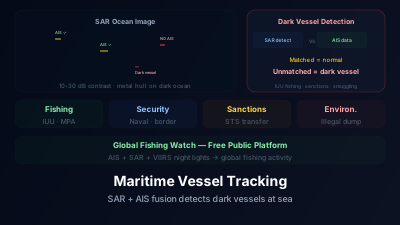
Quick Answer: Satellites detect ships at sea through two primary methods: SAR detects vessels as bright targets against the dark ocean surface (metal hulls are strong radar reflectors), detecting larger steel-hulled ships most reliably in calm to moderate seas and degrading as wave clutter rises. Detection performance is not a single number: it depends on vessel size, sea state, polarization and imaging mode, and vessels under about 15m are difficult to detect at any sea state at Sentinel-1 resolution. Optical imagery identifies ships by shape and wake patterns but is limited by cloud cover and nighttime. Comparing satellite detections against AIS (Automatic Identification System) transponder data reveals 'dark vessels' — ships that have turned off their transponders to avoid tracking, often indicating illegal fishing, smuggling, or sanctions evasion. Global Fishing Watch and other platforms combine satellite SAR, optical, and AIS data to monitor fishing activity worldwide. Sentinel-1 provides free, systematic ocean surveillance every 6-12 days.
The ocean covers 71% of Earth's surface, and for most of that area, there is no law enforcement presence. Ships can operate with effective anonymity simply by turning off their AIS transponder — the radio system that broadcasts their identity and position. A widely cited PLOS ONE study by Agnew and colleagues put worldwide losses to illegal and unreported fishing at "between $10 bn and $23.5 bn annually, representing between 11 and 26 million tonnes".
Satellites are changing this equation. A ship can turn off its transponder, but it can't turn off its radar cross-section.
SAR-Based Vessel Detection
Why SAR Works
The ocean surface has relatively low radar backscatter (dark in SAR images), while metal ship hulls are extremely strong radar reflectors (bright in SAR images). This contrast makes ship detection in SAR images a well-defined signal processing problem.
The physics: A metal ship hull acts as a corner reflector, bouncing radar energy back toward the satellite with very high efficiency. A steel vessel of a few tens of metres typically returns radar energy orders of magnitude stronger than the sea around it, which is what makes it stand out from ocean clutter — although the actual margin depends on hull material and geometry, aspect angle, polarization and how rough the sea is at the time.
Detection Algorithm
The standard approach is CFAR (Constant False Alarm Rate) detection:
- Estimate local background: Calculate the mean and standard deviation of ocean backscatter in a neighborhood around each pixel
- Set threshold: A pixel is flagged as a potential vessel if its backscatter exceeds the background by a specified number of standard deviations (typically 5-10σ)
- Cluster and filter: Group adjacent flagged pixels into vessel candidates. Filter by size, shape, and context to remove false alarms (platform structures, islands, sea ice, etc.)
- Characterize: Estimate vessel length from the extent of the detection, and heading from wake patterns if visible
Performance
Detection performance is not a single number — it is a function of vessel size, sea state, polarization and imaging mode, and any credible figure has to be quoted against a specific sensor configuration and validation dataset. The direction of the effects, however, is consistent:
| Sea State | Effect on detection of ships >25m | False Alarm Rate |
|---|---|---|
| Calm (Beaufort 0-2) | Best case — dark, smooth background maximises contrast | Low |
| Moderate (Beaufort 3-5) | Still generally reliable for larger steel hulls | Moderate |
| Rough (Beaufort 6+) | Noticeably degraded; smaller vessels drop out first | Higher |
Detection degrades in rough seas because wave-generated clutter increases the background level, reducing the signal-to-noise ratio. Very small vessels (<15m) are difficult to detect at any sea state with Sentinel-1's resolution.
Sentinel-1 for Maritime Surveillance
Sentinel-1 provides systematic ocean coverage:
- IW mode: 250km swath at 5×20m resolution — covers large ocean areas efficiently
- Revisit: Every 6-12 days over most ocean areas
- Free and open: Available to any maritime authority worldwide
- Archive: Continuous from 2014, enabling historical analysis
Optical Vessel Detection
Capabilities
VHR optical satellites (WorldView, Pléiades, SkySat) provide:
- Ship identification by shape, size, and superstructure
- Vessel type classification (container, tanker, fishing, naval)
- Activity indication (underway with wake vs. stationary)
- Color and markings (at sub-meter resolution)
Limitations
- Cloud cover prevents observation
- Nighttime observation impossible (except for night light detection from VIIRS)
- Lower detection rate for small vessels than SAR
- More expensive than Sentinel-1
AIS Correlation: Finding Dark Vessels
The most powerful application combines satellite imagery with AIS data:
AIS (Automatic Identification System)
Ships above a certain tonnage are required by international law to broadcast AIS signals containing:
- Ship identity (MMSI, name, call sign)
- Position (GPS)
- Speed and heading
- Vessel type and dimensions
AIS receivers on land, on other ships, and on satellites collect these broadcasts, creating a global ship tracking dataset.
The Dark Vessel Problem
Ships engaged in illegal activity often disable their AIS transponders:
- Illegal fishing: Fishing in prohibited zones or exceeding quotas
- Sanctions evasion: Ships transferring cargo to circumvent trade sanctions
- Smuggling: Drug trafficking, arms smuggling, human trafficking
- Unauthorized transshipment: Transferring catch at sea to avoid port inspection
Detection Method
- Satellite image: Detect all vessels in the image area (SAR or optical)
- AIS data: Query all AIS positions at the image acquisition time within the image footprint
- Match: Correlate satellite detections with AIS positions
- Identify unmatched: Satellite detections without a corresponding AIS signal = potential dark vessels
- Investigate: Unmatched detections flagged for further monitoring or enforcement action
The ship detection guide covers how vessels, dark vessels included, show up in Sentinel-1 SAR.
Global Fishing Watch
The most prominent example of satellite-based maritime monitoring:
Platform: globalfishingwatch.org — free, public platform showing global fishing activity
Data sources:
- AIS vessel tracking (billions of positions)
- Satellite SAR vessel detections (Sentinel-1, commercial SAR)
- VIIRS nighttime light detections (illuminated fishing vessels)
- VMS (Vessel Monitoring System) data from cooperating countries
Products:
- Apparent fishing effort maps (hours of fishing per area)
- Vessel identity database
- Dark vessel detection alerts
- Marine Protected Area monitoring
- Port visit analytics
Applications
Fisheries Enforcement
- Detect fishing in Marine Protected Areas or exclusive economic zones
- Identify vessels fishing without proper licensing
- Monitor transshipment events (potential catch laundering)
- Track fishing fleet movements and effort distribution
Maritime Security
- Naval domain awareness in contested waters
- Detection of vessels approaching sensitive infrastructure (oil platforms, cables, ports)
- Border and customs surveillance
Sanctions Monitoring
- Track sanctioned vessels attempting to evade detection
- Monitor ship-to-ship transfers (fuel or cargo) that circumvent sanctions
- Identify flag changes and identity manipulation
Environmental Protection
- Detect vessels dumping waste or discharging bilge in prohibited areas
- Monitor ballast water exchange compliance
- Track vessels operating in emission control areas
Search and Rescue
- Historical vessel tracking to establish last known position
- Wide-area search using SAR imagery to locate distressed vessels
Challenges
Temporal gaps: Sentinel-1 revisits every 6-12 days — a vessel detected in one pass may be hundreds of kilometers away before the next observation. Persistent surveillance requires constellation approaches (multiple SAR satellites).
Attribution: SAR detects a ship but doesn't identify it. Without AIS correlation, the detected vessel is anonymous. VHR optical imagery or physical interception is needed for positive identification.
Small vessel detection: Most illegal fishing in developing countries involves small boats (<15m) that are below the detection threshold of Sentinel-1. Higher-resolution commercial SAR or optical imagery is needed.
Processing scale: Global ocean monitoring generates massive data volumes. Automated detection algorithms must process hundreds of SAR scenes daily with low false alarm rates.
The convergence of free SAR data (Sentinel-1), commercial SAR constellations (Capella, ICEYE, Umbra), and AI-powered analytics platforms has made comprehensive maritime surveillance technically feasible. The remaining challenges are primarily institutional — ensuring that detection intelligence reaches enforcement agencies with the authority and capacity to act on it.
Related reading
Detecting vessels in one scene and keeping a berth or anchorage under continuous watch are different setups. Measuring a number versus watching for events covers the second, including the distinction between a measurement that fires on satellite passes and an event watch that fires on a cadence you choose.

Remote sensing specialist with 10+ years in satellite data processing and AI. Founder of Off-Nadir Lab. Ph.D. in Informatics (Yokohama National University, 2026). Master's in Earth System Science and Technology (Kyushu University). Co-author, Remote Sensing Encyclopedia. More about the author →