
Machine Learning for Satellite Image Classification: From Random Forest to Deep Learning
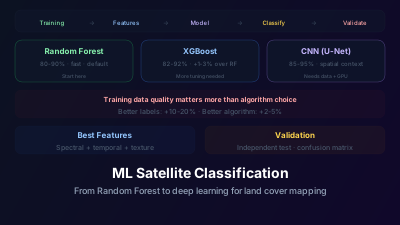
Quick Answer: Machine learning classifies satellite pixels into land cover categories by learning statistical patterns from training examples. Random Forest remains the workhorse — fast to train, resistant to overfitting, handles mixed feature types, and is a strong baseline on typical 5-10 class land cover problems. Gradient boosting (XGBoost, LightGBM) often edges it out, though usually by a small margin. Deep learning (CNNs like U-Net) excels when spatial context matters (building detection, road extraction) but requires more training data and computation. The most impactful factor is training data quality, not algorithm choice — switching from Random Forest to deep learning tends to buy an incremental gain, while fixing mislabeled polygons, balancing classes, and covering the full environmental range of the study area tends to buy a much larger one. If a classification is failing, audit the labels before touching the model.
Satellite classification projects routinely spend far more effort on model architecture than on the training labels, even though label errors usually cost more accuracy than architectural refinements gain. The most common failure mode in satellite image classification isn't the algorithm. It's the training data.
That said, algorithm choice does matter, and understanding when to use which approach saves time and produces better results.
The Classification Problem
Satellite image classification assigns each pixel (or object) to a category:
- Land cover classes: forest, cropland, urban, water, bare soil
- Crop types: wheat, rice, corn, soybean
- Damage levels: undamaged, moderate, severe
- Any categorical distinction visible in satellite data
The process:
- Training data: Labeled examples of each class (pixels or polygons with known class labels)
- Feature extraction: Spectral bands, indices, texture, temporal features for each training sample
- Model training: Algorithm learns the relationship between features and classes
- Prediction: Apply the trained model to classify every pixel in the image
- Accuracy assessment: Compare classified map against independent reference data
Which algorithm should you choose?
Start with Random Forest for pixel-based land cover work: it trains in minutes, resists overfitting, and performs competitively on typical 5-10 class problems. Move to gradient boosting when you need to squeeze out a last increment of accuracy, and reserve deep learning for tasks where spatial context — shape, arrangement, texture at scale — carries the signal that spectral values alone cannot.
Random Forest
An ensemble of decision trees, each trained on a random subset of training data and features. Classification is by majority vote across all trees.
Why it's the default choice:
- Fast to train (minutes for millions of pixels)
- Resistant to overfitting (the ensemble averaging smooths out individual tree errors)
- Handles mixed feature types (spectral, indices, texture, elevation, categorical)
- Provides feature importance rankings (which bands/indices matter most)
- Minimal hyperparameter tuning needed (number of trees = 500 works for most cases)
- Works well with relatively small training datasets (hundreds to thousands of samples)
Typical performance: strong on 5-10 class land cover problems, and a sensible baseline against which to measure anything more complex. The accuracy you actually reach depends far more on the class definitions, the site, and the label quality than on the algorithm.
Gradient Boosting (XGBoost, LightGBM, CatBoost)
Builds trees sequentially, each correcting the errors of the previous tree. Produces stronger individual predictions than Random Forest's averaging approach.
When to choose over Random Forest:
- Often edges out Random Forest, though usually by a small margin
- Better at capturing complex feature interactions
- More hyperparameter tuning required (learning rate, max depth, regularization)
- Slightly slower to train but still fast enough for operational use
Support Vector Machine (SVM)
Finds the optimal hyperplane separating classes in feature space. With kernel functions (RBF), handles non-linear class boundaries.
When to choose:
- Small training datasets (<1000 samples) where SVMs can outperform ensemble methods
- High-dimensional feature spaces (many bands/indices)
- Becoming less popular as Random Forest and gradient boosting are easier to use and scale better
Convolutional Neural Networks (CNNs)
Deep learning models that process image patches rather than individual pixels, learning spatial patterns (edges, textures, shapes) in addition to spectral features.
Architectures for satellite classification:
- U-Net: Encoder-decoder architecture for semantic segmentation. Standard choice for pixel-wise classification with spatial context.
- DeepLab: Atrous convolution for multi-scale feature extraction. Good for objects of varying sizes.
- ResNet/EfficientNet: For scene classification (classifying entire image patches rather than individual pixels).
For a deeper treatment of architectures, tiling, and the satellite-specific pitfalls of neural networks, see deep learning for Earth observation.
When to choose deep learning:
- Spatial context is important (building footprint extraction, road detection)
- Large training datasets available (tens of thousands of labeled patches)
- GPU resources available
- Task involves pattern recognition beyond spectral signatures (object shape, arrangement)
When NOT to choose deep learning:
- Small training datasets (deep learning overfits severely with <1000 samples)
- Pixel-level spectral classification where spatial context doesn't help (mineral mapping)
- Computational resources are limited
- Interpretability is important (deep learning is harder to explain than Random Forest)
Feature Engineering
For pixel-based classifiers (Random Forest, XGBoost, SVM), the features you provide matter enormously:
Spectral Features
- All available bands (don't pre-select — let the algorithm decide importance). Sentinel-2 provides 13 spectral bands per scene, all of which can feed the classifier.
- Band ratios (NDVI, NDWI, NDBI, NBR — see how to choose a satellite index)
- Red-edge indices (for vegetation type discrimination)
Temporal Features
- Multi-date observations (spring, summer, autumn composites)
- Phenological metrics (green-up date, peak NDVI, growing season length)
- Time series statistics (mean, median, standard deviation, min, max per band)
Free archives make temporal features cheap to build: NASA describes Landsat as "the longest continuous space-based record of Earth's land in existence," and Sentinel-2 scenes are freely available through the Copernicus Data Space Ecosystem. See the overview of free satellite data sources for what else is available at no cost.
Texture Features
- GLCM metrics (contrast, homogeneity, entropy, correlation) computed over neighborhood windows
- Edge detection filters
- Most valuable for distinguishing classes with similar spectral signatures but different spatial patterns
Ancillary Features
- Elevation and slope from DEM
- Distance to water, roads, settlements
- Climate variables (precipitation, temperature)
- Soil type
The feature engineering effect: Adding temporal and texture features to a spectral-only Random Forest generally improves separability — classes that overlap spectrally often separate cleanly once seasonality or spatial pattern is available. How much you gain depends on the classes and the site, but the gain frequently exceeds what you'd get by switching algorithms.
Why is training data the most critical factor?
Because every algorithm can only reproduce the patterns present in its labels. Switching from Random Forest to deep learning tends to buy an incremental gain; fixing mislabeled polygons, balancing classes, and covering the full environmental range of your study area tends to buy a much larger one. If a classification is failing, audit the labels before touching the model.
Quality Over Quantity
1000 carefully labeled, representative training samples outperform 10,000 sloppy labels every time. Common training data problems:
Mislabeled samples: A "forest" training polygon that includes a road or clearing introduces confusion. Verify training data against high-resolution imagery.
Class imbalance: If 90% of training data is "forest" and 2% is "wetland," the classifier will rarely predict wetland. Balance classes through stratified sampling or class weighting.
Non-representative samples: Training data collected only in flat terrain won't generalize to mountainous areas. Ensure geographic and environmental diversity.
Temporal mismatch: Training labels from 2020 applied to 2024 imagery — if land cover has changed, the labels are wrong.
How much training data do you need?
As a working rule, a few hundred well-distributed samples per class are enough for tree-based methods, while convolutional networks need thousands of labeled patches to avoid overfitting. Collecting beyond the recommended range rarely helps unless the extra samples also add geographic or seasonal diversity. The table gives practical minimums and recommended targets per method:
| Method | Minimum Samples per Class | Recommended |
|---|---|---|
| Random Forest | 50-100 | 500-2000 |
| Gradient Boosting | 100-200 | 500-2000 |
| SVM | 20-50 | 200-1000 |
| CNN (U-Net) | 1000-5000 patches | 10,000+ patches |
Sources of Training Labels
- Field survey (most reliable but expensive and limited)
- Interpretation of VHR imagery (Google Earth, Planet, aerial photos)
- Existing land cover maps (may be outdated)
- OpenStreetMap (variable quality)
- Active learning (classifier identifies uncertain pixels for human labeling)
How do you assess classification accuracy?
Compare the classified map against independent reference samples that were never used in training, and report per-class metrics rather than a single headline percentage. A confusion matrix with producer's and user's accuracy for every class shows which categories are reliable and which are being systematically confused — information that overall accuracy alone hides completely.
The Golden Rule
Never assess accuracy on training data. Always use independent reference data that wasn't used for training.
Metrics
Overall Accuracy (OA): Percentage of correctly classified reference samples. Simple but can be misleading with class imbalance.
Kappa Coefficient: Accounts for chance agreement. Values 0.6-0.8 = substantial agreement; >0.8 = excellent.
Producer's Accuracy: Per-class metric — what fraction of the reference data for class X was correctly classified? (Measures omission error.)
User's Accuracy: Per-class metric — what fraction of pixels classified as class X actually are class X? (Measures commission error.)
F1 Score: Harmonic mean of precision and recall. Useful for imbalanced classes.
Confusion Matrix: The complete picture — shows exactly which classes are confused with which.
Sample Size for Validation
Minimum ~50 reference samples per class (more for rare classes or where high confidence is needed). Total validation sample size of 500-1000 points is typical for regional studies.
Practical Workflow
- Define classes clearly — unambiguous, mutually exclusive, detectable by satellite
- Collect training data — diverse, representative, correctly labeled
- Extract features — spectral + temporal + texture + ancillary
- Split data — 70% training, 30% validation (spatially stratified)
- Train initial model — Random Forest with default parameters
- Evaluate — confusion matrix, identify problem classes
- Iterate — improve training data for confused classes, add features
- Compare algorithms — try gradient boosting, deep learning if justified
- Final accuracy assessment — on fully independent validation data
- Document — training data sources, features used, parameters, accuracy
The most important steps are 2 (training data quality) and 6-7 (iterative improvement). The algorithm selection (step 8) is often the least impactful decision in the entire workflow.
Classification maps from two dates are also the starting point for post-classification change analysis — see land cover change detection methods for how classified outputs feed change mapping. And if you want to inspect a classified raster without opening a desktop GIS, you can drop the GeoTIFF onto a browser map and check it visually in seconds.

Remote sensing specialist with 10+ years in satellite data processing and AI. Founder of Off-Nadir Lab. Ph.D. in Informatics (Yokohama National University, 2026). Master's in Earth System Science and Technology (Kyushu University). Co-author, Remote Sensing Encyclopedia. More about the author →