
Supervised vs Unsupervised Classification in Remote Sensing
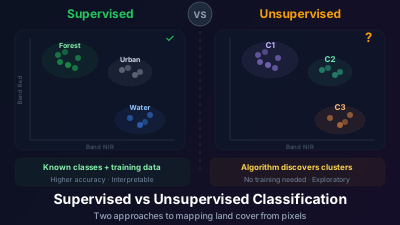
Quick Answer: Supervised classification requires labeled training samples to teach an algorithm what each land cover class looks like; unsupervised classification (clustering) groups pixels by spectral similarity without prior knowledge. Supervised gives higher accuracy when good training data exists. Unsupervised is faster for exploration but requires post-hoc labeling. Hybrid approaches — using unsupervised clustering to guide training sample selection — often work best in practice.
Consider a large-area land-cover mapping task with limited ground truth and a short delivery window — forests, rice paddies, urban areas and water to be separated across a whole region, with no field campaign to draw labels from and a single Sentinel-2 mosaic available. This is a typical case in which the choice between supervised and unsupervised classification becomes consequential.
The scenario forces a decision every remote sensing analyst faces: supervised or unsupervised classification?
The Problem Both Approaches Solve
Classification is the process of assigning every pixel in a satellite image to a category — forest, water, urban, agriculture, bare soil, etc. The input is a multi-band image where each pixel has reflectance values in several spectral bands. The output is a thematic map where each pixel has a class label.
Both supervised and unsupervised methods use the same underlying principle: pixels with similar spectral characteristics likely represent the same type of land cover. The difference is how they define "similar."
Supervised Classification
You tell the algorithm what to look for by providing training samples — sets of pixels you've already identified as belonging to specific classes.
The Process
-
Collect training data: Identify representative areas for each class. For "forest," you might digitize 20 polygons over known forested areas. For "water," select several lakes and river sections. The goal is to capture the spectral variability within each class.
-
Train the classifier: The algorithm learns the statistical relationship between spectral values and class labels. Different algorithms learn differently — Maximum Likelihood fits Gaussian distributions, Random Forest builds decision trees, Support Vector Machines find optimal separating hyperplanes.
-
Classify: Every pixel in the image is assigned to the class it most closely matches, based on what the classifier learned.
-
Validate: Compare the classification against independent ground truth (not the training data) to assess accuracy.
When It Works Well
Supervised classification excels when:
- You have reliable ground truth or local knowledge
- The number of classes is well-defined
- Classes are spectrally distinct
- You need the output to match specific, predefined categories (e.g., a national land cover scheme)
Common Algorithms
| Algorithm | Strengths | Limitations |
|---|---|---|
| Maximum Likelihood | Statistically rigorous, well-understood | Assumes normal distribution per class |
| Random Forest | Handles non-linear relationships, robust | Can overfit with too many trees |
| Support Vector Machine | Good with small training sets, high-dimensional data | Slow on very large datasets |
| k-Nearest Neighbors | Simple, no assumptions about distributions | Sensitive to irrelevant features |
The Training Data Problem
The quality of supervised classification is directly tied to the quality of your training data:
Mistake 1: Not enough variability. Training "forest" only in flat lowland areas, then expecting the classifier to handle mountain forests where illumination and species are different. The classifier has never seen those spectral signatures and misclassifies them.
Mistake 2: Mixed pixels in training areas. If your "urban" training polygons include some pixels that are actually parks or shadows, the classifier learns a confused version of "urban."
Mistake 3: Unbalanced classes. 500 training pixels for "forest" but only 20 for "wetland" — the classifier may never properly learn the minority class.
Unsupervised Classification
No training data required. The algorithm examines all pixels and groups them into clusters based on spectral similarity.
The Process
- Specify the number of clusters: You tell the algorithm to find, say, 15-20 spectral groups
- Run clustering: The algorithm iteratively assigns pixels to clusters and adjusts cluster centers until convergence
- Label the clusters: After clustering, you examine each cluster and assign it a meaningful class name based on what it represents on the ground
Common Algorithms
K-Means: The workhorse. You specify k clusters; the algorithm randomly initializes cluster centers, assigns each pixel to the nearest center, recalculates centers, and iterates until stable. Fast and deterministic (given the same initialization).
ISODATA (Iterative Self-Organizing Data Analysis): An extension of K-Means that can split clusters that are too heterogeneous and merge clusters that are too similar. More adaptive but requires more parameter tuning.
When It Works Well
- Exploring an unfamiliar area where you don't know what classes exist
- Quick preliminary assessment before investing in training data collection
- Identifying spectral classes that don't correspond to obvious land cover types (e.g., different soil mineralogies that all look like "bare soil" to the eye)
The Labeling Problem
Here's the fundamental trade-off: unsupervised classification pushes the expert knowledge requirement to the end of the process instead of the beginning. You still need to interpret the clusters.
And clusters don't always correspond to meaningful classes. K-Means might split "forest" into three clusters (sunlit canopy, shaded canopy, edge pixels) while merging "dark water" and "radar shadow" into one cluster. The spectral grouping is valid; it just doesn't match what you want to map.
In practice, 15–20 clusters works well for a typical scene. After labeling, you merge clusters that represent the same class and split any that are ambiguous.
Hybrid Approaches
The most effective workflows combine both methods:
Stage 1: Run unsupervised classification with a generous number of clusters (20-30). This reveals the natural spectral structure of the scene.
Stage 2: Examine clusters overlaid on the original imagery. Identify which clusters correspond to your target classes. Note where confusion exists.
Stage 3: Use this knowledge to strategically collect training samples for supervised classification — focusing on areas where unsupervised clustering was ambiguous.
This approach is faster than blind training sample collection and produces better results than unsupervised classification alone.
Accuracy Assessment
Both approaches need accuracy assessment. The standard tool is a confusion matrix (also called error matrix):
- Rows = classified labels
- Columns = reference (ground truth) labels
- Diagonal = correctly classified pixels
- Off-diagonal = errors
From the confusion matrix, you can compute:
- Overall accuracy: Total correct / total pixels
- Producer's accuracy: How well a particular class was mapped (omission error)
- User's accuracy: How reliable a particular class label is (commission error)
- Kappa coefficient: Agreement beyond chance (though its usefulness is debated)
An overall accuracy of 85% sounds good until you realize that 85% means 15% of your map is wrong. In a 100-hectare study area, that's 15 hectares of incorrect classification. Whether that matters depends on your application.
Numbers aside, look at the map: dropping the classified raster into the GeoTIFF viewer puts it over a basemap, which shows where the errors sit.
A Reasonable Default
For most projects, a supervised approach with Random Forest — using the hybrid exploration method described above to guide training sample selection — is a sound default. Random Forest is forgiving of imperfect training data, handles multiple classes well, and provides a built-in variable importance measure that tells you which bands matter most.
If you're completely new to an area and have no ground truth at all, start unsupervised. Let the data tell you what's spectrally distinct. Then refine with supervision once you understand the landscape.
Classification is one of those tasks that seems simple in concept — "just assign each pixel a label" — but the difference between a mediocre map and a useful one lies entirely in how carefully you handle training data, parameter selection, and validation.
Related reading
Unsupervised methods are also what make continuous monitoring possible without labelled data: instead of clustering a scene, you compare each new reading against the area's own history. Measuring a number versus watching for events describes that approach, including why a median-and-MAD threshold is used rather than mean and standard deviation.

Remote sensing specialist with 10+ years in satellite data processing and AI. Founder of Off-Nadir Lab. Ph.D. in Informatics (Yokohama National University, 2026). Master's in Earth System Science and Technology (Kyushu University). Co-author, Remote Sensing Encyclopedia. More about the author →