
Introducing Delta Signals: Geospatial Event Intelligence for Satellite Monitoring
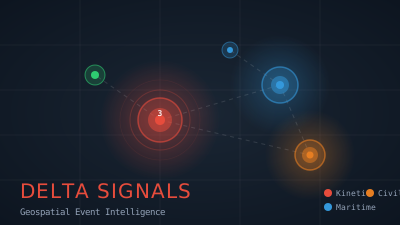
Quick Answer: Delta Signals is Off-Nadir Delta's geospatial event-intelligence layer. It maps geolocated security and geopolitical event signals on top of satellite imagery, enriched with AI-generated summaries, severity scores, and actor information, and refreshed continuously through the day. It is evidence-based: each signal is traceable to its original news sources and to a location whose precision is stated rather than assumed, so you can open, check, and share the evidence behind it. It helps analysts connect satellite-observed changes to the real-world events that caused them.
Satellite imagery tells you what changed. Delta Signals tells you why.
Delta Signals is the event-intelligence layer inside Off-Nadir Delta. It places geolocated geopolitical and security event signals directly on the map, alongside your satellite data, so the report and the imagery sit in one view. It is also the event layer behind the situational-awareness dashboard — the broader picture this feeds into. This post explains what it does and how analysts use it.
The Gap Between Pixels and Ground Truth
When you monitor an area with satellite imagery, you can detect changes with remarkable precision: burned vegetation, flooded roads, shifting coastlines, new construction. But the imagery alone rarely tells you the cause.
- Did that vegetation loss happen because of drought — or because of conflict-related displacement?
- Is that sudden drop in nighttime lights an economic disruption, or something else entirely?
- What triggered the movement you detected near that port?
Intelligence analysts have always bridged this gap manually, correlating satellite observations with open-source reporting. Delta Signals automates that correlation, bringing it directly into the map interface.
What Delta Signals Provides
Delta Signals aggregates publicly available event signals — covering armed conflict, maritime incidents, protests, humanitarian crises, and more — and processes them through an AI enrichment pipeline that produces:
For every signal:
- A short article summary drawn from the original news source
- AI-extracted actor names, event type, and precise location
- A severity score (1–10) reflecting the intensity of the event
- An OSINT relevance score (1–10) reflecting analytical value for satellite monitoring
- Threat vector classification (kinetic, maritime, economic, political, etc.)
- Escalation trend indicator (escalating / de-escalating / stable / new)
- Impact scope (local / regional / international)
At the map level:
- Cluster visualization with color-coded event categories
- AI-corrected geolocation when the source location is imprecise
- Continuous refresh through the day, with deduplication — the same event reported by many outlets appears once, not hundreds of times
Designed for Analysts, Not Data Engineers
Delta Signals is built to require zero configuration. Open the Delta Signals panel from the sidebar, pick a date, and the signals appear as color-coded clusters on the map. Click any cluster to read the enriched summary, understand the actors involved, and assess relevance to what the satellite is showing.
The categories correspond directly to satellite monitoring use cases:
| Signal Category | Satellite Evidence to Correlate |
|---|---|
| Kinetic / Armed Conflict | SAR backscatter changes, building damage, displacement |
| Maritime | Ship detection, port activity, coast guard movements |
| Protest / Civil Unrest | Crowd density, road blockages, nighttime light anomalies |
| Humanitarian | Settlement expansion, IDP camp emergence, supply convoy routes |
AI Enrichment: More Than a Summary
Raw event data tends to be brief and locationally imprecise — a headline and a country code. Our enrichment pipeline goes further:
Location refinement: Many events are attributed to a country or a large region. The enrichment layer extracts the most specific location mentioned in the article text and resolves it to precise coordinates, making the signal useful at sub-national scale.
Deduplication: A significant event generates dozens of news articles. Our deduplication logic identifies events that describe the same real-world occurrence — even when the framing, actors named, or time of reporting differ — and consolidates them into a single canonical signal. What you see on the map reflects the actual number of events, not the volume of coverage. The same logic is tuned so a fast-moving story still surfaces while it is breaking, rather than waiting for hundreds of outlets to pick it up — a low headline count is not the same as low importance.
Threat and impact assessment: Each event is evaluated on dimensions that matter to monitoring analysts: Is this escalating? Does it cross a border? Is there infrastructure at risk? These assessments are produced systematically and consistently, without the bias or fatigue that affects manual review at scale.
Coverage and Scope
Delta Signals focuses on events with direct geospatial relevance — incidents where a physical location is clearly referenced and where satellite observation is meaningful. Pure diplomatic communications, financial policy decisions, or opinion pieces are filtered out.
Coverage is global and refreshes through the day, covering:
- Kinetic incidents (strikes, engagements, force posture changes)
- Maritime events (incidents at sea, chokepoints, naval movements)
- Protest and civil unrest with geographic specificity
- Humanitarian emergencies with displacement or supply implications
Events are retained for a rolling window, allowing time-series correlation with your monitoring data.
Evidence and Auditability
Delta Signals is not a black box. Every signal is built to be checked, not just read — the same principle that separates rigorous open-source intelligence from rumor. When an open-source finding can be shown, shared, and checked by others, it holds up; a claim you cannot trace does not. Each Delta Signal carries the evidence to do exactly that:
- A link to the original source. Every signal keeps a link back to the news report it was distilled from. Open any signal and you can read the original article yourself — the summary never stands in for the source.
- Corroboration, consolidated. When many outlets report the same event, they are merged into a single signal. What you see reflects real-world events, not the raw volume of coverage — and events reported by multiple independent sources carry that corroboration with them.
- A resolved location, with its precision stated. The location is extracted from the article text — the place the event actually occurred, not where it was reported from — geocoded, and checked against the country the reporting names before it is placed on the map. Where the article only supports a country or an administrative centre, the signal says so instead of presenting that point as a pinpoint: the response carries how the coordinate was resolved (
geo_status) and what it stands for (location_footprint), so a broad answer is never read as a precise one. - A relevance threshold. Low-relevance or weakly-corroborated noise is filtered out before anything surfaces. Only events with clear geospatial significance, or reporting from multiple sources, are enriched and shown — so the feed stays signal, not chatter.
The result is an event layer you can defend. When a signal informs a decision, you can open its source, see how precisely its location was resolved, and hand the same evidence to a colleague — the audit trail travels with it.
Using Delta Signals with Monitoring
The most powerful workflow combines Delta Signals with area monitoring:
- Draw a monitoring area around any region of interest
- Enable a satellite index (SAR backscatter, NDVI, nighttime lights, etc.) to track changes over time
- Open Delta Signals and navigate to the same date range
- Look for signals that coincide — spatially and temporally — with anomalies in your satellite time series
When the satellite shows an anomaly and Delta Signals shows a kinetic event in the same area on the same day, you have a correlated observation that is far more actionable than either source alone.
Where to See It
The fastest way to see Delta Signals is the Delta Watchfloor — the situational-awareness dashboard, which opens on one event at a time and states how many publishers carry it, how far it got toward satellite evidence, and where it stopped. Without an account you see the previous day's top events and every event on the map; a free account opens every event and its details; the deeper workflows — running an AI remote-sensing deep-dive with Delta Agent, longer history, and your own monitored areas — are where paid plans add value.
You can also work signals directly on the map: open one, pull Sentinel-1 SAR or Sentinel-2 optical over its location, and correlate it with a monitored area's time series. For the wider discipline this sits inside — geolocating, corroborating, and confirming open-source reports with imagery — see what is geospatial OSINT.
Delta Signals uses publicly available event data enriched through an AI analysis pipeline developed by Off-Nadir Delta. The platform is an independent project and is not affiliated with any organization or institution.

Remote sensing specialist with 10+ years in satellite data processing and AI. Founder of Off-Nadir Lab. Ph.D. in Informatics (Yokohama National University, 2026). Master's in Earth System Science and Technology (Kyushu University). Co-author, Remote Sensing Encyclopedia. More about the author →