What Is Geospatial OSINT? Turning Open Sources Into a Picture of the Ground
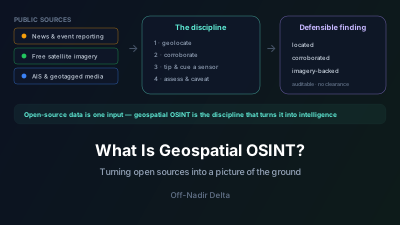
Quick Answer: Geospatial OSINT is the practice of building intelligence about places and events from publicly available sources — news and social reporting, free satellite imagery, AIS, and geotagged media — by geolocating each signal, corroborating it, and reading the imagery to confirm what physically happened. It is an analytic discipline; open satellite data is one of its inputs, not the whole of it.
A reported explosion, a ship that vanishes from tracking, a field that empties overnight. Geospatial OSINT is how you turn reports like these into something you can stand behind: a located, corroborated, imagery-backed account of what happened and where. None of it requires a clearance or a classified feed — only public sources and a disciplined way of reading them.
What is geospatial OSINT?
Geospatial OSINT is the collection and analysis of publicly available information to answer questions about places — where something happened, what is physically there now, and how it changed. It pulls from open sources an intelligence officer would recognize: news and social media reporting, commercial and free satellite imagery, ship and aircraft tracking, and geotagged photos and video.
The word "geospatial" trips people up, so it is worth separating two things that often get conflated. Open-source geospatial data — a free Sentinel scene, an OpenStreetMap layer — is a source. Geospatial OSINT is the discipline of turning sources like that into a defensible conclusion. You can download imagery all day and produce no intelligence; the work is in the geolocation, corroboration, and judgment.
Geospatial OSINT, GEOINT, IMINT: what is the difference?
They overlap, and the boundary that matters is the source, not the subject. The U.S. National Geospatial-Intelligence Agency defines geospatial intelligence (GEOINT) as "the exploitation and analysis of imagery and geospatial information to describe, assess and visually depict physical features and geographically referenced activities on the Earth" (NGA, GEOINT Basic Doctrine). Imagery intelligence (IMINT) is the imagery-derived slice of that.
Geospatial OSINT applies the same analytic tradecraft, but restricts itself to sources anyone can access. The constraint is also the strength: an open-source finding can be shown, shared, and checked by others. That auditability is why newsrooms, NGOs, and researchers can publish geospatial conclusions and have them hold up. For working definitions of GEOINT, IMINT, AOI, and tip-and-cue, see the glossary.
What public sources feed geospatial OSINT?
No single source is enough. The method is fusion — letting one source point you at another. The recurring inputs:
| Source | What it tells you | The catch |
|---|---|---|
| News and event reporting | That something happened, roughly where and when | Location is often a country or city, not coordinates |
| Free satellite imagery | What is physically on the ground, and how it changed | Resolution and revisit set hard limits |
| AIS / vessel tracking | Where ships say they are | Vessels can switch the transponder off |
| Geotagged social media | Eyewitness detail, sometimes precise coordinates | Has to be verified, not just believed |
| Maps and terrain data | The fixed context — roads, ports, borders | Static; it dates |
Open satellite imagery is the input that changed the field. Under the European Union's Copernicus programme, every Sentinel scene is released under a free, full, and open data policy for scientific and commercial use (ESA). Anyone can pull radar and optical imagery of anywhere on Earth, repeatedly, at no cost. A decade ago that was the part of the workflow you had to pay for. For a tour of what is freely available, see free satellite data sources explained.
How do analysts actually do it?
The work follows a loop, and skipping a step is where bad conclusions come from:
- Collect the signal. A report, a post, a tracking gap — something says look here.
- Geolocate it. Pin the claim to coordinates, not a region. This is the craft Bellingcat built its open-source investigation toolkit around, matching landmarks, shadows, and terrain to a point on the map.
- Corroborate. A single source is a lead, not a finding. Independent reports, a second image, or a contradicting one all move your confidence.
- Cue the imagery. Pull a satellite look at the located area — the step analysts call tip-and-cue: an open-source signal tips you to a place, and you cue a sensor to observe it. We walk through that handoff in the Delta Agent's imagery-tasking tradecraft.
- Assess and caveat. State what the imagery can and cannot show, and where your confidence is capped.
That last step separates analysis from speculation, and it is the one people are quickest to drop.
Why is geospatial OSINT having a moment?
Two things collapsed the barrier to entry. Open imagery removed the data cost, and AI removed much of the manual triage — geolocating, summarizing, and sorting thousands of daily reports down to the handful worth a satellite look. What used to be a skilled analyst's full day of tab-juggling is increasingly a workflow. The result is that conflict monitoring, sanctions tracking, disaster response, and investigative journalism now run substantially on public sources, by teams without a national intelligence budget.
What can public satellite imagery actually prove?
Less than people claim, and that is the most important thing to internalize. Resolution sets a ceiling. At the ~10 m of free Sentinel imagery you can detect that a structure, vessel, or burn scar is present and measure its extent; you cannot identify a vehicle type or read a marking — that needs sub-metre commercial imagery. The distinction between detecting, recognizing, and identifying is formalized in the four types of satellite image resolution, and respecting it is the line between a careful brief and an over-read.
Radar matters here too. A Sentinel-1 SAR pass sees through cloud and works at night, so it can confirm change when optical sees nothing — the right tool for an event under overcast. Knowing which sensor a given question needs is itself part of the tradecraft.
Doing geospatial OSINT without a GIS stack
Traditionally this loop lived across separate tools: one for event feeds, another for imagery, a desktop GIS to tie them together, and a notebook for the reasoning. Off-Nadir Delta is built to keep the whole loop on one screen, in the browser:
- The event layer — Delta Signals — maps geolocated event signals distilled from global news media, so the "collect and geolocate" steps are already done.
- The analyst — Delta Agent — reasons over those signals, returns a sourced and located brief, and recommends which sensor to cue and why.
- The picture — the Delta Watchfloor — holds the common operating picture: what is happening, what changed, and your own areas of interest.
- The imagery — the map — lets you pull Sentinel-1 SAR or Sentinel-2 optical over any located area and run change detection or vessel detection, no GIS install and no API keys.
It is not a replacement for tradecraft. It is the tradecraft loop with the tool-switching taken out. For an honest, job-by-job look at the wider field — including when another tool is the better fit — see the best OSINT satellite imagery tools, or the persona-specific walkthrough in satellite intelligence for OSINT.
Where to start
Pick a place you already follow and run the loop once. Open the Delta Watchfloor to browse located event signals for free, ask the Delta Agent why one matters and which sensor would confirm it, then pull the imagery and look. The discipline is learned by doing it on something you can sanity-check, not by reading about it.
The steps are written out one at a time in these workflow guides:
- How to verify a reported event with free satellite imagery
- How to find the most recent satellite image of any place
- What you can actually see in 10 m satellite imagery
- Confirming and dating a reported fire with satellite data
- How to keep watch on a facility with free satellite imagery
Geospatial OSINT, as described here and as practiced on Off-Nadir Delta, uses publicly available sources for situational awareness, research, and journalism — not for targeting or the surveillance of individuals. Off-Nadir Delta is an independent project and is not affiliated with any organization or institution.

Remote sensing specialist with 10+ years in satellite data processing and AI. Founder of Off-Nadir Lab. Ph.D. in Informatics (Yokohama National University, 2026). Master's in Earth System Science and Technology (Kyushu University). Co-author, Remote Sensing Encyclopedia. More about the author →