A Field Guide to Free Satellite Data Sources: Sentinel-1, Sentinel-2, VIIRS, and NASA FIRMS
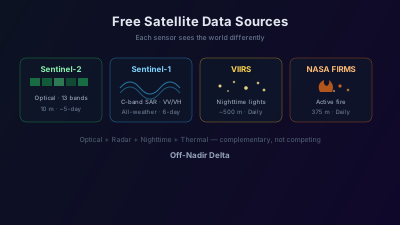
Quick Answer: Four free data sources cover most use cases: Sentinel-2 (10m optical, 13 bands, ~5-day revisit) for vegetation and land cover; Sentinel-1 (C-band SAR, ~10m, all-weather) for floods and surface change; VIIRS nighttime lights (~500m, daily) for human activity; and NASA FIRMS (375m, daily) for active fire. Optical and radar are complementary — combine them rather than choosing one.
Why Source Selection Matters More Than Resolution
When people start with satellite imagery, the first question is almost always "how sharp is it?" But resolution is rarely the thing that makes or breaks an analysis. The thing that matters is what the sensor actually measures — reflected sunlight, radar backscatter, emitted light at night, or thermal anomalies. Each answers a different question.
The good news: the most useful sources are free and open. ESA's Copernicus programme and NASA distribute global, multi-year archives at no cost, with attribution. This guide walks through the four sources that cover the vast majority of monitoring work, and explains when to reach for each.
For a structured reference with resolution, revisit, and attribution for every source, see the Data Sources page.
Sentinel-2: The Optical Workhorse
Sentinel-2 is what most people picture when they think "satellite image" — natural-looking optical imagery, captured in 13 spectral bands from visible light through shortwave infrared.
- Resolution: 10 m for visible and near-infrared bands
- Bands: 13 spectral bands
- Revisit: ~5 days with both satellites
- Best for: vegetation health, crop and forest monitoring, land cover, water quality
Because it captures multiple bands, Sentinel-2 supports spectral indices like NDVI, EVI, and NDWI — simple band-math formulas that turn raw reflectance into measures of vegetation vigor or water content. Its one weakness is fundamental to all optical sensors: it cannot see through cloud. Over the wet tropics, weeks can pass without a clear scene.
Sentinel-1: Radar That Ignores the Weather
Sentinel-1 solves the cloud problem. It is a C-band Synthetic Aperture Radar (SAR) — an active sensor that transmits its own microwave pulses and measures what bounces back. Radar penetrates cloud, smoke, and light rain, and works just as well at night.
- Resolution: ~10 m (Interferometric Wide swath mode)
- Polarization: VV and VH
- Revisit: 6-day repeat cycle
- Best for: flood mapping, surface-change detection, vessel detection, all-weather monitoring
SAR imagery looks unfamiliar at first — it measures surface roughness and moisture, not color — but that is exactly why it is powerful. Calm water appears dark (it reflects radar away from the sensor), while cities and rough terrain appear bright. For disaster response, where clouds almost always accompany the event, SAR is often the only sensor that can deliver an image on the day it matters.
VIIRS Nighttime Lights: A Proxy for Human Activity
VIIRS nighttime lights measure something none of the above can: visible light emitted at night. NASA's Black Marble products calibrate and atmospherically correct the VIIRS Day/Night Band so that city lights become a usable signal.
- Resolution: ~500 m
- Product: NASA Black Marble VJ146A2 (NOAA-20); VNP46A2 (Suomi NPP) for dates before 2019-08-28
- Revisit: daily
- Best for: urbanization and electrification trends, economic-activity proxies, power-outage detection after disasters
At ~500 m, VIIRS is coarse, but its daily cadence and a clean signal make it ideal for tracking change over time rather than mapping fine detail. A sudden drop in nighttime brightness after a storm is one of the fastest indicators of a grid-scale power outage.
NASA FIRMS: Active Fire, Updated Daily
NASA FIRMS provides near real-time thermal fire detections from VIIRS and MODIS. Hotspots are published daily and require no account or API key to browse.
- Resolution: 375 m (VIIRS), 1 km (MODIS)
- Latency: near real-time, daily
- Best for: wildfire situational awareness, tracking fire spread
FIRMS is not imagery in the usual sense — it is a point layer of thermal anomalies — but overlaid on a basemap or satellite scene it turns "is something burning here?" into an answerable question within hours.
Putting It Together
The single biggest mistake is treating these as competitors. They are complementary:
| Source | Measures | Resolution | Revisit | See through cloud? |
|---|---|---|---|---|
| Sentinel-2 | Reflected light (13 bands) | 10 m | ~5 days | No |
| Sentinel-1 | Radar backscatter | ~10 m | 6 days | Yes |
| VIIRS | Light emitted at night | ~500 m | Daily | Partly |
| NASA FIRMS | Thermal fire anomalies | 375 m / 1 km | Daily | Yes (thermal) |
A typical workflow uses more than one. Map a flood with Sentinel-1 while cloud blocks the optical view, then confirm the recovery weeks later with a clear Sentinel-2 scene. Spot a thermal anomaly in FIRMS, then pull the Sentinel-2 burn scar once skies clear. Watch a region's nighttime lights for an outage, then task radar to see what changed on the ground.
How to Choose
- Need color, vegetation, or land cover? Start with Sentinel-2.
- Clouds in the way, or need night coverage? Use Sentinel-1.
- Tracking human activity or outages? Use VIIRS nighttime lights.
- Is something on fire right now? Use NASA FIRMS.
Every source above is free to browse in Off-Nadir Delta — no GIS software, no code, no API keys. For definitions of the technical terms used here, see the glossary.
Attribution reminder: When you export or publish imagery, credit the source — "Contains modified Copernicus Sentinel data" for Sentinel-1/2, "NASA Black Marble (VJ146A2 / VNP46A2)" for VIIRS nighttime lights, and "NASA FIRMS" for active fire data.

Remote sensing specialist with 10+ years in satellite data processing and AI. Founder of Off-Nadir Lab. Ph.D. in Informatics (Yokohama National University, 2026). Master's in Earth System Science and Technology (Kyushu University). Co-author, Remote Sensing Encyclopedia. More about the author →