
MODIS Satellite Data: The Daily, Decades-Long View of Earth
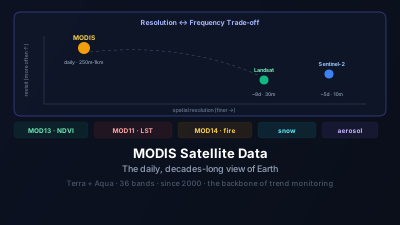
Quick Answer: MODIS (Moderate Resolution Imaging Spectroradiometer) flies on NASA's Terra and Aqua satellites and images the entire Earth every 1-2 days at 250m-1km resolution across 36 spectral bands. Its coarse resolution is the price for two things nothing else offers together: daily revisit and a continuous 20+ year archive (since 2000). That combination makes MODIS the backbone of operational monitoring — vegetation indices, land surface temperature, active fire detection (which feeds NASA FIRMS), snow cover, and aerosols. Use MODIS when temporal frequency and long baselines matter more than spatial detail; use Sentinel-2 or Landsat when you need to resolve individual fields or buildings. MODIS is being succeeded by VIIRS, which continues the record.
The Trade Every Satellite Makes
Every Earth observation sensor trades spatial resolution against temporal resolution — you can see fine detail rarely, or coarse detail often, but not both. Sentinel-2 resolves 10m fields but revisits every 5 days. MODIS sits at the opposite end: it can't resolve a single farm, but it images the entire planet every day, and has done so without interruption since 2000.
For a huge class of problems — droughts, fire seasons, vegetation trends, heatwaves — that daily, decades-long view is exactly what you need. This guide explains what MODIS is, what it measures, and when its coarse-but-constant data beats sharper imagery.
What MODIS Is
MODIS (Moderate Resolution Imaging Spectroradiometer) is a sensor flown on two NASA satellites:
| Satellite | Launched | Equator crossing | Role |
|---|---|---|---|
| Terra | 1999 | ~10:30 (descending) | Morning view |
| Aqua | 2002 | ~13:30 (ascending) | Afternoon view |
Together they observe most of the globe every 1-2 days. MODIS captures 36 spectral bands spanning visible, near-infrared, shortwave, and thermal infrared, at three resolutions:
- 250m — red and near-infrared (used for vegetation)
- 500m — additional visible/SWIR bands
- 1km — thermal and atmospheric bands
That wide 2,330 km swath is what enables near-daily global coverage.
The Products That Matter
You rarely use raw MODIS radiance. NASA processes it into analysis-ready products, each with a code. The ones you'll encounter most:
| Product | Measures | Typical use |
|---|---|---|
| MOD13 / MYD13 | NDVI & EVI (16-day, 250m) | Vegetation trends, phenology, drought |
| MOD11 / MYD11 | Land surface temperature | Heatwaves, evapotranspiration, urban heat |
| MOD14 / MYD14 | Active fire / thermal anomalies | Wildfire detection (feeds NASA FIRMS) |
| MOD10 | Snow cover | Hydrology, snowmelt timing |
| MCD43 | BRDF / albedo | Energy balance, surface reflectance correction |
| MOD04 | Aerosol optical depth | Air quality, haze |
(The MOD prefix is Terra, MYD is Aqua, MCD is combined.)
Why Coarse Resolution Is a Feature, Not a Bug
It's easy to dismiss 250m-1km pixels as "low quality." But for the right question, coarse resolution is exactly right:
- Daily revisit captures fast events — the start of a fire season, a heatwave, a flush of green-up — that a 16-day sensor would miss entirely.
- A 20+ year archive lets you establish what "normal" looks like, so you can measure anomalies with confidence. You cannot detect a drought without decades of baseline.
- Global, consistent coverage means continental and climate-scale patterns appear cleanly, without mosaicking thousands of tiles.
In short: MODIS answers "how is this changing over time?" while high-resolution sensors answer "what exactly is here?"
MODIS vs Sentinel-2 vs Landsat
These sensors are complementary tools, not competitors:
| MODIS | Sentinel-2 | Landsat 8/9 | |
|---|---|---|---|
| Resolution | 250m-1km | 10-60m | 30m (15m pan) |
| Revisit | ~daily | ~5 days | ~8 days (combined) |
| Archive since | 2000 | 2015 | 1972 |
| Best for | Daily/long-term trends | Field-level detail | Long baseline + thermal |
A common workflow: use MODIS to find when and where something is happening at continental scale, then zoom in with Sentinel-2 or Landsat for field-level detail. For applications like drought monitoring and deforestation, MODIS provides the long-term context that high-resolution snapshots lack.
The Succession to VIIRS
Terra and Aqua have far outlived their design lives, and MODIS will eventually retire. Its successor is VIIRS (Visible Infrared Imaging Radiometer Suite), aboard the Suomi NPP and NOAA-20/21 satellites. VIIRS continues the daily global record with improved capabilities — including the Day/Night Band for nighttime lights — and product teams have worked to bridge the MODIS and VIIRS records so the multi-decade time series stays continuous. For active fire monitoring, both MODIS and VIIRS detections flow into NASA FIRMS today.
Key Takeaways
- MODIS = daily global coverage + a 20+ year archive at 250m-1km, across 36 bands.
- It trades spatial detail for temporal frequency and longevity — the right trade for trend and anomaly monitoring.
- Key products cover vegetation (MOD13), temperature (MOD11), fire (MOD14), snow, and aerosols.
- Pair MODIS with Sentinel-2/Landsat: MODIS finds the when/where, high-res sensors show the what.
- VIIRS continues the record as MODIS retires, keeping the long time series intact.
MODIS data is produced by NASA and distributed free and open. Active fire detections are available through NASA FIRMS.

Remote sensing specialist with 10+ years in satellite data processing and AI. Founder of Off-Nadir Lab. Ph.D. in Informatics (Yokohama National University, 2026). Master's in Earth System Science and Technology (Kyushu University). Co-author, Remote Sensing Encyclopedia. More about the author →