
What Nighttime Lights Tell Us About Cities (And What They Don't)
Quick Answer: VIIRS Black Marble nighttime lights data correlates with GDP, population density, and electrification rates, making it a unique proxy for human activity. But overinterpretation is common — light pollution, seasonal variation, and sensor saturation can mislead. This post covers what works, what doesn't, and how to use the data responsibly.
A Proxy, Not a Measurement
Nighttime lights from the VIIRS Day/Night Band are one of the most intuitive satellite products. Bright areas mean people, dim areas mean fewer people, dark areas mean nobody's home. It's immediately understandable in a way that SAR backscatter or NDVI values aren't.
That intuitive appeal is both the strength and the danger of this data. Nighttime radiance is a proxy for human activity — it correlates with things we care about (economic output, population, infrastructure) but doesn't directly measure any of them.
What the Data Actually Is
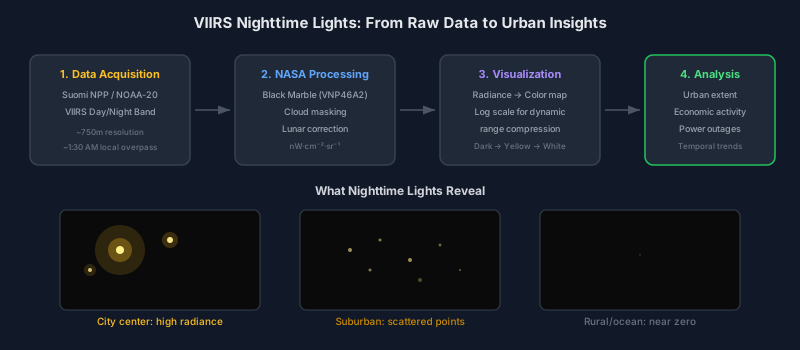
NASA's Black Marble daily product (VNP46A2 from Suomi NPP, VJ146A2 from NOAA-20 — the latter is what Off-Nadir Delta serves from 2019-08-28) provides calibrated nighttime radiance in units of nW·cm⁻²·sr⁻¹. The satellite passes over each location at roughly 1:30 AM local time, capturing artificial light emissions.
Key specifications:
- Spatial resolution: ~500m (15 arc-seconds)
- Temporal coverage: Daily composites available from 2012-present
- Processing: Cloud-masked, atmospherically corrected, lunar illumination removed
- Units: Radiance, not a unitless brightness index
That last point matters. The values are physically meaningful — you can compare radiance levels across locations and dates quantitatively, not just visually.
Applications That Work Well
Power Outage Detection
Comparing pre-event and post-event nighttime radiance after a natural disaster or conflict immediately reveals areas that have lost electricity. During Hurricane Maria in Puerto Rico (2017), nighttime lights data showed power restoration progress over weeks and months when ground reports were sparse.
This is one of the most reliable applications because you're looking for an abrupt, localized change — the signal is strong relative to noise.
Urbanization Tracking
Multi-year nighttime lights time series reveal urban expansion patterns. Areas that transition from dark to lit are almost certainly experiencing development. This is particularly useful in rapidly growing cities, where up-to-date land cover maps lag behind actual development.
Conflict and Crisis Monitoring
Dramatic, sustained drops in nighttime radiance can indicate conflict zones, economic collapse, or mass displacement. A satellite-imagery analysis led by Dr. Xi Li at Wuhan University found that 83% of the lights visible over Syria at night went out between March 2011 and February 2015, with the decline varying sharply by province (Human Rights Watch, 2015). This kind of analysis provides an independent, objective measure that complements (but cannot replace) on-the-ground reporting.
Fishing Fleet Detection
Brightly lit squid fishing vessels are visible in nighttime imagery as isolated bright points on otherwise dark ocean. The patterns are seasonal and regional, and tracking them over time reveals fishing activity trends and potential overfishing areas.
Where It Gets Misleading
Light Pollution ≠ More Activity
A city that adopts LED street lighting may appear brighter without any change in population or economic activity. Conversely, municipalities that reduce unnecessary lighting (dark sky ordinances) will appear dimmer. Neither change reflects what most analysts actually care about.
Seasonal Variation
Higher-latitude cities have longer nights in winter and shorter nights in summer. Snow cover increases reflectance of artificial light. Holiday lighting in December creates temporary brightness peaks. All of these need to be accounted for in time-series analysis.
Saturation in Dense Urban Cores
The VIIRS sensor has a dynamic range limit. The brightest city centers — Times Square, Shibuya Crossing, the Las Vegas Strip — can saturate the detector, making it impossible to distinguish between "very bright" and "extremely bright." For studies focusing on central business districts, this is a real limitation.
Rural Electrification Ambiguity
A newly lit village in rural Africa might be a genuine electrification milestone — or it might be a temporary mining camp, a gas flare, or a large fire. Ground truth or contextual analysis is essential.
Practical Tips
-
Use gap-filled composites rather than single-night observations. Individual nights are affected by clouds, moonlight correction errors, and occasional satellite artifacts.
-
Compare the same month across years to minimize seasonal effects.
-
Cross-reference with other data. Nighttime lights plus daytime optical imagery (from Sentinel-2) gives you a much more complete picture than either alone.
-
Be cautious with thresholds. There's no universal radiance value that separates "urban" from "rural." What counts as bright depends entirely on regional context.
-
Watch for gas flares. Oil and gas flaring can produce extremely bright, persistent light sources that have nothing to do with human settlement. The Niger Delta and parts of Siberia are common problem areas.
Reading the Numbers: What Radiance Values Mean
Because Black Marble values are physical radiances rather than an index, they are comparable across space and time — but there is no universal lookup table that maps a radiance number onto a settlement type. What is stable is the ordering, and it spans several orders of magnitude:
Remote wilderness sits near the instrument's noise floor. Sparse rural settlement is faintly but consistently above it. Small towns and suburban peripheries form the broad middle. Dense urban cores are one to two orders of magnitude brighter than their own suburbs, and the very brightest cores can reach the detector's dynamic range limit, where "very bright" and "extremely bright" become indistinguishable. Gas flares sit above all of this — they are among the brightest things in the dataset and can exceed nearby settlements by orders of magnitude.
Two systematic effects shift those values without any change on the ground. Composite values drift with latitude, because longer winter nights change how much of the month contributes usable observations. And the transition from sodium vapor street lights to LEDs, which has swept much of Europe and North America, shifted spectral output into a range the Day/Night Band responds to less strongly — so converted cities can appear to dim even where total light emission rose. Derive your own baseline for the region you are studying rather than importing thresholds from elsewhere.
Detecting power outages: Look for a substantial drop relative to the same pixel's own seasonal baseline that persists across consecutive composites. Persistence is what separates signal from artefact: cloud-masking imperfections and unusual atmospheric conditions produce short-lived dips, while infrastructure disruption lasts weeks to months. A single anomalous composite is a prompt to investigate, not a finding.
A note on gas flares: If you're monitoring an area in or near petroleum-producing regions (Nigerian Delta, Siberian lowlands, Permian Basin), filter flare pixels before any analysis — they can be orders of magnitude brighter than nearby settlements and will dominate spatial statistics if not removed.
Try It
Off-Nadir Delta provides access to VIIRS nighttime radiance data. Load a familiar city and explore the patterns — the core should be brightest, with radiance decreasing outward into suburbs, then dropping off sharply at the urban edge. That gradient itself tells you something about the city's spatial structure.

Remote sensing specialist with 10+ years in satellite data processing and AI. Founder of Off-Nadir Lab. Ph.D. in Informatics (Yokohama National University, 2026). Master's in Earth System Science and Technology (Kyushu University). Co-author, Remote Sensing Encyclopedia. More about the author →
Related Articles
Monitoring Economic Activity and Infrastructure with VIIRS Nighttime Light Time Series
Mar 30, 2026
Night Lights, SO2, Earthquakes and Cyclones: Four Measured Events and What Each One Can and Cannot Tell You
Oct 8, 2026
What Is a Thermal Anomaly? Telling an Unusual Heat Source from a Routine Flare in Satellite Data
Oct 6, 2026