
Drought Monitoring with Satellite Data: Indices, Methods, and Early Warning
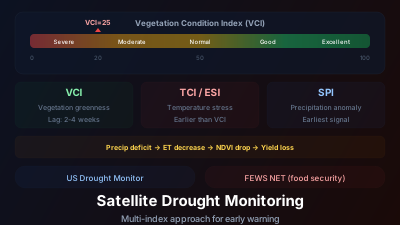
Quick Answer: Satellite drought monitoring compares current vegetation conditions against historical baselines. The Vegetation Condition Index (VCI) ranks current NDVI against the historical min-max range: VCI = (NDVI - NDVImin)/(NDVImax - NDVImin) × 100. VCI below 35 indicates drought stress. Temperature Condition Index (TCI) works similarly with land surface temperature. Combined indices integrating vegetation, temperature, and precipitation data (like the US Drought Monitor) provide the most reliable assessment. MODIS 16-day composites enable global drought monitoring; Sentinel-2 adds field-level detail for agricultural impact assessment.
The 2022 drought across Europe was visible from space well before most governments declared emergencies. NDVI anomaly maps in early summer already showed vegetation stress across southern France, northern Italy, and the Iberian Peninsula — fields that were normally deep green sitting clearly below their long-term seasonal norm. By August, the pattern had spread into central Europe.
Satellite data didn't predict the drought — the weather forecasts did that. But satellite data showed precisely where drought was hitting hardest, which crops were affected, and how conditions compared to previous droughts. That spatial specificity is what satellite monitoring uniquely provides.
The Core Concept: Anomaly Detection
Drought monitoring from satellites isn't about absolute values — it's about comparison to normal conditions. An NDVI of 0.4 might be perfectly healthy for a semi-arid rangeland but catastrophically low for irrigated corn.
The approach: compare current satellite observations against a historical baseline (typically 15-30 years) for the same location, same time of year. Deviations from the historical norm indicate abnormal conditions.
Vegetation-Based Indices
Vegetation Condition Index (VCI)
VCI normalizes current NDVI against the historical range:
VCI = (NDVIcurrent − NDVImin) / (NDVImax − NDVImin) × 100
Where NDVImin and NDVImax are the minimum and maximum NDVI values observed at this location during this same period across the historical record (e.g., the lowest and highest early-July NDVI in 20 years).
Interpretation:
- VCI > 60: Above-normal vegetation conditions
- VCI 40-60: Normal conditions
- VCI 20-40: Moderate drought
- VCI < 20: Severe drought
VCI's strength is its simplicity and spatial comparability. A VCI of 30 in Iowa means the same thing as a VCI of 30 in Punjab — both indicate that current vegetation is in the lower third of the historical range.
Vegetation Health Index (VHI)
VHI combines vegetation greenness (VCI) with surface temperature stress:
VHI = α × VCI + (1 − α) × TCI
Where TCI (Temperature Condition Index) is computed similarly to VCI but using land surface temperature (inverted — high temperature = stress):
TCI = (LSTmax − LSTcurrent) / (LSTmax − LSTmin) × 100
The weight α is typically 0.5 (equal weighting). VHI below 40 indicates vegetation stress from either moisture deficiency, heat stress, or both.
NOAA's Center for Satellite Applications and Research produces global VHI maps weekly at approximately 4 km resolution using AVHRR and VIIRS data.
NDVI Anomaly and Z-Score
Simple but effective:
- NDVI anomaly = Current NDVI − Long-term mean NDVI (same period, same location)
- NDVI z-score = (Current NDVI − Mean) / Standard deviation
Z-scores below −1.5 indicate conditions that occur less than 7% of the time historically — a meaningful drought signal.
Soil Moisture-Based Monitoring
Vegetation responds to drought with a lag — leaves don't wilt immediately when rain stops. Soil moisture indicators provide earlier warning:
Soil Water Index (SWI)
Derived from satellite microwave data (SMAP, Sentinel-1, ASCAT), SWI estimates root-zone soil moisture by modeling the infiltration from surface measurements. Deficit relative to normal indicates developing drought before vegetation shows stress.
Evaporative Stress Index (ESI)
ESI compares actual evapotranspiration (estimated from thermal satellite data) to potential evapotranspiration. When actual ET falls below potential ET, the vegetation is water-stressed — transpiration has decreased because stomata closed.
ESI typically detects agricultural drought onset earlier than NDVI-based indices, because evapotranspiration falls as soon as soil moisture becomes limiting, while NDVI responds only after prolonged stress produces visible canopy change. How much lead time you gain depends on the crop, the soil's water-holding capacity, and how fast the deficit develops.
Precipitation-Based Indices
Standardized Precipitation Index (SPI)
While not directly derived from optical/radar satellites, satellite precipitation estimates (GPM, CHIRPS) enable SPI calculation globally:
SPI standardizes accumulated precipitation over a chosen period (1, 3, 6, 12 months) against the long-term distribution:
- SPI > 0: Wetter than normal
- SPI −1 to 0: Mildly dry
- SPI −1.5 to −1: Moderately dry
- SPI < −1.5: Severely dry
Different accumulation periods capture different drought types: SPI-1 (one month) reflects short-term meteorological drought; SPI-12 (twelve months) reflects long-term hydrological drought.
Combined Drought Monitoring Systems
The most reliable drought assessment integrates multiple indicators:
US Drought Monitor
Combines:
- Satellite NDVI and NDVI anomalies
- Soil moisture observations and models
- Precipitation anomalies
- Streamflow measurements
- Expert interpretation
Produces weekly maps classifying drought intensity from D0 (abnormally dry) through D4 (exceptional drought). The human expert overlay is critical — automated indices occasionally produce false signals from irrigation, land cover change, or sensor artifacts.
FEWS NET (Famine Early Warning Systems Network)
Monitors food security in developing countries using:
- MODIS/VIIRS NDVI anomalies
- CHIRPS precipitation estimates
- Soil moisture models
- Market price data
- Livelihood zone analysis
FEWS NET demonstrates how satellite drought monitoring connects directly to humanitarian response — drought conditions detected from space trigger food security assessments and aid planning.
Agricultural Drought vs. Meteorological Drought
An important distinction:
Meteorological drought: Below-normal precipitation. Detected first by rainfall gauges and satellite precipitation estimates.
Agricultural drought: Insufficient soil moisture for crop growth. Detected by vegetation stress indices (VCI, ESI). Can occur even with normal precipitation if temperatures are unusually high (increasing evaporative demand).
Hydrological drought: Reduced streamflow and reservoir levels. Detected by satellite altimetry (water levels) and SAR (water extent). Develops slowly and persists long after rain returns.
Satellite monitoring captures all three types through different data streams, providing a comprehensive drought picture that no single indicator can achieve alone.
Resolution and Timeliness
| Data Source | Resolution | Update Frequency | Best For |
|---|---|---|---|
| MODIS/VIIRS | 250m-1km | Daily/16-day | Regional/national monitoring |
| Sentinel-2 | 10-20m | 5 days | Field-level crop impact |
| SMAP | 36 km | Daily | Large-scale soil moisture |
| CHIRPS | ~5 km | Dekadal/monthly | Precipitation anomalies |
| Landsat | 30m | 16 days | Historical drought analysis |
For operational drought monitoring, MODIS/VIIRS data at moderate resolution provides the right balance of coverage, frequency, and latency. For detailed agricultural impact assessment — which specific fields are affected, which crops are suffering — Sentinel-2 resolution is needed.
Reference: What the Index Thresholds Mean
The commonly used thresholds are percentile statements about the historical record — that is all they are, and reading them as direct yield predictions is the most common misuse:
| Satellite Index | Threshold | What it means |
|---|---|---|
| VCI < 10 | Extreme drought | Current NDVI sits below the 10th percentile of the historical range for this pixel and this time of year |
| VCI 10–20 | Severe drought | 10th–20th percentile |
| VCI 20–35 | Moderate drought | Below the 35th percentile |
| VCI 35–60 | Normal to mild stress | Within the normal range |
| NDVI anomaly < −0.15 | Significant stress | Well below the long-term mean for the period |
| SPI-3 < −1.5 | Severe meteorological drought | 3-month accumulated precipitation far below the fitted distribution |
| SPI-12 < −1.5 | Long-term hydrological drought | 12-month deficit; reservoir and groundwater implications |
The relationship between a drought index and actual yield loss is real but not universal. Lower VCI generally means larger yield loss, and the relationship is strong enough that agencies use VCI thresholds as alert triggers — but the coefficient differs by crop, by region, by irrigation status, and by when in the growing season the stress occurred. A deficit during grain fill costs far more yield than the same deficit after harvest maturity. Any index-to-yield conversion you use should be calibrated locally against yield records for the crop and region in question, not imported from another continent.
For historical events, the reliable move is to read the numbers from the operational bodies that publish them — FEWS NET for food-security outcomes, national agriculture ministries and statistical services for final yield figures — rather than inferring impact magnitude directly from the satellite anomaly.
Practical Lessons
Drought doesn't respect boundaries: A satellite view shows drought spreading across political borders, river basins, and land use types. National drought statistics that aggregate conditions within administrative boundaries miss the spatial pattern that satellite monitoring reveals.
Baseline matters enormously: A 10-year baseline may miss extreme events; a 30-year baseline captures more variability but may include land use changes. A 15–20 year baseline is a common compromise.
Irrigation masks drought signals: Irrigated areas maintain normal NDVI during drought (if water supply holds), creating green patches within a brown landscape. This isn't drought absence — it's drought dependence on irrigation. Including irrigated areas in regional drought statistics can underestimate drought severity.
Recovery takes longer than onset: Vegetation may stress within weeks but takes months to fully recover after rainfall resumes, especially if drought damaged root systems or killed perennial vegetation. Post-drought monitoring is as important as onset detection.
Satellite drought monitoring has matured from a research curiosity to a critical component of global food security and disaster management. The ability to see drought conditions developing across continents, weeks before harvest losses become apparent, gives decision-makers the lead time to act — if they choose to use it.

Remote sensing specialist with 10+ years in satellite data processing and AI. Founder of Off-Nadir Lab. Ph.D. in Informatics (Yokohama National University, 2026). Master's in Earth System Science and Technology (Kyushu University). Co-author, Remote Sensing Encyclopedia. More about the author →