
Snow and Ice Monitoring from Space: How NDSI Maps the Cryosphere
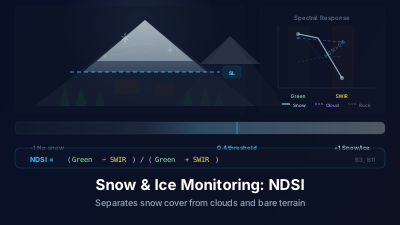
Quick Answer: NDSI uses the contrast between green (high snow reflectance) and SWIR (strong snow absorption) to distinguish snow from clouds, soil, and vegetation. Values above 0.4 reliably indicate snow cover. Unlike simple brightness thresholds, NDSI separates snow from clouds because clouds are bright in both bands while snow is bright only in visible wavelengths. Sentinel-2's 20m resolution enables detailed snowline mapping.
Why Snow Mapping Matters
Snow cover affects everything from water supply forecasting to climate modeling. A large share of the world's population lives in basins where seasonal snowmelt, not rainfall, is what fills the rivers and reservoirs in spring. Accurate snow extent mapping from satellites enables:
- Snowmelt runoff prediction — How much water will reservoirs receive in spring?
- Flood early warning — Rapid snowmelt combined with rain causes devastating floods
- Climate monitoring — Snow cover duration is a sensitive indicator of warming trends
- Ski industry and tourism — Snow depth and extent affect seasonal economies
- Transportation planning — Mountain road closures depend on snowfall and melt patterns
The Spectral Trick Behind NDSI
Snow is white — it reflects nearly all visible light. But in the shortwave infrared (SWIR), snow is surprisingly dark. This combination is unique among natural surfaces:
| Surface | Visible (Green) | SWIR | NDSI |
|---|---|---|---|
| Fresh snow | Very high (~0.9) | Very low (~0.05) | +0.8 to +0.9 |
| Old/dirty snow | High (~0.6) | Low (~0.15) | +0.5 to +0.7 |
| Clouds | High (~0.7) | High (~0.5) | -0.1 to +0.2 |
| Bare rock | Moderate (~0.3) | Moderate (~0.3) | -0.1 to +0.1 |
| Vegetation | Moderate (~0.1) | Low (~0.15) | -0.3 to +0.1 |
| Water | Low (~0.05) | Very low (~0.01) | +0.4 to +0.8 ⚠️ |
The formula:
NDSI = (Green - SWIR) / (Green + SWIR)
For Sentinel-2: (B3 - B11) / (B3 + B11)
The Cloud Discrimination Advantage
This is NDSI's most valuable property. Simple brightness-based snow detection fails because clouds are also white. But clouds are bright across all wavelengths, while snow drops dramatically in SWIR.
- Snow: Green ≈ 0.9, SWIR ≈ 0.05 → NDSI ≈ +0.9
- Cloud: Green ≈ 0.7, SWIR ≈ 0.5 → NDSI ≈ +0.2
With a threshold of 0.4, snow and clouds are clearly separated. This is the same principle used in NASA's MODIS snow products (MOD10A1) and is the standard approach for global snow mapping.
Practical Workflow
1. Select Imagery
Search for Sentinel-2 imagery over mountainous or high-latitude areas during winter or spring. Look for:
- Scenes with partial snow cover (fully snow-covered scenes are less interesting)
- Minimal cloud contamination
- Good sun illumination (low sun angles in winter can cause extensive shadows)
2. Apply NDSI
Switch to NDSI visualization. Snow-covered areas will appear bright (high NDSI), while snow-free areas appear dark.
3. Identify the Snowline
The transition zone where NDSI drops below the threshold (~0.4) marks the snowline — the elevation where snow cover begins. This boundary is a critical parameter for hydrological models.
4. Compare Dates
Load imagery from different dates to track:
- Snowline retreat during spring melt (snowline moves uphill)
- Snow accumulation during winter storms (snowline moves downhill)
- Year-to-year differences at the same date (climate indicators)
Common Pitfalls
Water Bodies Look Like Snow
Water has high NDSI values because it reflects some green light but absorbs SWIR almost completely. Without correction, lakes and rivers will be classified as "snow." This is the same spectral property exploited by NDWI for water detection.
Solution: Apply an additional NIR brightness threshold. Snow reflects strongly in NIR, while water absorbs it. Requiring NIR reflectance > 0.11 (the MODIS standard) effectively masks water.
Shadows Reduce NDSI
Mountain shadows reduce all reflectance values, pushing shadowed snow below the NDSI threshold even though snow is present.
Solution: Lower the threshold in shadowed areas, or use a shadow mask derived from a DEM and the sun angle. This is one of the most challenging aspects of accurate snow mapping in mountainous terrain.
Dirty or Aged Snow
As snow ages, dust, soot, and melt-freeze cycles reduce its visible reflectance while SWIR absorption remains strong. This lowers NDSI values, potentially below the detection threshold.
Solution: Use a lower threshold (0.3 instead of 0.4) for aged snow detection. The tradeoff is increased false positives from cloud edges and bright soil.
Glacier Ice vs Snow
Glacier ice has lower NDSI than fresh snow because ice absorbs more visible light (especially blue). Bare glacier ice may produce NDSI values of 0.3-0.5 — right at the threshold boundary.
Solution: For glacier mapping, consider combining NDSI with NIR/SWIR band ratios that better distinguish ice from snow.
Applications Beyond Snow Cover
Glacier Monitoring
Track glacier retreat by comparing NDSI maps from the same month across multiple years using difference analysis. The shrinking of persistent snow/ice areas reveals glacier loss.
Permafrost Indicators
Snow cover duration affects ground temperature and permafrost stability. Areas where snow cover is decreasing (shorter snow season) may experience permafrost degradation.
Albedo and Climate Feedback
Snow has high albedo (reflects sunlight back to space). When snow cover decreases, the darker underlying surface absorbs more solar energy, causing further warming. NDSI time-series help quantify this feedback loop.
Snow Cover Trends: What Satellites Reveal
Long-term satellite records (MODIS since 2000, Landsat since 1984) provide the baseline against which any NDSI time series you build should be read. The best-quantified single indicator in the cryosphere is Arctic sea ice: NASA reports that "September Arctic sea ice is shrinking at a rate of 12.2% per decade, compared to its average extent during the period from 1981 to 2010".
For land snow, the direction of change is consistent across mountain regions — earlier melt onset, shorter snow season, retreating glacier area — but the magnitudes are region-specific and depend heavily on elevation band, on the reference period chosen, and on whether the metric is snow-covered area, snow water equivalent or season length. Some high-elevation areas, notably parts of the Tibetan Plateau, do not follow the general pattern. If you need a trend number for a specific basin, take it from a study of that basin rather than from a global figure.
NDSI accuracy context: the dominant error sources in NDSI-based snow mapping, in rough order of impact, are cloud (which must be masked before analysis and simply removes observations rather than degrading them), forest canopy obscuring the snow beneath it, and terrain shadow depressing reflectance until shadowed snow falls below the threshold. All three are worse in exactly the terrain where snow mapping matters most — steep, forested mountain catchments. Validation figures published for products such as MODIS MOD10A1 are quoted per land-cover and per illumination condition for this reason, and a headline clear-sky accuracy tells you very little about how the product will behave on a north-facing forested slope in December.
Practical snowline detection: with Sentinel-2 at 20 m, the horizontal precision of a mapped snowline translates into a vertical precision that depends entirely on slope — on a shallow slope a few pixels of horizontal error is a large elevation error, on a cliff it is almost none. That is usually good enough to drive a hydrological model, which cares about the area above the line, and not good enough for glacier boundary delineation, which is a metre-scale problem better served by commercial imagery or aerial LiDAR.
Combining NDSI with SAR
SAR imagery responds to snow differently than optical sensors:
- Dry snow is largely transparent to C-band SAR — the radar "sees through" it to the ground
- Wet snow strongly absorbs SAR energy, appearing very dark
This means SAR can detect wet snow (melt conditions) even under cloud cover. Combining NDSI (total snow extent) with SAR (wet snow detection) provides a more complete picture of snow conditions than either sensor alone.
Try It in Off-Nadir Delta
Off-Nadir Delta includes NDSI as a built-in visualization for Sentinel-2 data:
- Search for Sentinel-2 imagery over a mountain range in winter or spring
- Apply NDSI visualization — snow appears bright, everything else dark
- Compare with true-color to verify the snow boundary
- Load multiple dates to track snowline changes through the melt season
- Overlay with Sentinel-1 SAR to identify wet snow zones

Remote sensing specialist with 10+ years in satellite data processing and AI. Founder of Off-Nadir Lab. Ph.D. in Informatics (Yokohama National University, 2026). Master's in Earth System Science and Technology (Kyushu University). Co-author, Remote Sensing Encyclopedia. More about the author →