
MNDWI and NDWI Explained: Mapping Water Bodies from Space
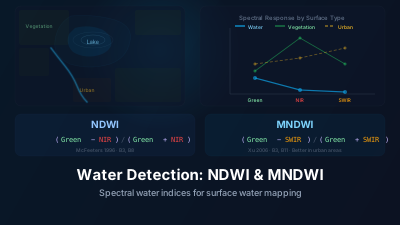
Quick Answer: MNDWI = (Green - SWIR) / (Green + SWIR), Sentinel-2 (B3 - B11) / (B3 + B11). It replaces the NIR band of NDWI with SWIR, which suppresses built-up false positives — use MNDWI when urban areas or bare soil might be confused with water. NDWI = (Green - NIR) / (Green + NIR) works well for natural water bodies in rural areas. Both range -1 to +1; positive values indicate water.
Why Water Detection Isn't as Simple as It Looks
Water appears dark in most satellite imagery — so why do we need specialized indices to detect it? Because several other surfaces also appear dark:
- Shadows from clouds, mountains, and buildings
- Asphalt and dark rooftops in urban areas
- Dark volcanic soils
- Burned areas after wildfires
A simple brightness threshold will misclassify all of these as water. Spectral indices exploit the specific way water absorbs and reflects different wavelengths to separate it from these dark-but-not-water surfaces.
The Two Main Water Indices
NDWI (Normalized Difference Water Index)
Proposed by McFeeters (1996), NDWI uses the contrast between green light (which water reflects somewhat) and near-infrared (which water absorbs strongly):
NDWI = (Green - NIR) / (Green + NIR)
For Sentinel-2: (B3 - B8) / (B3 + B8)
- Water: positive values (0.1 to 0.8)
- Vegetation: negative values (-0.8 to -0.1)
- Bare soil: negative values, close to zero
MNDWI (Modified Normalized Difference Water Index)
Proposed by Xu (2006), MNDWI replaces NIR with SWIR to reduce confusion with built-up areas:
MNDWI = (Green - SWIR) / (Green + SWIR)
For Sentinel-2: (B3 - B11) / (B3 + B11)
- Water: positive values (0.1 to 0.8)
- Built-up areas: strongly negative (unlike NDWI where they can be near-zero or positive)
- Bare soil: negative values
Before computing either index it helps to look at the scene itself: in the Sentinel-2 viewer, false color shows water dark against bright vegetation.
Why MNDWI Outperforms NDWI in Urban Areas
The key problem with NDWI is that built-up surfaces (concrete, asphalt) can produce near-zero or slightly positive NDWI values — dangerously close to actual water signatures. This happens because urban materials have relatively low NIR reflectance.
MNDWI solves this by using SWIR instead of NIR. Built-up surfaces have high SWIR reflectance, pushing them firmly into negative MNDWI territory. The separation between water (positive) and urban (strongly negative) becomes much cleaner.
| Surface Type | NDWI | MNDWI |
|---|---|---|
| Deep water | 0.4 to 0.7 | 0.5 to 0.8 |
| Shallow/turbid water | 0.1 to 0.3 | 0.2 to 0.4 |
| Vegetation | -0.5 to -0.1 | -0.4 to 0.0 |
| Bare soil | -0.3 to 0.1 | -0.5 to -0.1 |
| Built-up areas | -0.2 to 0.2 ⚠️ | -0.6 to -0.2 ✅ |
Practical Applications
Flood Extent Mapping
After a flood event, comparing pre-flood and post-flood NDWI images reveals inundated areas. Areas where NDWI changed from negative to positive indicate new water presence. This complements SAR-based flood mapping — SAR works through clouds during the event, while optical-based NDWI provides cleaner water boundaries once skies clear.
Reservoir and Lake Monitoring
Track seasonal water level changes by computing NDWI time series. The water boundary (NDWI = 0 threshold) shifts inward during dry seasons and expands during wet seasons. This is particularly useful for monitoring drought impacts on reservoirs.
Wetland Delineation
Wetlands present a challenge because they mix water and vegetation signals. In these transitional zones, both NDWI and NDVI are useful — high NDVI with near-zero NDWI suggests vegetated wetland, while positive NDWI with low NDVI indicates open water.
Urban Water Features
Parks, ponds, rivers running through cities — MNDWI is essential here. NDWI alone will produce too many false positives from dark rooftops and parking lots.
Tips for Better Water Mapping
Choose the Right Threshold
The default threshold of zero (water = positive, land = negative) works as a starting point, but optimal thresholds vary by scene:
- Clear, deep water: threshold of 0.1-0.2 reduces noise
- Turbid water: you may need to lower the threshold to 0.0 or even slightly negative
- Mixed pixels at water edges: a lower threshold captures more of the water boundary but may include wet soil
Watch for Cloud Shadows
Cloud shadows over land can produce positive NDWI values that look like water. Always inspect your results against the true-color image. If a "water body" appears next to a cloud and has an irregular shape matching the cloud outline, it's a shadow.
Consider Seasonal Timing
The best time to map permanent water bodies is during the dry season, when temporary water features have receded. For flood mapping, compare against a dry-season baseline.
Combine with SAR
For the most robust water mapping, combine optical water indices with SAR backscatter analysis. Water appears dark in both SAR and NIR, but the failure modes are different — SAR isn't affected by cloud shadows, and optical isn't affected by wind-roughened water surfaces (which can appear bright in SAR).
Threshold Performance by Water Condition
The default zero threshold works for clean, deep water but fails in real-world conditions. Here's what to expect and how to adjust:
| Water Condition | NDWI Range | MNDWI Range | Recommended Threshold | False Positive Risk |
|---|---|---|---|---|
| Deep, clear lake (oligotrophic) | 0.4–0.7 | 0.5–0.8 | 0.1 (conservative) | Very low |
| Turbid river / high sediment load | 0.1–0.3 | 0.2–0.4 | 0.0 | Low |
| Shallow turbid estuary | 0.05–0.2 | 0.1–0.3 | −0.05 to 0.0 | Moderate (wet sand confusion) |
| Wind-roughened lake surface | 0.2–0.5 | 0.3–0.6 | 0.1 | Low |
| Urban canal / small water body | 0.0–0.3 | 0.1–0.4 | 0.05 | Moderate (shadow confusion) |
| Flooded field (thin water layer) | −0.1 to 0.2 | 0.0–0.2 | −0.05 | High (wet soil confusion) |
| Moist/wet soil (not flooded) | −0.2 to 0.0 | −0.1 to 0.1 | — | Must distinguish from flooded field |
| Dense cloud shadow | 0.1–0.5 | 0.0–0.4 | — | High; requires cloud mask |
Accuracy in practice: how well a threshold performs is set almost entirely by how separable water is from its surroundings in that scene. Clean, deep lakes and reservoirs are the easy case — the water and land distributions barely overlap, and a per-scene threshold (Otsu or similar) is close to unambiguous. Floods over agricultural land are the hard case, because saturated soil sits between the two distributions and no threshold cleanly separates them. Urban water bodies fall in between, and MNDWI is materially more reliable than NDWI there because built-up surfaces move well away from the water values. Validate against a manually delineated subset of your own scene rather than assuming a published accuracy figure transfers.
The most common failure mode is cloud shadow misclassification. A cloud shadow over forest produces positive NDWI (the dark NIR of shadowed vegetation looks like water). The fix is always to run cloud and shadow masking (using SCL bands for Sentinel-2) before computing water indices, not after.
Try It in Off-Nadir Delta
Off-Nadir Delta supports both NDWI and MNDWI as built-in visualization options for Sentinel-2 data:
- Search for Sentinel-2 imagery over a lake, river, or coastal area
- Select NDWI or MNDWI from the visualization options
- Compare results — especially in areas with mixed urban and water features
- Toggle between NDWI and MNDWI to see how built-up area false positives disappear with MNDWI
For flood monitoring, load imagery from before and after a flood event and switch between NDWI views to visualize the change.
Related reading
A water index computed once tells you the extent on that date. Tracking it as a series over a fixed polygon is a different setup, with its own failure modes — measuring a number versus watching for events covers when a measurement watch is the right tool and how unusual readings are separated from ordinary seasonal movement.

Remote sensing specialist with 10+ years in satellite data processing and AI. Founder of Off-Nadir Lab. Ph.D. in Informatics (Yokohama National University, 2026). Master's in Earth System Science and Technology (Kyushu University). Co-author, Remote Sensing Encyclopedia. More about the author →