Precision Agriculture with Satellite Imagery: A Practical Guide
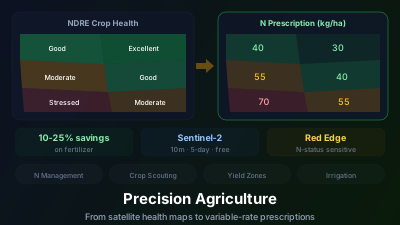
Quick Answer: Precision agriculture uses satellite imagery to manage fields at sub-field scale rather than treating them uniformly. Sentinel-2's 10m resolution and 5-day revisit enable practical in-season crop monitoring. Key applications include variable-rate nitrogen application (guided by NDRE maps), irrigation scheduling (thermal + NDVI), yield zone mapping (multi-year NDVI composites), and pest/disease early detection (anomaly detection in time series). The main barrier isn't technology — it's translating satellite-derived indices into actionable farm management decisions.
Uniform fertilizer application assumes a field is homogeneous. It rarely is. Soil texture, drainage, organic matter and residual nitrogen vary continuously across a single field, so one blanket rate is simultaneously too high where the crop cannot use the extra input and too low where it would respond. The surplus does not become yield — it leaches or volatilizes. Variable-rate prescription maps derived from satellite imagery replace that single number with a spatial one, matching input rates to the measured condition of the crop across the field.
That's precision agriculture at its core: applying the right input, at the right rate, in the right place, at the right time. And satellites are the only practical way to get the spatial information needed across large farm operations.
What Satellites Bring to Farming
Traditional farming treats each field as a uniform unit. One soil test per field, one fertilizer rate, one irrigation schedule. But anyone who's walked a large field knows the variability: low-lying areas hold more moisture, hilltops drain faster, soil texture changes across the field, and historical management creates persistent productivity zones.
Satellite imagery makes this variability visible and quantifiable at scales that ground-based observation can't match.
The Right Satellite for Agriculture
Sentinel-2 is the default choice for most agricultural monitoring:
- 10m resolution distinguishes individual management zones within fields
- 5-day revisit captures critical crop growth stages
- 13 bands including three red edge bands for chlorophyll sensitivity
- Free and open data
Planet (commercial) offers daily 3-meter imagery — better spatial and temporal resolution but at significant cost. Justified for high-value crops (vineyards, specialty crops) where field variability occurs at fine scales.
Landsat provides free 30m data with thermal bands, useful for crop water stress detection but too coarse for sub-field management in typical European or North American field sizes.
Key Applications
Variable-Rate Nitrogen Management
This is where satellite-guided precision agriculture has the clearest economic return. The workflow:
- Mid-season satellite acquisition during active vegetative growth (for wheat: stem elongation to flag leaf, roughly BBCH 30-39)
- Compute NDRE (red edge index) to map relative chlorophyll/nitrogen status across the field
- Zone the field into 3-5 management zones based on NDRE values
- Calibrate zones against leaf nitrogen measurements or tissue tests from representative points
- Generate prescription map adjusting nitrogen rate by zone — more where the crop is deficient, less where it's sufficient
The usual outcome is that total nitrogen use falls relative to a uniform rate while yield is held roughly constant — but the size of that saving depends on how variable the field actually is, what the uniform baseline rate was, and how well the zones were calibrated. On a field that really is homogeneous, there is nothing for variable rate to recover.
Index Values at Key Crop Growth Stages
Understanding what NDVI and NDRE values to expect at specific growth stages prevents misinterpretation of anomalies. These are representative Sentinel-2 values for well-managed winter wheat in a temperate climate:
| Growth Stage (BBCH) | NDVI (typical) | NDRE (typical) | N-stress signal |
|---|---|---|---|
| Germination / emergence (BBCH 0–9) | 0.10–0.20 | 0.05–0.15 | Not reliable |
| Tillering (BBCH 20–29) | 0.35–0.55 | 0.20–0.35 | NDRE at the low end of the field's range suggests deficiency |
| Stem elongation (BBCH 30–39) | 0.60–0.78 | 0.38–0.52 | Primary N-application window |
| Heading / flowering (BBCH 51–65) | 0.70–0.85 | 0.45–0.60 | High NDVI but NDRE still responsive |
| Grain fill (BBCH 70–80) | 0.55–0.70 | 0.30–0.45 | N-stress irreversible |
| Ripening / maturation (BBCH 83–89) | 0.20–0.45 | 0.10–0.25 | Senescence expected |
Using NDRE for nitrogen management: NDRE (using Sentinel-2 B8A at 865 nm and B5 at 705 nm) is more sensitive to chlorophyll/nitrogen status than NDVI once the canopy closes, because NDVI saturates while the red-edge signal keeps responding. The practical consequence is directional rather than absolute: at stem elongation, the lower end of the field's NDRE distribution is where additional nitrogen is most likely to pay, and the upper end is where it is least likely to. The cut-off value itself is not transferable — it has to be established locally against tissue tests or strip trials, because it moves with variety, season, and sensor processing level.
Crop Scouting Prioritization
On a 500-hectare operation, walking every field weekly is impractical. Satellite NDVI/NDRE maps highlight anomalies — areas where the crop is performing below the field average — directing scouts to locations that need attention.
Common anomalies detectable from satellite:
- Waterlogging: Low NDVI in topographic low points after heavy rain
- Nutrient deficiency: Gradual NDVI decline in specific zones
- Pest or disease patches: Localized NDVI drops that expand over time
- Equipment malfunction: Linear or geometric patterns of reduced NDVI (seeder miss, sprayer overlap/gap)
Yield Zone Mapping
Multi-year NDVI composites at peak biomass reveal persistent productivity patterns that reflect underlying soil properties, drainage, and management history. These zones are remarkably stable from year to year and provide the foundation for variable-rate seeding, fertilization, and soil sampling strategies.
The approach: compute peak-season NDVI for 3-5 years, average them, and classify into productivity zones. High-NDVI zones consistently produce more; low-NDVI zones are limited by some persistent factor (compaction, poor drainage, low organic matter).
Irrigation Scheduling
Combining vegetation indices (NDVI/NDRE) with thermal data (Landsat, ECOSTRESS) enables crop water stress detection:
- CWSI (Crop Water Stress Index): Compares actual canopy temperature to the expected temperature of a well-watered crop
- Thermal-NDVI relationship: Fields that are warm relative to their NDVI level are likely water-stressed
The limitation: thermal satellites (Landsat) have 16-day revisit, which is too infrequent for irrigation scheduling of high-frequency crops. Combining with soil moisture sensors or weather-based models fills the temporal gaps.
Practical Challenges
Cloud Cover During Critical Windows
Crops don't wait for clear skies. The nitrogen application window for winter wheat is typically 2-3 weeks. If every Sentinel-2 pass during that window is cloudy (common in northern European springs), the satellite data arrives too late to be useful.
Mitigation: Use SAR (Sentinel-1) as a backup — it works through clouds. SAR-based crop monitoring is less intuitive than optical indices but can track biomass accumulation and detect anomalies. Combining optical and SAR data provides the most robust monitoring.
The "Last Mile" Problem
Even perfect satellite-derived prescription maps are useless if the farm equipment can't implement them. Variable-rate application requires:
- GPS-guided equipment with section control
- Compatible file formats between satellite platform and equipment manufacturer
- Farmer willingness to trust and act on the recommendations
This "last mile" — translating satellite data into equipment-compatible prescriptions — is where most precision agriculture implementations fail or succeed.
Calibration and Ground Truth
Satellite indices provide relative information (this zone has more chlorophyll than that zone). Converting to absolute recommendations (apply 40 kg N/ha here, 60 kg N/ha there) requires local calibration through:
- Soil sampling
- Tissue/sap analysis
- Yield monitor data from previous seasons
- Local agronomic expertise
A satellite map without agronomic interpretation is just a pretty picture. The value comes from combining remote sensing data with domain knowledge.
Field Size and Fragmentation
Precision agriculture from satellites works best for fields larger than about 2 hectares (at 10m Sentinel-2 resolution). Below this size, the number of "pure" pixels within the field is too small for reliable zone mapping. In regions with small, fragmented fields (much of Asia, parts of Europe), higher-resolution commercial data may be necessary.
What's Coming
Higher temporal resolution: Satellite constellations (Planet, satellite groups) increasingly offer daily optical coverage, reducing cloud-gap problems.
Integration with IoT sensors: Combining satellite spatial data with real-time soil sensors, weather stations, and drone imagery creates a multi-scale monitoring system that's greater than the sum of its parts.
AI-driven recommendations: Machine learning models trained on years of satellite data, weather records, and yield data can generate more accurate and timely management recommendations than simple index thresholds.
SAR-optical fusion: Integrating Sentinel-1 and Sentinel-2 data to maintain continuous monitoring regardless of weather conditions. Early implementations are showing promise for detecting crop anomalies in cloud-prone regions.
The technology is mature enough for operational use today. Where satellite-guided management is adopted, the reported benefit is typically reduced input use at maintained yield, though the size of the effect depends on the crop, the field variability, and the baseline practice. The satellite data doesn't replace agronomic expertise — it amplifies it, giving the farmer eyes across their entire operation at a resolution that was previously impossible.

Remote sensing specialist with 10+ years in satellite data processing and AI. Founder of Off-Nadir Lab. Ph.D. in Informatics (Yokohama National University, 2026). Master's in Earth System Science and Technology (Kyushu University). Co-author, Remote Sensing Encyclopedia. More about the author →