
Crop Type Mapping with Satellite Imagery: Telling Wheat from Corn from Space
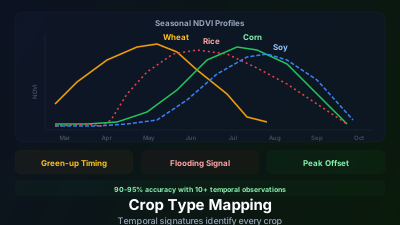
Quick Answer: Single-date satellite imagery cannot reliably distinguish between crop types because different crops can have similar spectral signatures at any given moment. Multi-temporal analysis exploits phenological differences — crops are planted, grow, and harvested at different times. Winter wheat greens up in early spring while corn hasn't been planted yet; rice paddies are flooded in spring while other crops aren't. Time series of NDVI or SAR backscatter across the growing season create distinctive temporal signatures for each crop type, which supervised classification then learns. How accurate the result is depends far more on the number of classes, field size relative to pixel size, and how many well-timed cloud-free observations you get than on the choice of classifier — accuracy is highest when separating winter from summer crops, and lowest in tropical smallholder systems with small fields and frequent cloud.
You can't reliably tell crop types apart from one satellite image — different crops look nearly identical on any single date. What separates them is timing, captured as a multi-date time series across the growing season. Consider a hypothetical request: map crop types across an entire agricultural region from a single July Sentinel-2 image. It cannot be done reliably, and the reason is worth spelling out.
In July, wheat is golden and ready for harvest. Corn is mid-height and intensely green. Soybeans are green but shorter. Sunflowers are green with a different canopy structure. From a single date, wheat is easily distinguishable (it's already senescing), but corn, soybeans, and sunflowers overlap spectrally — all are green, all are actively photosynthesizing, all have NDVI values between 0.6 and 0.85.
The solution isn't a better sensor — it's more dates.
Why do time series distinguish crop types?
Time series distinguish crop types because different crops follow different phenological calendars — they green up, peak, and are harvested at different dates. Winter wheat is already green in early spring while corn is still bare soil; rice paddies flood before transplanting. The shape of the NDVI curve over a season is as diagnostic as any single-date spectrum. Their calendars differ like this:
Winter wheat (northern hemisphere): Planted October-November, vegetative growth resumes March, heading in May-June, harvest in July. Peak NDVI in May.
Corn (maize): Planted April-May, rapid growth June-July, tasseling in July-August, harvest September-October. Peak NDVI in late July.
Soybeans: Planted May-June, slower initial growth, peak biomass August, harvest October. Peak NDVI in August.
Rice (irrigated): Transplanting in spring involves flooding — a completely unique spectral signature. Rapid growth through summer, harvest in autumn.
These differences in timing create distinct "temporal signatures" — the NDVI curve shape over the season is as diagnostic for crop type as the spectral signature at any single date.
Building a Temporal Signature Library
The practical approach:
- Collect all available Sentinel-2 images across the growing season (March through October for temperate regions)
- Cloud-mask each scene using the SCL band
- Compute NDVI (or other indices) for each cloud-free observation
- Extract time series at known crop type locations (training data)
- Characterize the temporal profile for each crop type
For training data, options include:
- Government crop declarations (where available)
- Field surveys
- Very high-resolution imagery interpretation
- Historical crop maps from previous years
- Farmer cooperation
Key Phenological Discriminators
Green-Up Timing
Winter cereals (wheat, barley, rye) green up weeks before spring-planted crops. An early April NDVI image separates them cleanly: winter crops are already green (NDVI > 0.4) while spring crop fields are still bare soil (NDVI < 0.2).
Flooding Signature
Rice paddies are flooded before or during transplanting. This produces a unique spectral signature — very low NIR reflectance (water absorption) combined with increasing green reflectance as rice seedlings emerge. No other major crop has this pattern.
SAR is particularly powerful for rice detection: flooded paddies produce a distinctive double-bounce signal (water surface + rice stems) that's unique in the SAR backscatter time series.
Peak Biomass Timing
Crops reach maximum biomass at different times. By late July in the northern temperate zone, winter wheat NDVI is declining (heading/senescence) while corn NDVI is still increasing. This timing offset allows discrimination even when the NDVI values themselves overlap.
Harvest Date
Sudden NDVI drops indicate harvest events. The timing of this drop — July for winter wheat, September for corn, October for soybeans — provides additional classification evidence.
Classification Methods
Random Forest with Temporal Features
The most commonly used approach. Input features include:
- NDVI values at each available date
- Computed features: peak NDVI, date of peak, rate of green-up, rate of senescence, growing season length
- Optionally: SAR backscatter time series, thermal data
Random Forest — one of the workhorses of machine learning for satellite image classification — handles the high dimensionality well and provides feature importance rankings that reveal which dates/features matter most.
Dynamic Time Warping (DTW)
DTW measures the similarity between temporal profiles, accommodating shifts in timing. A corn field that was planted one week later than average will have a shifted NDVI curve that DTW recognizes as "corn" despite the temporal offset. This makes DTW more robust to year-to-year phenological variability than simple per-date comparison.
Deep Learning (1D-CNN, LSTM)
Convolutional and recurrent neural networks can learn temporal patterns directly from raw time series without hand-crafted features. They tend to edge out Random Forest where training data is plentiful, but the margin is usually small relative to the gains from better training labels or more well-timed observations, and they require considerably more data and compute.
How accurate is crop type mapping?
Multi-temporal Sentinel-2 classification is most accurate for a handful of major crops in temperate regions, falls as the class list grows to eight or ten types that share parts of the same calendar, and falls furthest in tropical smallholder systems where fields are small and clouds are frequent. It hinges on the number of cloud-free dates, crop diversity, field size, and training data quality. Because reported figures depend so strongly on those factors, treat the ordering below as the reliable part and take any specific percentage from a study matched to your own class count, field sizes, and observation density.
| Scenario | Relative Accuracy |
|---|---|
| Winter vs. summer crops only | Highest — the phenological calendars barely overlap |
| Major crops (3-4 types), temperate region | High |
| Detailed mapping (8-10 types) | Lower — several crops share a calendar |
| Tropical smallholder (mixed cropping) | Lowest — small fields, few pure pixels, sparse clear observations |
The accuracy depends heavily on:
- Number of cloud-free observations: More dates = better discrimination
- Crop diversity: Fewer similar crops = easier classification
- Field size: Larger fields have more pure pixels = higher accuracy
- Training data quality: Mislabeled training samples are the leading cause of classification errors
Common Pitfalls
Relying on too few dates: A two-date classification (spring + summer) might seem sufficient but misses subtle timing differences that a full time series captures. Classification accuracy generally improves as more well-timed acquisitions are added, because each date contributes additional phenological separation between crops.
Ignoring mixed pixels: Field edges contain pixels that are mixtures of two crops or crop + road. These mixed pixels will be misclassified and inflate error rates. Applying a field boundary mask (if available) or eroding field edges by one pixel significantly improves results.
Training data from a different year: Phenological timing shifts from year to year based on weather. Training data from 2024 applied to 2025 imagery may underperform because planting dates or growing season conditions differ. Always use same-year training data when possible.
Confusing crops with similar phenology: Corn and sorghum have nearly identical temporal NDVI profiles in many regions. Distinguishing them may require SAR data (structural differences) or shortwave infrared bands (moisture content differences).
How does SAR improve crop type mapping?
SAR improves crop type mapping by reading canopy structure and moisture that optical bands miss, and by seeing through cloud. Sentinel-1's flooding double-bounce signal makes rice unmistakable, and different canopy architectures separate corn from soybean. Fusing radar and optical time series lifts accuracy most in cloud-prone regions where optical observations are sparse.
Sentinel-1 SAR provides complementary information:
- Rice: Double-bounce flooding signature is diagnostic
- Corn vs. soybean: Different canopy structures produce different VH backscatter patterns
- Winter crops: SAR detects early growth even under cloud cover
- Harvest events: Sudden backscatter changes when crop is removed
Combining Sentinel-1 and Sentinel-2 time series generally improves classification accuracy over optical alone. The size of the gain is not fixed: it is modest where clear optical observations are already plentiful, and large in cloud-prone regions, where SAR is not adding a second opinion so much as supplying the only observations available at the dates that matter.
What Actually Drives Classification Accuracy
Reported accuracies for crop type mapping vary widely between studies, and most of that variation comes from the difficulty of the problem rather than from the classifier. Comparing a published accuracy figure against your own result is only meaningful if the two share the same class count, field sizes, and observation density. Four factors dominate:
Number of classes. Separating winter from summer crops is nearly trivial, because the phenological calendars barely overlap. Separating eight to twelve crop types, several of which share a calendar, is a fundamentally harder problem, and accuracy falls accordingly. Any accuracy number quoted without the class count is uninterpretable.
Field size relative to pixel size. Large mechanized fields yield many pure pixels; smallholder plots may be only a few pixels across, so most of the field is edge and the spectral signal is a mixture. This, more than anything else, is why smallholder systems report lower accuracy than the US Corn Belt or the EU arable belt — the sensor, the classifier, and the analyst can all be excellent and the pixels still will not be pure.
Observation density through the season. Discrimination comes from timing, so it depends on having observations at the dates where the crops' calendars diverge. Accuracy rises steeply as the first several cloud-free observations arrive, then flattens: once the green-up, peak, and senescence transitions are each sampled, additional dates add little. What matters is not the raw count but whether the transitions were captured.
The cloud frequency penalty. In monsoon Asia and much of West Africa, peak growing season is also peak cloud, so the usable optical observations collapse to a handful — and, worse, they cluster in whatever dry window happened to occur, which may miss the transitions entirely. This is the case where Sentinel-1 SAR stops being supplementary and becomes essential, because it supplies observations on a fixed cadence regardless of cloud.
The practical implication for planning: before committing to an optical-only approach, check the seasonal cloud statistics for your area and ask whether they leave enough clear dates at the phenological transitions that separate your target crops. If they do not, plan a SAR-optical fusion from the start rather than discovering the gap mid-season.
Crop type mapping from satellites has matured from a research exercise to an operational tool used by agricultural statistics agencies, insurance companies, and commodity markets worldwide — the same crop maps often feed yield estimation models. The fundamental insight remains the same: crops are best identified not by what they look like at a single moment, but by how they change over time. You can build these time series yourself from free Sentinel-2 imagery.

Remote sensing specialist with 10+ years in satellite data processing and AI. Founder of Off-Nadir Lab. Ph.D. in Informatics (Yokohama National University, 2026). Master's in Earth System Science and Technology (Kyushu University). Co-author, Remote Sensing Encyclopedia. More about the author →