Irrigation Monitoring from Space: Tracking Water Use Across Farmland
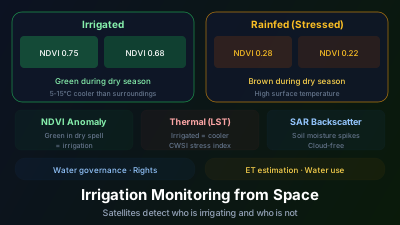
Quick Answer: Satellites detect irrigation through multiple signals: irrigated fields stay greener (higher NDVI) during dry periods than rainfed fields; thermal imagery shows irrigated crops are cooler due to evapotranspiration; SAR detects soil moisture increases after irrigation events. Sentinel-2 NDVI time series compared against rainfall data is the simplest approach — fields maintaining high NDVI during rainless periods are likely irrigated. Landsat thermal data adds crop water stress detection. Applications include water rights enforcement, aquifer depletion monitoring, and agricultural water use accounting.
Water allocation has always had an enforcement problem: the regulator knows what each farm is entitled to, but not what it actually applied. Satellites change that, because irrigation leaves a signature that is hard to hide. A field that stays lush and green through the driest weeks of summer, while its neighbours show clear water stress, is being watered — whatever the paperwork says.
Satellite-based irrigation monitoring has become a tool for water governance, not just agricultural research.
How Satellites Detect Irrigation
Irrigation changes three measurable properties:
1. Vegetation Greenness
Irrigated crops maintain photosynthetic activity during dry periods. Without rain, rainfed crops experience water stress — stomata close, chlorophyll degrades, NDVI drops. Irrigated crops continue growing normally.
The signature: during a dry spell, compare NDVI across fields. Fields maintaining NDVI above 0.6-0.7 while surrounding rainfed fields drop below 0.4 are almost certainly irrigated.
2. Surface Temperature
Transpiration cools the crop canopy. Well-watered crops are typically 5-15°C cooler than water-stressed crops or bare soil on hot days. Thermal satellite data (Landsat TIRS, ECOSTRESS) maps this temperature difference directly.
The Crop Water Stress Index (CWSI) normalizes canopy temperature between theoretical wet and dry bounds:
- CWSI near 0: Well-watered (likely irrigated during dry conditions)
- CWSI near 1: Severely stressed (rainfed or under-irrigated)
3. Soil Moisture
SAR backscatter increases when soil is wet. An irrigation event produces a sudden backscatter increase visible in Sentinel-1 data, particularly in the early season when canopy is sparse and soil is visible to the radar.
The temporal pattern is diagnostic: irrigation creates periodic backscatter spikes (every 7-14 days depending on irrigation scheduling) that rainfed fields don't show.
Mapping Irrigated Area
NDVI Anomaly Method
The simplest and most widely used approach:
- Compute NDVI for peak dry season (July-August in the Northern Hemisphere)
- Compare with rainfall data: Identify periods with zero or minimal precipitation
- Threshold: Fields with NDVI > 0.5 during extended dry periods (>30 days without significant rain) are classified as irrigated
This works because the only way to maintain green vegetation during a dry period is artificial water supply. The method is robust in arid and semi-arid regions where the contrast between irrigated and rainfed is stark.
In humid regions, the method is less reliable because rainfed crops may not experience significant water stress during the growing season.
Multi-Temporal Comparison
Compare the NDVI trajectory of each field against the expected rainfed trajectory (derived from nearby natural vegetation or known rainfed fields):
- Irrigated fields maintain or increase NDVI during dry spells
- Rainfed fields track the vegetation response to natural rainfall patterns
The deviation between actual and expected NDVI during dry periods quantifies the irrigation signal.
SAR-Based Detection
Sentinel-1 backscatter time series can detect individual irrigation events:
- Monitor VV backscatter time series for each field
- Identify sudden increases (>2 dB within 6 days) not associated with rainfall events
- Count irrigation events per season
This approach works through clouds — critical in monsoon regions where optical data may be unavailable during part of the irrigation season.
Estimating Water Consumption
Beyond mapping where irrigation occurs, satellites can estimate how much water is being used through evapotranspiration (ET) modeling:
Energy balance models (SEBAL, METRIC, SSEBop) use thermal satellite data to partition available energy between sensible heat (warming the air) and latent heat (evapotranspiration). The latent heat flux, converted to water depth, gives actual ET.
Irrigated ET minus rainfall ET equals irrigation water applied (approximately). Over a season, this provides a field-level water use estimate.
Important caveat: These models estimate ET, not gross irrigation. Irrigation efficiency varies — a flood-irrigated field might apply 150% of crop ET (with 50% lost to deep percolation and runoff), while a drip-irrigated field might apply 105% of ET.
Evapotranspiration Reference: Typical Crop Water Use
When estimating how much water irrigation is supplying, indicative reference ET ranges help you sanity-check satellite-derived estimates. Treat these as order-of-magnitude anchors only — published crop ET figures vary substantially with variety, planting date, and local climate, and a regional agronomic reference (such as an FAO or extension-service crop coefficient table for your area) should be used for anything quantitative:
| Crop | Peak ET (mm/day) | Seasonal Total (mm/season) | Climate |
|---|---|---|---|
| Winter wheat | 5–7 | 350–500 | Temperate |
| Maize (corn) | 6–9 | 500–700 | Temperate/semi-arid |
| Cotton | 5–8 | 600–900 | Semi-arid |
| Rice (paddy) | 6–10 | 700–1,200 | Tropical/subtropical |
| Vegetables (intensive) | 4–6 | 350–550 | Varies |
| Alfalfa | 8–12 | 1,000–1,500 | Arid/semi-arid |
| Vineyard (grapevine) | 3–5 | 400–600 | Mediterranean |
These are reference crop ET values under non-stressed conditions. Actual field ET depends on growth stage (early season ET is much lower), local climate, and stress. SEBAL and METRIC models derive actual ET from thermal satellite data, which may be 60–100% of reference ET depending on crop development and water availability.
Practical implication: If a wheat field in a semi-arid region shows seasonal ET of 450 mm from satellite-derived energy balance, and local rainfall was 120 mm, then approximately 330 mm of irrigation water was applied — about 3,300 m³/ha or 330 ML/km². At field scale, this converts directly to irrigation volume for water accounting purposes.
Applications
Water Rights Compliance
In regions with water allocation systems (western United States, Australia, Spain), satellite monitoring verifies that farmers are irrigating within their permitted volumes. Persistent high NDVI on fields without water allocation triggers investigation.
Aquifer Depletion Monitoring
Comparing irrigated area trends over decades reveals groundwater extraction patterns. Expanding irrigated area in regions dependent on groundwater (Punjab, Ogallala Aquifer, North China Plain) indicates increasing aquifer stress.
Agricultural Census Improvement
National agricultural statistics often rely on farmer-reported irrigated area, which can be unreliable. Satellite-derived irrigated area maps provide independent verification at national scale.
Climate Adaptation Planning
As climate change shifts rainfall patterns, understanding current irrigation dependence helps plan for future water demand. Regions currently irrigating at capacity during normal years have no buffer for drier conditions.
Challenges
Distinguishing irrigation methods: Drip irrigation wets only a fraction of the soil surface, producing a much weaker satellite signal than flood or sprinkler irrigation. High-resolution data (commercial satellites at 1-3 m) may be needed to detect drip irrigation patterns.
Winter irrigation: In some regions, fields are irrigated in winter for soil moisture charging or cover crops. Winter cloud cover limits optical monitoring, and frozen soil complicates SAR interpretation.
Greenhouses: Protected agriculture (greenhouses, hoop houses) uses significant water but is invisible to optical satellites that see only the structure's roof. SAR can sometimes detect greenhouse irrigation through moisture accumulation around structures.
Mixed water sources: A field might use both rainfall and supplemental irrigation. Separating the two contributions requires modeling or in-situ data.
The combination of free Sentinel-2 optical data, Sentinel-1 SAR, and Landsat thermal data provides a comprehensive irrigation monitoring toolkit. In water-scarce regions — which is an increasing share of the world's agricultural area — this monitoring capability is becoming essential for sustainable water management.

Remote sensing specialist with 10+ years in satellite data processing and AI. Founder of Off-Nadir Lab. Ph.D. in Informatics (Yokohama National University, 2026). Master's in Earth System Science and Technology (Kyushu University). Co-author, Remote Sensing Encyclopedia. More about the author →