
Understanding SAR Backscatter Coefficient (σ⁰): What the Numbers Actually Mean
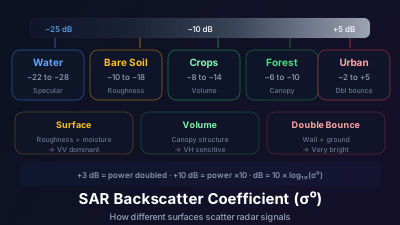
Quick Answer: The backscatter coefficient σ⁰ (sigma-nought) is the fundamental measurement unit of SAR imagery — it represents the radar cross-section per unit area, expressed in decibels (dB). Typical C-band VV values: calm water −22 to −28 dB, bare dry soil −15 to −20 dB, bare wet soil −8 to −14 dB, agricultural crops −8 to −14 dB, dense forest −6 to −10 dB, urban areas −2 to +5 dB. The decibel scale is logarithmic: a 3 dB increase means the backscatter power doubled. Understanding these ranges is essential for interpreting SAR imagery and setting analysis thresholds.
Open a calibrated Sentinel-1 scene and the pixel values run from roughly −25 to +5, with no obvious units attached. The image looks like noise with some structure in it. For anyone arriving from optical remote sensing, the immediate question is: what do these numbers mean, and where is the reflectance?
SAR doesn't measure reflectance. It measures backscatter — a fundamentally different quantity that requires a different mental model to interpret.
What σ⁰ Represents
The backscatter coefficient (σ⁰, pronounced "sigma-nought") is the radar cross-section of the ground surface normalized by the illuminated area. In plain terms: it measures how much of the transmitted radar energy is scattered back toward the satellite per unit area of ground.
σ⁰ depends on three factors:
- Surface roughness relative to the radar wavelength: Rough surfaces scatter more energy back; smooth surfaces reflect it away
- Dielectric properties of the surface: Wetter materials have higher dielectric constants and scatter more energy
- Geometry: The angle at which the radar illuminates the surface (incidence angle) and the structural arrangement of scatterers
Unlike optical reflectance (which ranges from 0 to 1), σ⁰ can theoretically range from near zero to greater than one. A smooth metal surface acting as a corner reflector can have σ⁰ much greater than 1 (it reflects more energy back toward the radar than a perfectly diffuse scatterer of the same area would).
Why Decibels?
Backscatter values span several orders of magnitude. Calm water might return 0.003 of the reference value, while an urban corner reflector might return 3.0 — a factor of 1,000 difference. Working with these raw numbers (called "linear scale") is impractical.
The decibel (dB) scale compresses this range logarithmically:
σ⁰_dB = 10 × log₁₀(σ⁰_linear)
Key conversions:
| Linear σ⁰ | dB value | Interpretation |
|---|---|---|
| 0.001 | −30 dB | Very weak return (calm water) |
| 0.01 | −20 dB | Weak return |
| 0.1 | −10 dB | Moderate return |
| 1.0 | 0 dB | Strong return |
| 10.0 | +10 dB | Very strong return (corner reflector) |
The decibel scale has a useful property: a 3 dB change means the power doubled (or halved). So going from −12 dB to −9 dB means the backscatter intensity doubled. Going from −12 dB to −6 dB means it quadrupled.
This is critical for interpreting change detection results. A 3 dB difference between two dates is a significant change; a 1 dB difference might be within the noise margin.
Typical σ⁰ Values by Land Cover
These ranges are for C-band (Sentinel-1) at moderate incidence angles (30-45°), VV polarization:
| Surface Type | σ⁰ Range (dB) | Why |
|---|---|---|
| Calm water | −22 to −28 | Specular reflection away from satellite |
| Wind-roughened water | −15 to −20 | Surface waves scatter some energy back |
| Bare dry soil (smooth) | −15 to −20 | Low roughness, low dielectric |
| Bare wet soil | −8 to −14 | Higher dielectric from moisture |
| Short grass/pasture | −12 to −16 | Low vegetation, partial soil contribution |
| Agricultural crops (mid-season) | −8 to −14 | Volume scattering from canopy |
| Dense forest | −6 to −10 | Strong volume scattering, relatively stable |
| Urban/built-up | −2 to +5 | Corner reflectors, double bounce from buildings |
| Metal structures | +5 to +15 | Extremely strong returns |
Why Water Is Dark
This confuses people who expect water to be reflective. In SAR, "reflective" and "bright" aren't the same thing. Calm water is an excellent reflector — it reflects nearly all the incident radar energy. But it reflects it away from the satellite (specular reflection, like a mirror). Almost nothing comes back to the sensor, so water appears very dark.
Wind-roughened water scatters some energy back, appearing brighter. This is why sea state, wind speed, and wave height all affect ocean backscatter — and why SAR is used for ocean wind measurement.
This is easy to check in the Sentinel-1 SAR viewer: open a coastline or a large river, and calm water shows up dark next to the land.
Why Urban Areas Are Bright
Buildings create double-bounce geometry: the radar signal hits the ground, bounces off a vertical wall, and returns directly to the satellite. This two-bounce path acts like a retroreflector, sending a strong signal back regardless of the viewing angle. The brightness is enhanced when buildings are oriented with walls roughly perpendicular to the radar look direction.
Corner reflectors used for SAR calibration exploit this same principle — three mutually perpendicular metal surfaces creating a triple-bounce return visible from any direction.
VV vs VH Backscatter
Sentinel-1 provides two polarization channels with different characteristics:
VV (co-polarization): Dominated by surface scattering. More sensitive to soil moisture and surface roughness. Higher absolute values than VH.
VH (cross-polarization): Requires a depolarization mechanism — typically volume scattering within vegetation canopies. More sensitive to vegetation biomass and structure. Lower absolute values (typically 6-10 dB below VV).
The VH/VV ratio (equivalently, the VV−VH gap in dB) is useful as a vegetation indicator. A low ratio — meaning a large VV−VH gap in dB — indicates dominant surface scattering (bare soil, water), because little of the signal is depolarised. A high ratio — a small VV−VH gap — indicates significant volume scattering (dense vegetation).
Incidence Angle Effects
σ⁰ varies with the incidence angle — the angle between the radar beam and the surface normal. For Sentinel-1 IW mode, the incidence angle ranges from about 29° at near-range to 46° at far-range across the 250 km swath.
This creates a systematic brightness gradient across the image:
- Near-range (left side in ascending): Higher backscatter due to steeper incidence
- Far-range (right side): Lower backscatter due to shallower incidence
The variation is typically 3-5 dB across the swath for flat terrain. This matters when comparing pixels from different parts of the swath or from overlapping orbits with different incidence angles.
Radiometric terrain correction and incidence angle normalization address this effect, but not all products have these corrections applied. Always check the processing level of your data.
Calibration: From DN to σ⁰
Sentinel-1 GRD products are distributed with calibration lookup tables in the metadata. The conversion from digital number (DN) to σ⁰ is:
σ⁰ = DN² / A²_sigma
Where A_sigma is the calibration coefficient from the annotation file. Most processing software (SNAP, for example) applies this automatically via the "Calibrate" operator.
Important: Always calibrate before any quantitative analysis. Uncalibrated DN values are not comparable between products, orbits, or time periods.
Practical Interpretation Tips
Look for contrast, not absolute values: In a single SAR scene, the relative brightness between different surface types is often more informative than the absolute σ⁰ values. Water is dark, urban is bright, vegetation is in between.
Temporal changes tell a story: A field that goes from −14 dB to −8 dB between June and August is gaining vegetation. A sudden drop from −8 dB to −18 dB suggests flooding or harvest.
VH for vegetation, VV for soil: If you're interested in crop growth, VH backscatter tracks biomass accumulation. If you're interested in soil moisture, VV on bare soil is more informative.
Bright spots in water: Individual bright pixels in otherwise dark water bodies are likely ships (or offshore platforms). SAR-based ship detection exploits this extreme contrast.
Don't compare different frequencies: C-band backscatter values are not comparable to L-band or X-band values for the same surface. Different wavelengths interact with different scatterer scales.
The backscatter coefficient is to SAR what reflectance is to optical remote sensing — the fundamental measurement that everything else builds upon. Developing an intuitive feel for σ⁰ ranges and what drives them is the foundation of SAR interpretation. It takes practice, but once you can "read" a SAR image by knowing that dark means smooth or wet, bright means rough or built, and the in-between is vegetation — you've acquired one of the most useful skills in Earth observation.
Frequently asked questions
What is the SAR backscatter coefficient σ⁰?
σ⁰ (sigma-nought) is the fundamental measurement of SAR imagery: the radar cross-section per unit ground area, expressed in decibels. It quantifies how much of the transmitted radar energy a surface scatters back toward the sensor.
Why is backscatter expressed in decibels?
Backscatter spans an enormous dynamic range, so a logarithmic decibel scale compresses it into readable numbers. Because it is logarithmic, a 3 dB increase means the backscattered power has doubled, and differences are read as ratios rather than absolute steps.
What are typical σ⁰ values by land cover?
As a rough guide for C-band at moderate incidence angles, VV polarization: calm water −22 to −28 dB, bare dry soil −15 to −20 dB, bare wet soil −8 to −14 dB, agricultural crops −8 to −14 dB, dense forest −6 to −10 dB, and urban areas −2 to +5 dB. These ranges are the starting point for setting analysis thresholds.
Why is calm water dark in SAR imagery?
A smooth water surface acts like a mirror, reflecting the radar pulse away from the sensor rather than back toward it. Little energy returns, so σ⁰ is very low and the water appears dark. Wind-roughened water scatters more and appears brighter.
Why do urban areas appear bright?
Buildings and streets form corner-reflector geometries that bounce the radar signal directly back to the sensor (double-bounce scattering). This returns strong energy, giving urban areas the highest σ⁰ values, sometimes above 0 dB.

Remote sensing specialist with 10+ years in satellite data processing and AI. Founder of Off-Nadir Lab. Ph.D. in Informatics (Yokohama National University, 2026). Master's in Earth System Science and Technology (Kyushu University). Co-author, Remote Sensing Encyclopedia. More about the author →