EVI vs NDVI: When NDVI Isn't Enough for Vegetation Analysis
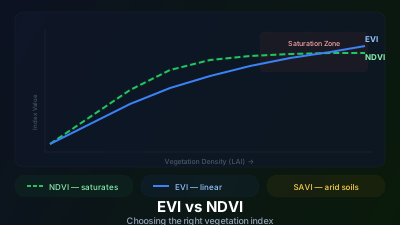
Quick Answer: NDVI saturates at high biomass (values above ~0.8 all look the same) and is influenced by soil brightness in sparse vegetation. EVI adds a blue band correction and canopy background adjustment to stay sensitive in dense forests. SAVI includes a soil brightness correction factor. Use NDVI for general vegetation mapping, EVI for dense tropical vegetation, and SAVI for arid regions with sparse cover.
Why One Vegetation Index Isn't Enough
NDVI is the workhorse of remote sensing vegetation analysis — simple, well-understood, and widely used. But like any tool, it has limitations that become apparent in specific conditions.
The two most common problems:
- Saturation over dense canopy — When vegetation is very dense (LAI > 3-4), NDVI approaches its maximum (~0.9) and stops distinguishing between "dense" and "very dense" vegetation.
- Soil background influence — In sparse vegetation (think semi-arid rangelands), the brightness of exposed soil significantly affects NDVI values, making it hard to separate vegetation signal from soil signal.
EVI and SAVI were specifically designed to address these problems.
The Formulas
NDVI (Normalized Difference Vegetation Index)
NDVI = (NIR - Red) / (NIR + Red)
Uses Sentinel-2 bands B8 (NIR) and B4 (Red). Range: -1 to +1.
EVI (Enhanced Vegetation Index)
EVI = 2.5 × (NIR - Red) / (NIR + 6×Red - 7.5×Blue + 1)
Uses Sentinel-2 bands B8 (NIR), B4 (Red), and B2 (Blue). Range: approximately -1 to +1.
SAVI (Soil-Adjusted Vegetation Index)
SAVI = 1.5 × (NIR - Red) / (NIR + Red + 0.5)
Uses Sentinel-2 bands B8 (NIR) and B4 (Red). The 0.5 is the soil brightness correction factor (L). Range: -1 to +1.
How They Compare
| Feature | NDVI | EVI | SAVI |
|---|---|---|---|
| Bands required | 2 (NIR, Red) | 3 (NIR, Red, Blue) | 2 (NIR, Red) |
| Saturation at high biomass | Yes | No | Moderate |
| Soil background sensitivity | High | Low | Low |
| Atmospheric sensitivity | Moderate | Low (blue band correction) | Moderate |
| Best for dense vegetation | Limited | Excellent | Good |
| Best for sparse vegetation | Limited | Good | Excellent |
| Simplicity | Highest | Moderate | High |
When to Use Each Index
Use NDVI When...
- General vegetation mapping — Quick assessment of where vegetation exists versus bare ground
- Time-series monitoring — Long-term trends where relative changes matter more than absolute values
- Simple thresholding — Classifying land as vegetated (>0.3) vs non-vegetated (<0.2)
- Mid-latitude agriculture — Moderate-density crops where saturation isn't an issue
NDVI remains the best starting point for most vegetation work. It's well-documented, easy to interpret, and sufficient for the majority of applications.
Use EVI When...
- Tropical forests — Dense canopy with LAI > 4 where NDVI saturates. EVI continues to differentiate between moderately dense and very dense vegetation.
- Phenology studies — Tracking the timing of green-up and senescence in forests. EVI's sensitivity to canopy structure makes it better at detecting subtle seasonal changes.
- Biomass estimation — EVI correlates better with above-ground biomass in high-productivity ecosystems.
- Atmospheric contamination concerns — The blue band correction in EVI reduces the influence of aerosols and thin clouds.
Use SAVI When...
- Arid and semi-arid regions — Where vegetation cover is sparse (<30%) and soil is visible between plants
- Rangeland monitoring — Assessing grass cover in dry landscapes
- Early-stage crop monitoring — When crops are young and much soil is still exposed
- Desertification assessment — Tracking vegetation change at the margins of drylands
Practical Example: Amazon vs Sahel
Consider two contrasting environments:
Amazon rainforest: NDVI values will be 0.85-0.95 almost everywhere — you can't distinguish between slightly degraded forest and pristine canopy. EVI will show meaningful variation (0.4-0.6), revealing canopy density differences invisible to NDVI.
Sahel grasslands: NDVI might read 0.25 over sparse grass on dark soil and 0.25 over slightly denser grass on bright sand — the soil signal contaminates the vegetation signal. SAVI removes this soil effect, giving you cleaner vegetation estimates.
When the Difference Is Actually Large
Knowing where the two indices diverge helps you decide whether the added complexity of EVI is worth it for your application. The pattern follows directly from the saturation behaviour described above:
- Sparse cover and bare soil (low NDVI): the two indices track each other closely. There is no saturation to escape and nothing to gain from the extra bands — the choice barely matters.
- Moderate cover, typical mid-latitude cropland: NDVI and EVI move together through most of the growing season, diverging mainly at peak canopy closure. For most agricultural monitoring, NDVI's simpler interpretation is worth more than EVI's marginal extra sensitivity.
- Dense canopy (high NDVI): this is where the indices genuinely part company. NDVI compresses everything above roughly 0.8 into a narrow band, so a real reduction in canopy density produces a change barely distinguishable from noise. EVI, which does not saturate in the same way, keeps producing measurable variation over the same range — which is the entire reason to reach for it.
That last case is the one that matters operationally. In closed tropical forest, NDVI can be almost flat across a wide range of actual canopy conditions; a difference that NDVI renders as near-zero can still be clearly visible in EVI. Anywhere your analysis depends on distinguishing dense from very dense, NDVI is the wrong instrument.
The practical decision rule: if your scenes show NDVI consistently above 0.75, switch to EVI. Below that threshold, NDVI has adequate sensitivity and its simpler interpretation is an advantage.
Common Pitfalls
Don't over-interpret small EVI differences
EVI is more sensitive than NDVI in dense vegetation, but this also means it's more sensitive to view angle effects and sun angle variations. Compare images from similar acquisition geometries.
SAVI's L factor matters
The standard L=0.5 works for most situations, but optimal L depends on vegetation density. For very sparse cover, L=1.0 may be better; for dense cover, L approaches 0 (making SAVI converge to NDVI).
Cloud shadows affect EVI more
Because EVI uses the blue band, which is most affected by atmospheric scattering, cloud shadows and haze can create artifacts. Always check your scene for cloud contamination.
Complement with SAR for all-weather monitoring
When cloud cover prevents optical observations, SAR-based vegetation indices (RVI, RFDI) from Sentinel-1 provide an alternative measure of vegetation structure. Combining optical and SAR approaches gives the most robust monitoring.
Try All Three in Off-Nadir Delta
Off-Nadir Delta supports NDVI, EVI, and SAVI as built-in visualization options for Sentinel-2 imagery:
- Load a Sentinel-2 scene over your area of interest
- Switch between NDVI, EVI, and SAVI in the visualization selector
- Compare the results — especially in areas with very dense or very sparse vegetation
- Use the layer manager to toggle between indices for the same scene
This side-by-side comparison is the fastest way to build intuition for when each index adds value over standard NDVI.
Explore NDVI and EVI for any region with the NDVI Online Viewer, or set up automated multi-index time series monitoring for any area using the Monitoring Dashboard.

Remote sensing specialist with 10+ years in satellite data processing and AI. Founder of Off-Nadir Lab. Ph.D. in Informatics (Yokohama National University, 2026). Master's in Earth System Science and Technology (Kyushu University). Co-author, Remote Sensing Encyclopedia. More about the author →