Satellite Imagery for Agriculture: What Actually Works at Field Scale
Quick Answer: Sentinel-2's 10m resolution and 5-day revisit makes it the workhorse for field-scale agriculture monitoring. NDVI tracks crop vigor through the growing season, but red-edge indices (like NDRE) detect stress earlier. The key challenge isn't resolution — it's cloud cover during critical growth stages, which is where SAR data fills the gap.
The Promise vs. The Reality
The pitch for satellite-based agriculture monitoring is compelling: watch every field on Earth every few days, detect crop stress before it's visible to the eye, optimize irrigation and fertilizer application, predict yields months before harvest.
Much of this is real. But the gap between a conference demo and a working field monitoring system is wider than the marketing suggests. Across different climates and crop types, the practical details matter more than the satellite specifications.
Which Satellite Data to Use
Sentinel-2: The Agricultural Workhorse
For most field-scale monitoring, Sentinel-2 is the clear starting point:
- 10m resolution — a 1-hectare field contains ~100 pixels, enough for within-field variability mapping
- 5-day revisit — roughly matches the timescale of visible crop growth changes
- 13 spectral bands — including red edge bands (B5, B6, B7) that are specifically sensitive to vegetation biochemistry
- Free and open — no per-scene costs, unlimited historical access back to 2015
The red edge bands deserve special attention. They sit in the narrow spectral region (700-780 nm) where chlorophyll absorption transitions to near-infrared reflectance. This transition point shifts with chlorophyll content, making red edge bands sensitive to stress that standard NDVI (red + NIR) hasn't detected yet.
Sentinel-1 SAR: The Cloud Buster
Optical monitoring has a fundamental weakness: clouds. In tropical and monsoon climates, cloud cover during the growing season can exceed 80%. You might get one clear Sentinel-2 observation per month when you need weekly updates.
Sentinel-1 SAR sees through clouds. While SAR can't measure chlorophyll content directly, it responds to:
- Crop structure: Plant height and density affect radar backscatter
- Soil moisture: Bare soil moisture is detectable before and after growing season
- Flooding: Rice paddy inundation is clearly visible in SAR
Combining SAR and optical time series provides monitoring continuity that neither achieves alone.
Vegetation Indices That Matter
NDVI — The Standard
NDVI (Normalized Difference Vegetation Index) remains the most widely used index:
NDVI = (NIR - Red) / (NIR + Red)
It works because healthy vegetation absorbs red light (for photosynthesis) and strongly reflects near-infrared. The ratio normalizes for illumination differences, making it comparable across dates and locations.
Strengths: Simple, well-understood, decades of validation literature, available from any sensor with red and NIR bands.
Weaknesses: Saturates over dense vegetation (NDVI values plateau above ~0.85 even as leaf area continues to increase), sensitive to soil background in sparse canopies, doesn't detect early stress until chlorophyll loss is significant.
NDRE — Earlier Stress Detection
NDRE (Normalized Difference Red Edge) uses the red edge band instead of red:
NDRE = (NIR - Red Edge) / (NIR + Red Edge)
Red edge reflectance changes before red reflectance does when a plant is stressed, and NDRE keeps responding after NDVI has saturated in a closed canopy. The practical consequence is that NDRE tends to flag nitrogen deficiency, water stress, or disease earlier than NDVI. How much earlier depends on the crop, the stress type, and how severe it becomes — it is a lead, not a fixed number of days, and it is only useful if you are observing frequently enough to catch it.
Requires: Red edge bands (Sentinel-2 has them; many older or commercial sensors don't).
Other Useful Indices
| Index | Formula | Use Case |
|---|---|---|
| EVI | Enhanced Vegetation Index | Dense canopy (less saturation than NDVI) |
| MSAVI | Modified Soil-Adjusted VI | Sparse canopy / early season (reduces soil influence) |
| NDMI | (NIR - SWIR) / (NIR + SWIR) | Crop water content / drought stress |
Building a Practical Monitoring Workflow
Step 1: Establish the Growing Calendar
Before touching any satellite data, understand the crop calendar for your area:
- Planting dates
- Key growth stages (emergence, tillering, flowering, grain fill, maturity)
- Harvest period
The satellite monitoring should be densest during critical stages (flowering through grain fill) when stress has the largest yield impact.
Step 2: Build a Clean Time Series
Download or stream Sentinel-2 data for your fields across the growing season. The critical processing steps:
- Use Level-2A (surface reflectance) — atmospheric correction is already applied
- Apply cloud masking — the Scene Classification Layer (SCL) flags clouds, shadows, and snow
- Filter aggressively — a single unmasked cloud pixel corrupts the field average
This is where most projects hit their first major obstacle. Automated cloud masks miss thin cirrus, cloud edges, and shadow. Manual quality checks on at least a sample of dates are essential.
Step 3: Interpret Within Context
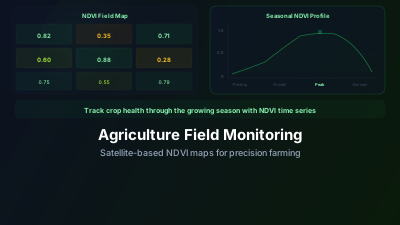
A single NDVI map is nearly useless without context. What makes agricultural remote sensing powerful is the time series — watching how index values change through the season.
A healthy crop follows a predictable NDVI trajectory: low at planting, rising through vegetative growth, peaking near flowering, declining through senescence. Deviations from this expected curve indicate problems:
- Low peak relative to previous years: possible nutrient deficiency or water stress
- Early decline: disease, premature drought stress, or heat damage
- Uneven values within a field: spatial variability in soil, drainage, or management
Step 4: Ground-Truth Relentlessly
Satellite indices correlate with crop conditions — they don't directly measure yield, nitrogen content, or disease presence. The correlation strength varies by:
- Crop type (broadleaf crops respond differently than grains)
- Growth stage (early season bare soil confounds all indices)
- Climate zone (dry regions vs. humid tropics have different index behavior)
You need ground measurements — yield monitors, soil samples, scout reports — to calibrate and validate what the satellite data shows.
What Doesn't Work (Yet)
Individual Plant Monitoring
Even at 10m resolution, each pixel averages hundreds of plants. You're monitoring fields, not plants. Drone imagery (sub-10cm resolution) fills this gap for high-value crops, but satellite-based individual plant monitoring is not viable.
Reliable Yield Prediction
Despite decades of research, satellite-only yield prediction remains unreliable for operational decision-making. Weather, soil characteristics, and management practices contribute too much variation that spectral indices alone can't capture. Satellite data improves prediction models, but it doesn't replace agronomic expertise.
Pest and Disease Identification
Satellite indices can detect that a crop is stressed — they generally cannot tell you why. Different stresses (drought, nitrogen deficiency, fungal disease) can produce similar spectral signatures. Diagnosis still requires field scouting.
The Realistic Value Proposition
Where satellite monitoring genuinely delivers value in agriculture:
- Spatial variability mapping — identifying which parts of a field consistently underperform
- Anomaly alerting — flagging fields or regions where current vegetation deviates from historical norms
- Irrigation scheduling — NDMI-based moisture monitoring for large-area irrigation management
- Insurance and compliance — verifying crop presence, planting dates, and growing conditions at scale
- Regional yield estimation — aggregated over districts or countries (where individual field errors average out)
These are meaningful, economically valuable applications. They're just different from the "precision agriculture solves everything" narrative.
Explore Sentinel-2 optical data for your agricultural area of interest. Search for scenes across different months and load them individually to compare how the landscape transforms through the growing season — the seasonal rhythm of agriculture is visible from space, and understanding that rhythm is the foundation of satellite-based crop monitoring.

Remote sensing specialist with 10+ years in satellite data processing and AI. Founder of Off-Nadir Lab. Ph.D. in Informatics (Yokohama National University, 2026). Master's in Earth System Science and Technology (Kyushu University). Co-author, Remote Sensing Encyclopedia. More about the author →