
How Accurate Is Satellite Data? A Practical Guide to Validation and Uncertainty
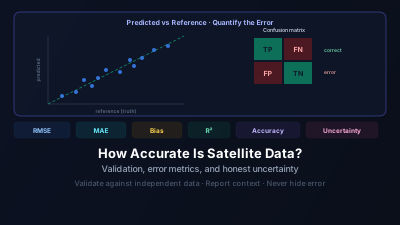
Quick Answer: Satellite-derived values are estimates with error, and trustworthy analysis means quantifying that error. For continuous variables (temperature, biomass, NDVI), the core metrics are RMSE (typical error magnitude), MAE (average error), bias (systematic over/under-estimation), and R² (explained variation). For classification (land cover, water vs land), use overall accuracy, a confusion matrix, and per-class producer's and user's accuracy. Validation requires comparing predictions against independent reference data — never the data used to build the model. Always account for cloud and quality flags, report uncertainty rather than hiding it, and remember that a single clear number ('92% accurate') is meaningless without knowing what was measured, where, and against what reference.
Satellite Data Is an Estimate, Not Ground Truth
A common mistake among newcomers is treating a satellite product as fact: "the NDVI is 0.62," "this pixel is water," "the temperature is 31°C." In reality, every satellite-derived value is an estimate produced from physics, calibration, and algorithms — and every estimate carries error.
That doesn't make satellite data unreliable. It makes validation essential. The difference between a credible analysis and a misleading one is whether you can answer: how accurate is this, and how do I know? This guide covers the metrics and practices that answer that question.
Two Kinds of Problems, Two Sets of Metrics
How you measure accuracy depends on what you're estimating.
Continuous variables (regression)
When you predict a number — land surface temperature, biomass, chlorophyll, NDVI — you compare predicted values against reference measurements using:
| Metric | What it tells you | Good when |
|---|---|---|
| RMSE (Root Mean Square Error) | Typical error magnitude, in the variable's units; penalizes large errors heavily | Lower is better; sensitive to outliers |
| MAE (Mean Absolute Error) | Average absolute error, more robust to outliers | Lower is better |
| Bias (Mean Error) | Systematic over- or under-estimation | Near zero is better |
| R² | Fraction of variation the model explains (0-1) | Closer to 1 is better |
A worked intuition: if your satellite biomass estimate has RMSE = 25 t/ha and bias = +5 t/ha, the typical error is about 25 tonnes per hectare and you're systematically over-estimating by 5. Both numbers matter — a low RMSE with high bias still means your map is consistently wrong in one direction.
Categorical variables (classification)
When you predict a class — water vs land, crop type, burned vs unburned — accuracy is summarized by a confusion matrix, which cross-tabulates predicted classes against reference classes. From it you derive:
- Overall accuracy — share of all pixels classified correctly. Easy to quote, but can hide poor performance on rare classes.
- Producer's accuracy — of the real instances of a class, how many you caught (sensitivity / omission error).
- User's accuracy — of the pixels you labeled as a class, how many were right (reliability / commission error).
- Kappa / F1 — single-number summaries that balance the above (use with care).
For an imbalanced problem — say, mapping flooded pixels that cover 3% of a scene — a model that labels everything dry scores 97% overall accuracy while being completely useless. That's why per-class accuracy and the confusion matrix matter more than a headline number.
The Golden Rule: Validate Against Independent Data
The single most important principle in validation: never evaluate a model on the same data you used to build it. Doing so measures memorization, not real-world accuracy.
Sound reference data comes from sources independent of your prediction:
- Field measurements (GPS points, plot surveys)
- Higher-resolution imagery interpreted by an analyst
- Established reference datasets and existing validated maps
- A held-out test split, kept entirely separate from training
Reference data should be representative of the whole study area and time window — not just the easy, cloud-free, flat parts.
Sources of Error You Must Account For
Even a well-validated product degrades if you ignore the conditions behind each pixel:
- Clouds and shadows. Optical pixels under cloud are garbage. Always apply cloud masking and respect quality flags before computing anything.
- Atmospheric effects. Haze and scattering shift reflectance; atmospheric correction reduces this but never perfectly.
- Geolocation error. If pixels are misregistered, your reference points compare against the wrong ground location. See geometric correction.
- Mixed pixels. A 30m pixel containing both forest and field is neither — coarse resolution blurs boundaries.
- Temporal mismatch. Comparing a satellite pass to a field measurement taken weeks later introduces real change as apparent error.
Communicating Uncertainty Honestly
The mark of a trustworthy analysis is that it states its limits. In practice:
- Report a metric with its context. State the error, the reference data it was measured against, the area, and the period — "RMSE of 0.8 °C against independent weather-station records across the region over four years" — not "highly accurate."
- Show confidence, not just a value. A monitoring anomaly alert should convey how far outside normal a reading is, not just flag it.
- Disclose what you couldn't measure. Persistent cloud, gaps in the time series, or untested conditions are part of the result.
- Prefer ranges over false precision. "Between 180 and 230 t/ha" is more honest than "204.7 t/ha" when your RMSE is 25.
This is exactly the discipline behind combining sensors: when one source is uncertain, multi-index monitoring and SAR-optical fusion provide independent evidence that raises confidence in the conclusion.
Key Takeaways
- Satellite values are estimates with error — credible analysis quantifies that error.
- For numbers, report RMSE, MAE, bias, and R²; for classes, use a confusion matrix with per-class accuracy.
- A single headline accuracy number is meaningless without context and can hide failure on rare classes.
- Validate against independent reference data, never the data used to build the model.
- Account for clouds, atmosphere, geolocation, mixed pixels, and timing, and communicate uncertainty honestly.
This guide describes standard remote sensing validation practice and is intended as educational reference material.

Remote sensing specialist with 10+ years in satellite data processing and AI. Founder of Off-Nadir Lab. Ph.D. in Informatics (Yokohama National University, 2026). Master's in Earth System Science and Technology (Kyushu University). Co-author, Remote Sensing Encyclopedia. More about the author →