Watching Mines, Tailings Dams, and Industrial Sites from Space: Environmental and Operational Risk
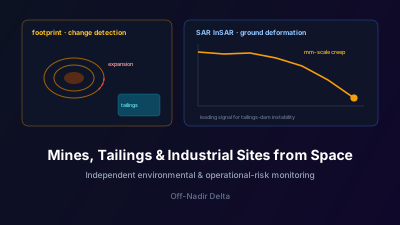
Quick Answer: Industrial sites — mines, tailings dams, refineries, oil terminals — carry environmental and operational risk that is often visible from space before it is disclosed. Open satellite imagery tracks the things that matter at these sites: footprint expansion, tailings and waste extent, vegetation stress and water quality nearby, and activity levels. Optical imagery measures change and vegetation indices; Sentinel-1 SAR watches through cloud and, via interferometry, is used to measure ground deformation at millimetre scale — the leading signal for tailings-dam instability. For an ESG, insurance, lending, or watchdog team, the value is an independent, repeatable record over sites you cannot inspect on the ground, updated on the satellites' schedule rather than the operator's.
The industrial sites with the largest environmental footprints are usually the hardest to visit: a remote open-pit mine, a tailings impoundment behind a fence, a refinery in another jurisdiction. Ground inspection is infrequent and depends on access. Satellites have neither problem — they revisit the same coordinates every few days, regardless of who owns the fence.
This post is about using that vantage responsibly and concretely: what open imagery actually resolves at an industrial site, which sensors and techniques carry the signal, and how to turn occasional images into a standing watch.
Why monitor industrial sites from space?
Because it gives you an independent, repeatable record of a site you cannot otherwise observe. Open Earth-observation data revisits everywhere on a fixed cadence, so you get an unbroken time series over a mine or plant without permission, travel, or reliance on operator disclosure. That independence is the whole point for oversight: the imagery does not depend on the site being self-reported accurately, and — being openly licensed — the record is one you can publish with attribution. It extends the same monitoring logic used across satellite area monitoring to the specific case of high-consequence facilities.
The trade is resolution and interpretation. At ~10 m, open imagery reads footprints, extents, and change, not fine equipment detail, and every signal is an indicator to confirm rather than a finished conclusion. Used within those limits, it is a powerful early-warning and accountability tool.
What can you actually see at a mine or industrial site?
You can see how the site's footprint and surroundings change over time. The recurring measurements are:
- Footprint expansion. Pit or quarry growth, new access roads, spreading waste-rock dumps — straightforward to track as an area that changes between dates.
- Tailings and waste extent. The area and, over time, the growth of tailings storage facilities and settling ponds.
- Vegetation stress and land disturbance. Clearing and stress in the surrounding vegetation, read through indices like NDVI — see understanding NDVI — which often marks the impact footprint beyond the site fence.
- Water and turbidity. Changes in nearby water bodies and discharge, visible as spectral shifts in optical bands.
- Activity level. Whether a site is ramping or idle, inferred from vehicle presence, thermal signatures, or — for around-the-clock operations — night-time lights.
Each is a count, an area, or an index you can measure directly and, crucially, difference between two dates to isolate what actually changed.
Which sensors and techniques carry the signal?
Optical for what things look like, radar for reliability and for motion. Sentinel-2 optical at 10 m with a five-day revisit (ESA Sentinel-2) supplies true-colour context and the spectral indices for vegetation and water. Sentinel-1 SAR provides "all-weather, day-and-night" coverage (ESA Sentinel-1), so a monitor does not go blind under the cloud that often sits over mining regions — the reason SAR sees through clouds is more than a convenience here.
Radar adds a technique optical cannot match: interferometry (InSAR) compares the phase of repeated SAR passes to measure ground movement at millimetre-to-centimetre scale, which is why Sentinel-1 data underpins operational ground-motion services. That capability makes the highest-consequence signal — slow deformation of a tailings dam — measurable from orbit.
Why are tailings dams the case that matters most?
Because they fail rarely but catastrophically, and the warning sign is exactly what satellites measure. A tailings storage facility that is beginning to move often creeps — millimetres per week — long before any visible failure. InSAR ground-motion measurement from Sentinel-1 can surface that creep as a deformation trend, and change detection tracks the impoundment's extent and any seepage or vegetation change downstream. None of this replaces engineering instrumentation on a well-run dam, but for third parties — insurers, lenders, regulators, downstream communities — it is often the only independent view available, and a rising deformation trend is precisely the kind of departure a time-series anomaly watch is built to flag.
How do you turn this into ongoing risk monitoring?
You define the site, pick the signals, and compare each pass to the site's own baseline. Draw the pit, the tailings facility, and a buffer of surrounding land; track footprint area, an NDVI series for the buffer, and change between scenes; then flag when any of them steps outside the established band. This is the same baseline-and-anomaly method used across area monitoring: the system learns each site's normal rhythm of expansion and seasonality, and alerts on the departure — a sudden extent jump, an off-season vegetation loss, a deformation trend — rather than on a fixed rule.
Pairing the flag with its cause turns monitoring into intelligence. A change at a facility read alongside the events around it — a permit, an incident report, a commodity move — is the geopolitical and event intelligence pattern applied to fixed infrastructure: the imagery shows what changed, the event context suggests why.
Who uses this, and for what decision?
Anyone accountable for a site they do not operate. ESG and sustainability teams verify environmental claims and track disturbance independently. Insurers and reinsurers assess exposure and monitor accumulating risk at insured facilities, extending the imagery-in-insurance approach from post-event claims to standing risk. Lenders and investors check that a financed project matches its reported footprint. Regulators, journalists, and affected communities document impact with a record that does not depend on the operator — the accountability use that sits alongside broader geospatial OSINT.
How Off-Nadir Delta does it without code
Draw the site and the buffer, choose your signals, and keep the watch running. Off-Nadir Delta builds the time series and anomaly flags for the areas you draw and runs change detection between dates, stacking Sentinel-1 SAR and Sentinel-2 optical in the browser — no GIS install, no scripting, on openly licensed data you can cite. When a flag fires, open the scenes to confirm what moved, or ask the Delta Agent what the change implies and which sensor confirms it.
Try it
Choose a site with real consequences — a mine near a watershed, a tailings facility above a town, an industrial plant under scrutiny — draw it with a buffer, and let a baseline form. The point of watching from space is not surveillance of a company; it is an independent, publishable record of change at places that are otherwise closed to view.
Off-Nadir Delta uses open, openly licensed satellite data for environmental and situational awareness. Satellite indicators — including deformation and change signals — must be confirmed against imagery and, for safety-critical structures, against engineering data before any conclusion is drawn; they are not a substitute for on-site instrumentation. Off-Nadir Delta is an independent project and is not affiliated with any organization or institution.

Remote sensing specialist with 10+ years in satellite data processing and AI. Founder of Off-Nadir Lab. Ph.D. in Informatics (Yokohama National University, 2026). Master's in Earth System Science and Technology (Kyushu University). Co-author, Remote Sensing Encyclopedia. More about the author →