
Can AI Read a Satellite Image? The Reasoning Layer Above Pixel Models
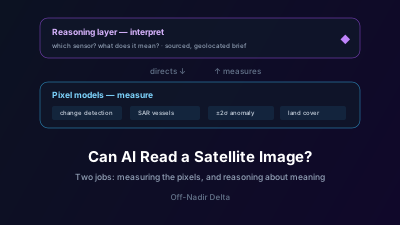
Quick Answer: 'AI for satellite imagery' means two different things. Pixel-level models measure — they classify land cover, detect vessels, or flag change between two dates, producing numbers. A reasoning layer interprets — it takes a question, decides which imagery and sensor to use, reads the result in context, and explains what it implies, with sources. Neither replaces the other: the pixel models are precise but blind to meaning, and the reasoning layer is only as trustworthy as the evidence it cites and the resolution it works from. The useful question is not 'can AI read an image' but 'which of these two jobs do I need, and does the answer show its work?'
Ask "can AI read a satellite image" and you will get confident answers in both directions, because the question hides two very different tasks. One is measuring the pixels — the mature, quantitative side of machine learning on imagery. The other is reasoning about what the measurement means — a newer layer that behaves more like an analyst than a classifier.
This post separates the two, says where each is reliable and where it is not, and explains why the honest version of "yes, AI can read imagery" always comes with a statement of its sources and its limits.
What are the two kinds of "AI for satellite imagery"?
They are measurement and interpretation, and they answer different questions. A pixel-level model answers "what is in this image, or what changed?" — it outputs a class, a count, a mask, a difference. A reasoning layer answers "what should I look at, and what does it mean?" — it plans the collection, reads the evidence, and explains the implication. The first is a function from pixels to numbers; the second is a workflow from a question to a sourced judgment. Most of the confusion around AI satellite imagery analysis comes from collapsing the two into one word.
The division matters because their failure modes are opposite. A pixel model fails silently — it returns a confident number even when the input is out of distribution. A reasoning layer fails loudly if it is built right — it should tell you when the evidence is thin. You want both, doing the job each is good at.
What can the pixel-level models actually do?
They quantify well-posed questions, and they are the reliable workhorses. Supervised deep learning classifies land cover and detects objects; classical machine learning like Random Forest reaches strong accuracy on tabular spectral features; change detection differences two co-registered scenes to isolate what moved; SAR vessel detection finds the bright returns of ships against dark water, as used in ship monitoring. Each produces a measurement you can check.
Their limit is that they have no concept of meaning or context. A change-detection map shows that pixels differed between March and June; it does not know whether that was harvest, flooding, or construction, and it will report the seasonal difference just as confidently as the meaningful one. That is not a flaw to fix — it is the boundary of what a measurement is. Interpretation is a separate job.
What does the reasoning layer add?
It supplies the context a measurement lacks: which question to ask, which sensor answers it, and what the result implies. Given a plain-language question, a reasoning analyst localises the area against live events, chooses whether radar or optical suits the scene, reads the imagery, and returns an explanation with its sources — the workflow the Delta Agent runs, described in detail in how the agent explains its sensor choices. Where a pixel model hands you a number, the reasoning layer hands you a short brief: what to look for, why this sensor, and how far to trust one pass.
Crucially, the two compose. The reasoning layer can call the pixel models — run change detection over the area it localised, count vessels in the SAR scene it chose — and then explain the numbers those models return. Measurement feeds interpretation; interpretation directs measurement. That loop is the substance behind geospatial intelligence: not a single clever model, but a question turned into evidence and back into a judgment.
Is the reasoning layer trustworthy?
Only to the degree it shows its work, which is why sourcing and resolution are the whole game. A reasoning layer that asserts conclusions without citing the events and imagery behind them is worse than a raw viewer, because it launders a guess into a sentence. A useful one does the opposite: it names the sources, states which sensor and date it used, and caps its confidence when a judgment rests on a single pass or an ambiguous signature — the estimative discipline covered in the tradecraft post.
Resolution sets a hard ceiling that no amount of reasoning removes. Open Sentinel-class imagery resolves to about 10 m, which is ample for flooding, burn scars, large construction, and vessels, but cannot identify a specific vehicle or person — see the four types of resolution for why. An honest reasoning layer describes only what the available regime can resolve and states the gap; the failure mode to fear is a fluent answer that over-reads detection-grade pixels into identification.
So — can AI read a satellite image?
Yes, in two senses, and it helps to be precise about which. It can measure an image with high reliability on well-posed questions, and it can reason about imagery — plan, read, and explain — with reliability that depends entirely on whether it cites evidence and respects resolution. What it cannot do is turn 10 m pixels into identification, replace your judgment, or know what a change means without context. "Reading," for imagery, is not one skill but a stack: pixels to numbers, numbers to meaning, meaning to a decision you still own.
How Off-Nadir Delta puts the stack together
It runs both layers in one browser workflow, with the reasoning on top. On the map, the pixel models do the measuring — change detection between dates, SAR vessel detection, and per-area time-series anomaly monitoring. Above them, the Delta Agent reasons: it takes your question, points to the area and sensor, reads what the imagery shows, and explains it with sources — then hands the finding back to the map so you can verify it yourself. Neither layer is asked to do the other's job. For the wider workflow this sits inside, see what is geospatial OSINT.
Try it
Bring a question about a place, not a request for a picture. Ask the agent what is happening and which sensor confirms it, let it run the measurement, and read the explanation against the imagery it used. The measure of a good answer is not fluency — it is whether you can trace every claim back to a source and a sensor.
The Delta Agent reasons over openly licensed data for situational awareness only, and shows its sources so its judgments can be verified — not for identifying or targeting individuals. Off-Nadir Delta is an independent project and is not affiliated with any organization or institution.

Remote sensing specialist with 10+ years in satellite data processing and AI. Founder of Off-Nadir Lab. Ph.D. in Informatics (Yokohama National University, 2026). Master's in Earth System Science and Technology (Kyushu University). Co-author, Remote Sensing Encyclopedia. More about the author →