
Tracking Urban Sprawl with Satellite Time Series: How Cities Grow from Space
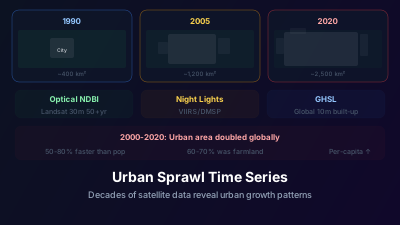
Quick Answer: Landsat's 50+ year archive provides the most comprehensive record of urban growth worldwide. Urban areas are mapped through spectral indices (NDBI, NDVI inversion), classification algorithms, and nighttime light data (VIIRS/DMSP). Mapping global urban change annually from Landsat, Liu et al. (Nature Sustainability, 2020) found that global urban extent expanded by 9,687 km² per year between 1985 and 2015 — roughly four times earlier estimates — consuming agricultural land and natural habitats. Key metrics include urban expansion rate, density gradient (compact vs. sprawling), and land consumption per capita. The Global Human Settlement Layer (GHSL) maps urban extent at 10m resolution from Sentinel-2 and Landsat for multiple epochs. Satellite monitoring reveals that many cities are expanding horizontally faster than their populations grow — the definition of sprawl.
Beijing in the mid-1980s was a comparatively compact city. Over the following decades it spread across the surrounding plain in successive rings, absorbing farmland and villages as it went. That transformation is captured pixel by pixel in the Landsat archive, which provides an undeniable visual record of one of the fastest urbanizations in human history — no ground survey required, and no reliance on any single government's statistics.
Every city has a version of this story. Some grow compactly, densifying within existing boundaries. Others sprawl outward, consuming agricultural land and fragmenting ecosystems. Satellite time series distinguish between these growth patterns — information that's essential for sustainable urban planning.
How Satellites Map Urban Areas
Spectral Approaches
Urban surfaces have distinctive spectral properties:
- High reflectance in SWIR: Concrete, asphalt, and roofing materials are relatively bright in SWIR
- Low NDVI: Impervious surfaces have very low vegetation index values
- Mixed spectral signature: Urban pixels often contain mixtures of roof, road, vegetation, and shadow
Normalized Difference Built-up Index (NDBI): NDBI = (SWIR − NIR) / (SWIR + NIR)
High NDBI values indicate built-up surfaces. Combined with low NDVI, this provides a simple urban mask.
Impervious Surface Fraction: Sub-pixel analysis estimates the percentage of each pixel covered by impervious material. At 30m Landsat resolution, an urban pixel might be 60% impervious (road and rooftop) and 40% pervious (garden and tree canopy). Estimating this fraction provides a more nuanced urban map than binary classification.
Machine Learning Classification
Modern urban mapping uses Random Forest, support vector machines, or deep learning trained on labeled examples of urban and non-urban land cover. Multi-temporal features (seasonal NDVI variation distinguishes evergreen urban vegetation from seasonal cropland) improve classification accuracy.
Nighttime Lights
VIIRS Day/Night Band (DNB) detects artificial light at night, providing a direct proxy for human settlement:
- Bright areas = urban/suburban
- Dimmer areas = rural with some infrastructure
- Dark areas = uninhabited or unelectrified
DMSP-OLS (1992-2013) and VIIRS (2012-present) together provide a 30+ year nighttime light time series for tracking urbanization. The advantage over optical land cover mapping: nighttime lights capture urban function (human activity) rather than just land cover (impervious surface).
Global Datasets
Global Human Settlement Layer (GHSL)
Produced by the European Commission Joint Research Centre:
- GHS-BUILT-S: Built-up surface mapped at 10m resolution from Sentinel-2 (2018) and Landsat (1975, 1990, 2000, 2015)
- GHS-POP: Population distribution gridded at 100m resolution
- GHS-SMOD: Settlement model classifying areas as urban center, dense urban cluster, semi-dense, suburban, rural
- Free and open: Available for any location worldwide
GHSL enables consistent comparison of urbanization across countries, time periods, and definitions.
World Settlement Footprint (WSF)
Produced by DLR (German Aerospace Center):
- WSF 2015: Global settlement mask at 10m from Sentinel-1 SAR and Landsat optical
- WSF Evolution: Settlement extent for 1985-2015 from Landsat
- Uses SAR data for urban detection (advantage: buildings produce strong backscatter)
Global Urban Footprint (GUF)
Derived from TanDEM-X SAR data at 12m resolution. Urban buildings create distinctive radar signatures — strong double-bounce and volume scattering — that are distinguishable from natural surfaces.
Measuring Sprawl
Urban expansion alone isn't sprawl — sprawl is expansion that's disproportionate to population growth. Key metrics:
Land Consumption Rate (LCR)
LCR = Annual urban area increase / Total urban area
Cities with LCR exceeding population growth rate are sprawling — consuming land faster than they're adding people.
Urban Expansion Intensity Index (UEII)
Normalizes expansion by existing urban area and time period, enabling comparison across cities of different sizes and study periods.
Density Gradient
How does population density change from city center to periphery? Compact cities have steep gradients (dense core, sharp edge). Sprawling cities have shallow gradients (moderate density everywhere, no clear edge).
Satellite-derived built-up area combined with population data reveals whether new growth is compact infill or low-density peripheral expansion.
Fragmentation Metrics
Landscape ecology metrics applied to urban maps:
- Patch density: How fragmented is the urban area? Many small patches = leapfrog development
- Edge density: High edge-to-area ratio indicates irregular, dispersed growth
- Connectivity: Are urban patches connected or isolated?
What Satellite Data Reveals
Global Trends
The most consistent satellite-derived finding is that urban land is growing faster than urban population. Mapping global urban change annually from Landsat at 30 m, Liu et al. (Nature Sustainability, 2020) found that global urban extent expanded by 9,687 km² per year between 1985 and 2015 — about four times greater than previous estimates built up from individual cities — and concluded that "the urban land area already exceeds what is needed to sustain population growth."
The pattern that follows from this:
- Per capita urban land consumption has risen in both developed and developing countries
- Because cities were historically founded on fertile plains near water, agricultural land is the dominant source of new urban land in most regions
- The gap between land growth and population growth — not the absolute expansion rate — is what distinguishes sprawl from ordinary urban growth
Regional Patterns
China: Explosive urban expansion, consuming vast areas of productive farmland. Average density has decreased despite massive construction — new developments are often lower density than historic urban cores.
Sub-Saharan Africa: Rapid urbanization but largely informal, low-rise development. Urban areas expanding fast with limited infrastructure.
Europe: Relatively slow expansion. Many cities pursuing densification policies. Suburban sprawl still occurring around southern European cities.
North America: Continued low-density sprawl around Sun Belt cities. Some evidence of re-urbanization in older cities (infill development).
Reading an Expansion Rate Correctly
The single most useful derived quantity is the land consumption ratio — the urban expansion rate divided by the population growth rate over the same period. A ratio above 1.0 means the urban footprint is growing faster than the population, which is the working definition of sprawl. It is worth computing this yourself for the city you care about, from a satellite-derived built-up series and a population series covering the same years, rather than importing a published regional figure:
- Published expansion rates differ substantially depending on which built-up product is used (GHSL, WSF, GUF and Landsat classifications do not agree on where the urban boundary is), and on the epochs compared.
- Ratios computed over different periods are not comparable — an expansion rate averaged over 20 years hides the years when most of the construction actually happened.
- Regions with near-stagnant population can produce very high ratios from modest absolute expansion, which says more about the denominator than about construction activity.
The correct reading of a high ratio is directional: new development is lower density than the existing city. Establishing how much lower requires the underlying built-up and population data for that specific place.
Implications
Agricultural Land Loss
Urban expansion preferentially consumes the most productive agricultural land — because cities were historically founded on fertile plains near water. Satellite monitoring quantifies this loss, informing food security assessments and agricultural preservation policies.
Ecosystem Fragmentation
Sprawling urban growth fragments natural habitats, reduces wildlife corridors, and degrades ecosystem services. Satellite-derived urban expansion maps combined with biodiversity data identify where development threatens sensitive ecosystems.
Infrastructure Costs
Low-density sprawl costs more to serve with roads, water, sewer, and public transit than compact development. Satellite-derived density metrics help urban planners quantify the infrastructure cost implications of different growth patterns.
Carbon Emissions
Sprawling cities generate more per-capita transportation emissions (longer commutes, car dependency) than compact cities. Satellite urban form data feeds into transportation and emissions models.
Tracking urban growth from space isn't just an exercise in mapping — it's fundamental to understanding how humanity is reshaping the planet's surface, consuming natural resources, and creating the physical infrastructure that will define living conditions for billions of people over the coming decades.

Remote sensing specialist with 10+ years in satellite data processing and AI. Founder of Off-Nadir Lab. Ph.D. in Informatics (Yokohama National University, 2026). Master's in Earth System Science and Technology (Kyushu University). Co-author, Remote Sensing Encyclopedia. More about the author →