
Construction Monitoring from Satellite Imagery: Tracking Projects from Space
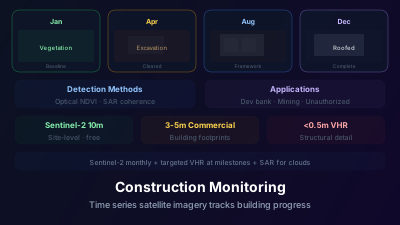
Quick Answer: Satellite imagery tracks construction progress through regular change detection — comparing current imagery against baseline and previous observations. VHR optical imagery (<1m) shows building foundations, structural framework, and completion stages. SAR coherence detects ground disturbance from excavation and new construction. Typical monitoring frequency is biweekly to monthly using Sentinel-2 (10m) for site-level progress, or commercial satellites (0.3-0.5m) for building-level detail. Applications include infrastructure project verification for development banks, mining compliance monitoring, and unauthorized construction detection.
Large infrastructure projects share a structural problem: money is released against milestones, but the people releasing it are rarely on site. Physical inspections are expensive, infrequent, and by their nature a snapshot — they tell you what a site looked like on the day an inspector stood in it, not what happened in the eleven months in between. A linear project such as a highway corridor makes this worse, because progress is distributed over hundreds of kilometres rather than concentrated at one address.
Satellite imagery fills exactly that gap. It cannot judge engineering quality, but it can show, repeatedly and without a site visit, whether earthworks advanced, whether structures went up, and whether the site was active at all. That is why construction monitoring from space has grown from a niche application to a standard tool for project oversight, compliance verification, and competitive intelligence.
What Satellites Can Observe
Site Preparation Phase
- Vegetation clearing: NDVI drops as trees and ground cover are removed. Clearly visible at Sentinel-2 resolution (10m).
- Earthmoving: Terrain modification (cut and fill) changes surface reflectance and texture. Large excavations visible in both optical and SAR data.
- Access road construction: New road alignments appear as linear features cutting through vegetation or terrain.
Foundation and Structural Phase
- Foundation excavation: Dark rectangular shapes (excavated pits) visible in VHR optical imagery (<1m resolution required)
- Structural framework: Steel or concrete frameworks cast shadows and have distinctive geometric patterns visible at sub-meter resolution
- Crane presence: Tower cranes indicate active construction; their presence/absence tracks activity status
Completion Phase
- Roof installation: Building footprints become visible from above when roofs are installed — a definitive marker of structural completion
- Surface finishing: Parking lots, landscaping, and road surfacing change spectral characteristics
- Utility installation: Solar panel arrays, cooling systems on rooftops
Linear Infrastructure
Roads, railways, pipelines, and transmission lines are well-suited to satellite monitoring:
- Progress measured as length completed per reporting period
- Surface condition (graded, paved, operational) distinguishable at 10m+ resolution for roads
- Pipeline trenching visible as linear ground disturbance
Methods
Multi-Temporal Optical Comparison
The most straightforward approach: compare current imagery against a baseline and previous observations:
- Establish baseline: Pre-construction image showing the site condition
- Regular acquisition: Monthly Sentinel-2 for site overview; quarterly VHR for detailed assessment
- Visual interpretation: Expert analysis of changes between dates
- Automated change detection: NDVI differencing, spectral change analysis for large-area monitoring
SAR-Based Monitoring
SAR adds construction monitoring capabilities independent of weather:
Coherence change: New construction (pouring concrete, erecting steel) changes the surface scattering properties, reducing coherence between SAR image pairs. This indicates active construction activity — even if the specific nature of the work isn't identifiable.
Backscatter change: New buildings increase radar backscatter (strong corner reflectors). Monitoring backscatter over time tracks the appearance of new built structures.
Height estimation: InSAR-derived height maps can detect building height as structures rise. This is an active research area with promising results from high-resolution SAR (TerraSAR-X, COSMO-SkyMed).
Time-Lapse Analysis
Assembling time series imagery into animations provides an intuitive visualization of construction progress. Monthly or quarterly composites spanning years of construction produce compelling visual evidence of project timeline and scope.
Applications
Development Finance Verification
International development banks (World Bank, Asian Development Bank) fund infrastructure projects with disbursements tied to construction milestones. Satellite monitoring verifies:
- Construction progress aligns with reported schedule
- Physical outputs match claimed completion percentages
- No unauthorized scope changes
This independent verification supplements on-site inspections and provides a continuous record between infrequent physical visits.
Mining Operations Monitoring
Mining sites undergo continuous modification:
- Open pit progression: Pit expansion, bench advancement, overburden removal
- Tailings dam management: Dam construction, pond extent, freeboard estimation
- Rehabilitation: Revegetation of exhausted areas
Environmental regulators and investors use satellite monitoring to verify that mining operations comply with approved plans and environmental conditions.
Unauthorized Construction Detection
Municipal governments use satellite change detection to identify unauthorized building activity:
- Construction in protected zones (flood plains, conservation areas, setback zones)
- Buildings exceeding permitted height or footprint
- Development without building permits
Comparing satellite imagery against approved development plans flags discrepancies for investigation.
Competitive Intelligence
Companies monitor competitor construction to estimate:
- Factory expansion timelines
- New facility capabilities (size, equipment visible on satellite imagery)
- Supply chain development (warehouse, logistics facility construction)
This application raises ethical considerations but is widely practiced in industries where physical facility capacity determines competitive position.
Accuracy and Limitations
Resolution requirements by application:
| Application | Minimum Resolution | Typical Source |
|---|---|---|
| Site-level progress | 10m | Sentinel-2 |
| Building footprint detection | 3-5m | Commercial (SkySat, etc.) |
| Structural detail assessment | 0.3-0.5m | WorldView, Pléiades |
| Equipment/vehicle detection | <0.5m | WorldView, aerial |
Temporal gaps: Cloud cover can prevent optical observation for weeks, particularly in tropical regions during wet season — often when construction progresses rapidly.
Interior work invisible: Satellite imagery shows external changes only. Interior fit-out, mechanical/electrical installation, and finishing work are not detectable. A building may appear "complete" from satellite months before it's actually ready for occupancy.
Interpretation ambiguity: Without ground knowledge, distinguishing between construction phases can be difficult. Is a cleared site being prepared for construction, or has construction stalled? Context and temporal patterns are needed to differentiate.
Cost vs. frequency trade-off: Sentinel-2 is free but limited to 10m resolution. VHR commercial imagery provides the detail but is charged per acquisition, with a premium for tasking a specific window. Operational monitoring programs must balance information needs against budget.
Construction Monitoring Reference: Resolution, Cost, and Application
Choosing the right monitoring configuration requires understanding the cost-capability tradeoff. Commercial imagery is priced by area, product level, tasking urgency and licence terms, and is usually quoted rather than listed, so treat the cost column below as a relative ranking and get a current quote for your own footprint:
| Use Case | Required Resolution | Recommended Source | Relative Imagery Cost | Monitoring Frequency |
|---|---|---|---|---|
| Road/highway progress (km tracked) | 10m | Sentinel-2 (free) | None | Weekly to biweekly |
| Dam / large structure footprint | 10m | Sentinel-2 (free) | None | Weekly to biweekly |
| Building foundation detection | 3–5m | SkySat, SPOT | Low | Monthly at milestones |
| Structural frame / crane presence | 0.5–1m | Pléiades, WorldView | Moderate | Quarterly at key stages |
| Equipment count / vehicle detection | 0.3–0.5m | WorldView-3, GeoEye | High (tasking premium) | Event-triggered |
| Port/terminal construction verification | 3m–10m | Sentinel-2 + SkySat combo | Low, on a free baseline | Monthly |
| All-weather baseline (cloud-prone) | 10–20m | Sentinel-1 SAR (free) | None | Every 6–12 days |
How the budget actually behaves: the free layer — Sentinel-2 optical plus Sentinel-1 SAR — costs nothing in data fees and carries the routine, high-frequency monitoring. What costs money is very high resolution, and it costs money per acquisition, so the budget is driven almost entirely by how many VHR scenes you task and how tightly you constrain their timing. Tasking a specific window at a specific site is the expensive option; buying from archive is much cheaper. The other real cost is analyst time to interpret and report, which recurs every period whether or not any VHR was bought. A sensible programme therefore spends its money on a small number of well-chosen VHR acquisitions at contractual milestones and lets free data carry everything in between.
The false progress problem: Satellite imagery cannot verify quality — only physical change. A contractor who pours substandard concrete or under-specifies road base will show identical satellite progress to one using correct specifications. Satellite monitoring verifies scope and timeline, not engineering quality. That distinction must be clear in any monitoring protocol.
Best Practices
Establish a clear baseline: Acquire pre-construction imagery that documents the site condition before any work begins. This baseline is the reference for all subsequent change detection.
Match acquisition timing to project schedule: Align satellite imaging frequency with construction milestone dates. Monthly imaging for active construction phases; quarterly for slower phases.
Combine resolutions: Use free Sentinel-2 for frequent site-overview monitoring; acquire targeted VHR imagery at key milestone dates for detailed assessment.
Include SAR for weather resilience: In cloud-prone areas, include Sentinel-1 SAR in the monitoring plan to ensure continuous temporal coverage.
Document interpretation consistently: Use standardized reporting formats and progress classification criteria to ensure comparability across monitoring periods and analysts.
Construction monitoring from satellite represents a practical, cost-effective complement to traditional site supervision. It doesn't replace physical inspections — an experienced engineer on site sees things a satellite never will. But it provides temporal continuity and spatial overview that no amount of site visits can match, particularly for large, distributed infrastructure programs spanning hundreds of kilometers.

Remote sensing specialist with 10+ years in satellite data processing and AI. Founder of Off-Nadir Lab. Ph.D. in Informatics (Yokohama National University, 2026). Master's in Earth System Science and Technology (Kyushu University). Co-author, Remote Sensing Encyclopedia. More about the author →