Solar Farm Detection and Mapping from Satellite Imagery
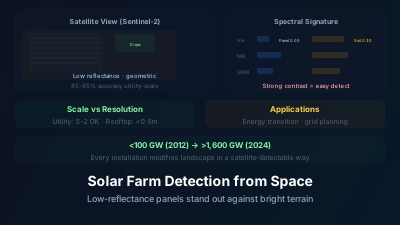
Quick Answer: Solar panels have distinctive spectral signatures — low reflectance in visible bands (designed to absorb sunlight) and characteristic reflectance patterns in NIR/SWIR. Large utility-scale solar farms (>1 MW) are readily detectable at Sentinel-2's 10m resolution due to their geometric regularity and spectral contrast against surrounding land. Machine learning classifiers trained on known installations do well on utility-scale farms, where the dark spectral signature and geometric regularity are close to unambiguous, and markedly worse on small rooftop systems; reported accuracy is tied to the training region and imagery source and drops when a model is moved to a different landscape. Global solar farm databases are being compiled from Sentinel-2 and commercial satellite data. Applications include tracking renewable energy deployment, land use impact assessment, and grid capacity planning.
Flying over central Spain or the American Southwest, the landscape is increasingly punctuated by vast blue-black rectangles — utility-scale solar farms covering hundreds of hectares each. From satellite altitude, these installations are equally distinctive: geometric arrays of low-reflectance panels creating a sharp contrast against the surrounding bright soil or vegetation.
The rapid growth of solar energy creates a new mapping challenge and opportunity. Where are all the solar installations? How fast are they growing? What land are they consuming? Satellite data answers these questions at global scale.
Why Solar Panels Are Spectrally Distinctive
Solar photovoltaic panels are engineered to absorb as much sunlight as possible — which makes them spectrally unique in satellite imagery:
Visible bands: Very low reflectance (0.03-0.08) — panels are engineered to absorb the overwhelming majority of incoming visible light rather than reflect it. This makes solar farms appear very dark in true-color satellite images.
NIR (near-infrared): Moderate reflectance (0.10-0.25). Higher than visible but still lower than most natural surfaces. Silicon-based panels have a characteristic NIR reflectance increase compared to their visible reflectance.
SWIR: Variable, depending on panel technology and glass coating. Generally low reflectance.
Key contrast: Against bright soil (reflectance 0.20-0.40 in visible), solar panels create a strong negative contrast. Against vegetation (which has a similar low visible reflectance), the distinction relies on NIR — vegetation has high NIR reflectance (0.40-0.60) while panels remain moderate.
Detection Methods
Spectral Indices
Solar Panel Index: Various custom indices exploit the spectral differences:
- Low visible reflectance + moderate NIR → panel signature
- Low NDVI (panels aren't vegetation) + low albedo (panels absorb light) → discriminates from both vegetation and bright bare soil
Geometric Analysis
Utility-scale solar farms have unmistakable geometric characteristics:
- Regular rectangular shapes: Individual panel arrays arranged in rows
- Uniform spacing: Consistent inter-row gaps for maintenance access
- Large contiguous areas: Utility-scale installations span tens to hundreds of hectares
- Linear internal structure: Row patterns visible at sub-meter to 10m resolution
These geometric features distinguish solar farms from other dark surfaces (water bodies, shadows, dark rock).
Machine Learning Classification
The most effective approach combines spectral and spatial features:
- Training data: Known solar farm locations (from permits, industry databases, or manual identification in VHR imagery)
- Feature extraction: Spectral bands, indices, texture metrics, geometric descriptors
- Classification: Random Forest, gradient boosting, or convolutional neural networks (CNNs)
- Post-processing: Remove false positives using size thresholds, shape analysis, and proximity to electrical infrastructure
Published classifiers do well on utility-scale installations (>1 MW / ~2 hectares), where the combination of dark spectral signature and strong geometric regularity is close to unambiguous, and markedly worse on small rooftop systems, where the target is a few pixels on a heterogeneous roof. Accuracy figures from any one study are tied to its training region and its imagery source, and drop when the model is applied to a different landscape.
Change Detection for New Installations
Comparing imagery from different dates identifies newly constructed solar farms:
- Agricultural land or desert → sudden appearance of low-reflectance geometric arrays
- Construction phase visible as ground clearing followed by panel installation
- Typically detectable within one Sentinel-2 revisit cycle after panel installation begins
Scale-Dependent Detection
| Installation Type | Typical Size | Detection Resolution | Satellite Source |
|---|---|---|---|
| Utility-scale (>10 MW) | 20-500+ ha | 10m sufficient | Sentinel-2 |
| Community solar (1-10 MW) | 2-20 ha | 10m marginal, 3-5m better | Sentinel-2 / commercial |
| Commercial rooftop | 0.1-2 ha | 1-3m needed | Commercial VHR |
| Residential rooftop | <0.01 ha | <0.5m needed | Aerial / very high res |
Sentinel-2 at 10m resolution effectively maps utility-scale solar farms but misses most rooftop installations. Comprehensive mapping of distributed solar requires commercial VHR imagery or aerial data.
Global Solar Farm Mapping
Several initiatives are building global solar installation databases:
Academic efforts: Research groups at ETH Zurich, Stanford, and others have published global or national solar farm maps using Sentinel-2 and Landsat with machine learning classifiers.
Industry databases: Solar energy industry associations maintain installation registries, but these are often incomplete for smaller installations.
OpenStreetMap: Volunteer mapping includes solar farms as a land use category, with variable completeness globally.
The goal — a comprehensive, continuously updated global database of all solar installations — remains a work in progress but is advancing rapidly.
Applications
Energy Transition Monitoring
Tracking solar deployment rates by country, region, and time period:
- Is solar capacity growing fast enough to meet climate targets?
- Which regions are leading or lagging in deployment?
- How does actual deployment compare to announced plans?
Satellite-based monitoring provides independent verification of deployment statistics reported by governments and industry.
Land Use Impact Assessment
Solar farms consume land — a concern when they displace productive agriculture or natural habitats:
- Agricultural land conversion: Satellite time series show whether solar farms replaced active cropland, fallow land, or unused terrain
- Habitat impact: Mapping solar installations against biodiversity data identifies potential ecological conflicts
- Agrivoltaics: Some installations combine solar panels with agriculture (grazing, shade crops). Satellite monitoring can verify that dual-use commitments are maintained
Grid Planning
Utility companies and grid operators need accurate maps of distributed generation:
- Solar generation is intermittent and location-dependent
- Knowing where solar capacity is installed helps predict grid supply and manage congestion
- Satellite mapping supplements incomplete administrative records
Property and Tax Assessment
For local governments, identifying solar installations affects property tax assessment, zoning compliance, and building code enforcement. Satellite-based detection can flag installations not reflected in permit databases.
Challenges
Panel technology evolution: New thin-film, bifacial, and colored solar panels may have different spectral signatures than conventional crystalline silicon panels. Classification models trained on current technology may not generalize to future installations.
Confusion with other dark surfaces: Water bodies, shadows, dark agricultural mulch, and certain building materials can produce spectral signatures similar to solar panels. Context (location, shape, persistence) helps resolve ambiguity.
Seasonal variation: Solar panel reflectance is relatively stable year-round, but surrounding land cover changes seasonally. Classification accuracy may vary with season depending on the method used.
Rooftop detection difficulty: Small rooftop installations on buildings with mixed roof materials are challenging to detect even at sub-meter resolution. Deep learning approaches are improving but still far from complete detection.
Global Solar Growth: The Scale of the Mapping Challenge
The rapid deployment of solar energy is one of the most significant landscape transformations of the 21st century. IRENA's Renewable Capacity Statistics recorded a record 451.9 GW of solar added in 2024 alone — over three-quarters of all new renewable capacity worldwide that year.
Utility-scale solar occupies land at a roughly consistent rate per gigawatt, so a capacity curve of that shape implies a footprint curve of the same shape: thousands of square kilometres of new, spectrally distinctive, geometrically regular surface appearing on the land every year, much of it in places with no comprehensive installation register. That is precisely the situation satellite monitoring exists to handle — the change is large, fast, physically visible, and poorly captured by administrative records.
The rapid expansion of solar energy creates both a need and an opportunity for satellite-based monitoring. Every new installation modifies the landscape in a way that satellites can detect. Mapping this transformation provides the spatial intelligence needed to manage the energy transition effectively.

Remote sensing specialist with 10+ years in satellite data processing and AI. Founder of Off-Nadir Lab. Ph.D. in Informatics (Yokohama National University, 2026). Master's in Earth System Science and Technology (Kyushu University). Co-author, Remote Sensing Encyclopedia. More about the author →