
Ground Subsidence Monitoring with InSAR: Detecting Sinking Cities from Space
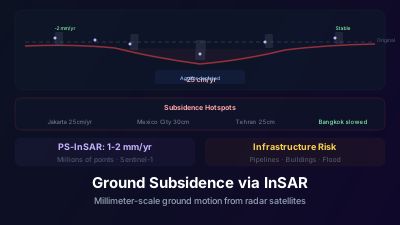
Quick Answer: Ground subsidence — the gradual sinking of the land surface — affects hundreds of cities worldwide, primarily from groundwater over-extraction. InSAR measures subsidence at 1-2 mm/year precision by tracking phase changes in SAR signals reflected from stable ground targets (buildings, infrastructure). PS-InSAR identifies millions of measurement points across urban areas. Jakarta sinks 10-25 cm/year; parts of Mexico City subside 30+ cm/year. Subsidence damages buildings, breaks pipelines, increases flood risk, and is largely irreversible. Sentinel-1 has made city-wide subsidence monitoring accessible globally — previously limited to cities with expensive ground-based monitoring networks.
Jakarta is sinking. Not metaphorically — physically sinking into the soft sediments beneath it. In northern Jakarta, the land surface has dropped by over 4 meters since the 1970s, and continues to subside at 10-25 cm per year. Buildings tilt. Sea walls that once stood above high tide are now regularly overtopped. The Indonesian government's decision to relocate the capital to Nusantara was driven in significant part by this subsidence crisis.
Jakarta isn't unique. Mexico City, Bangkok, Ho Chi Minh City, Shanghai, and dozens of other cities are sinking — and InSAR satellite data is how we know the precise rates and spatial patterns.
Why Cities Sink
Groundwater Extraction
The dominant cause in most subsiding cities. When water is pumped from underground aquifers, the water pressure that supported the overlying sediments decreases. The sediments compact under the weight of the city above, and the surface sinks.
The relationship is direct: more pumping → lower water table → more compaction → faster subsidence. In clay-rich sediments (common in coastal and river delta cities), the compaction is largely irreversible — even if pumping stops, the ground doesn't bounce back.
Mining
Underground mining creates voids that can collapse, causing surface subsidence. Coal mining regions worldwide show subsidence patterns that mirror the underground workings. Modern mining plans account for subsidence, but legacy mines from decades past continue to cause problems.
Natural Compaction
River deltas and coastal plains naturally compact under their own weight as sediments consolidate. This natural subsidence (typically 1-5 mm/year) is accelerated by sediment starvation from upstream dams that reduce sediment supply to the delta.
Tectonic and Volcanic
Some subsidence is tectonic (fault-controlled) or volcanic (magma chamber deflation). These are natural processes but can affect infrastructure in the same way as anthropogenic subsidence.
How InSAR Measures Subsidence
The Principle
SAR satellites emit radar pulses and record the returned signal, including its phase. The phase of the returned signal depends on the distance between satellite and ground — if the ground moves between two SAR acquisitions, the phase changes proportionally.
Phase change = (4π / λ) × displacement
For Sentinel-1 at C-band (λ = 5.55 cm), a ground displacement of 2.8 cm produces a full phase cycle (2π). Displacements smaller than this — down to ~1 mm — are detectable through statistical analysis of multiple image pairs.
PS-InSAR (Persistent Scatterer InSAR)
The most established technique for urban subsidence monitoring:
- Acquire many SAR images (typically 30-100+ Sentinel-1 scenes over 2-5 years)
- Identify persistent scatterers: Points that maintain stable radar reflection across all images — typically building corners, metal structures, rock outcrops
- Estimate displacement time series: For each PS point, determine the displacement at each acquisition date relative to a reference point
- Model the displacement: Linear velocity, seasonal variation, and acceleration
The result: a map of thousands to millions of measurement points across the city, each with a displacement velocity (mm/year) and full time series.
SBAS (Small Baseline Subset)
Complements PS-InSAR by using distributed scatterers (areas of consistent backscatter rather than individual point targets). SBAS provides:
- Better spatial coverage in areas without many buildings
- Lower precision per point than PS-InSAR
- Useful for monitoring agricultural land, bare soil, and suburban areas
Global Subsidence Hotspots
Jakarta, Indonesia
- Rate: 10-25 cm/year in northern areas
- Cause: Massive groundwater extraction for a city of 10+ million with inadequate piped water supply
- Impact: Coastal flooding, infrastructure damage, capital relocation decision
Mexico City, Mexico
- Rate: Up to 30 cm/year in some central areas
- Cause: Extraction from the lacustrine clay aquifer system beneath the former lake bed
- Impact: Building tilting, water/sewer pipe breaks, historic monument damage
Bangkok, Thailand
- Rate: 1-3 cm/year (reduced from 10+ cm/year after pumping restrictions)
- Cause: Groundwater extraction, reduced by regulation since the 1990s
- Success story: Policy intervention based on monitoring data demonstrably slowed subsidence
Houston, Texas, USA
- Rate: 1-5 cm/year in suburban areas
- Cause: Oil and gas extraction, groundwater pumping
- Impact: Increased flooding risk, foundation damage
Tehran, Iran
- Rate: Up to 25 cm/year in western plains
- Cause: Agricultural groundwater extraction in a water-stressed region
- Impact: Earth fissures, infrastructure damage, aquifer depletion
Infrastructure Risk Assessment
Subsidence doesn't damage structures through the sinking itself — it damages them through differential subsidence: adjacent areas sinking at different rates, creating tilting, stretching, and shearing forces.
InSAR subsidence maps enable infrastructure risk assessment:
Pipeline risk: Pipelines crossing areas of differential subsidence experience bending stress. InSAR displacement gradients identify the highest-risk pipeline segments.
Building risk: Buildings straddling subsidence boundaries may crack. InSAR data combined with building footprints identifies structures at risk.
Flood risk: Subsidence in coastal areas lowers the ground surface relative to sea level, increasing flood exposure. Combining subsidence rates with sea level rise projections shows where flooding will worsen over coming decades.
Transportation: Railways and roads crossing differential subsidence zones require frequent maintenance. InSAR prioritizes maintenance locations.
The Sentinel-1 Revolution
Before Sentinel-1, InSAR subsidence monitoring required commercial SAR data (ERS, Envisat, TerraSAR-X) costing thousands to hundreds of thousands of dollars per city. Only wealthy cities with known problems invested in monitoring.
Sentinel-1 changed this completely:
- Free data: No acquisition cost
- Systematic acquisition: Every 6-12 days over virtually all land surfaces
- Global coverage: Every city on Earth can be monitored
- Archive depth: Data from 2014 to present provides 10+ years of time series
Sentinel-1 scenes are browsable in the Sentinel-1 SAR viewer, which shows backscatter imagery rather than InSAR displacement.
The result: researchers and national geological surveys have produced subsidence maps for cities worldwide, and continental-scale services now exist — the European Ground Motion Service processes Sentinel-1 data across the whole of Europe and publishes displacement time series as a standing public product rather than a one-off study.
Interpreting an InSAR Velocity Map
Two things trip people up when they first read a PS-InSAR result, and both change the number you take away from it.
The measurement is along the line of sight, not straight down. PS-InSAR reports displacement projected onto the satellite–ground direction, which for Sentinel-1 is tilted a few tens of degrees from vertical. Purely vertical ground motion therefore shows up smaller than it really is: the line-of-sight value is the vertical value multiplied by the cosine of the incidence angle. To recover the vertical component from a single orbit direction you divide by that cosine — a modest but systematic correction, and one that assumes horizontal motion is negligible, which is usually reasonable for groundwater-driven subsidence and not reasonable near active faults or landslides. Combining ascending and descending orbits removes the assumption and separates the vertical and east–west components properly.
Everything is relative to a reference point. A velocity map shows each point's motion with respect to a chosen reference, so an apparently stable city sitting on a subsiding reference will read as uplift, and a subsiding city referenced to its own sinking centre will understate its rate. Absolute rates require tying the InSAR solution to GNSS benchmarks.
Rates themselves span four orders of magnitude between cities — from a fraction of a millimetre per year where the driver is slow natural compaction or glacial isostatic adjustment, to tens of centimetres per year in delta cities pumping heavily from compressible clay-rich sediments. What makes a city dangerous is not the headline maximum rate but the gradient: how sharply the rate changes across the built area.
Challenges
Atmospheric delay: Water vapor in the atmosphere delays the radar signal, mimicking ground displacement. Separating atmospheric effects from true displacement requires either multiple images (to average out random atmospheric variation) or external water vapor data (weather models, GPS).
Temporal decorrelation: In vegetated areas, surface changes between acquisitions destroy coherence, preventing displacement measurement. Urban areas maintain coherence well; agricultural areas often don't.
Vertical vs. horizontal: InSAR measures displacement in the satellite's line-of-sight direction, which is neither purely vertical nor purely horizontal. Extracting the vertical (subsidence) component requires either ascending and descending orbit combination or assumptions about the displacement direction.
Reference frame: InSAR measures relative displacement — the difference between each point and a reference point. If the reference point is itself subsiding (common in sinking cities), absolute subsidence rates are underestimated. GNSS benchmarks provide the absolute calibration.
Despite these challenges, InSAR-based subsidence monitoring has become an indispensable tool for managing the slow-motion disasters unfolding beneath many of the world's major cities. The data is clear, the physics is well-understood, and the measurements are precise enough to inform engineering decisions. The remaining challenge is institutional: translating subsidence measurements into groundwater management policy that addresses the root cause before the damage becomes unmanageable.
Related reading
Interferometry is the application where pass geometry is least forgiving: layover destroys coherence outright, so a pair chosen without checking the terrain geometry can be unusable regardless of how good the temporal baseline looks. How much of a SAR scene is actually usable works through computing the layover and shadow fractions for a specific incidence and look direction.

Remote sensing specialist with 10+ years in satellite data processing and AI. Founder of Off-Nadir Lab. Ph.D. in Informatics (Yokohama National University, 2026). Master's in Earth System Science and Technology (Kyushu University). Co-author, Remote Sensing Encyclopedia. More about the author →