
Population Estimation from Satellite Imagery: Counting People from Space
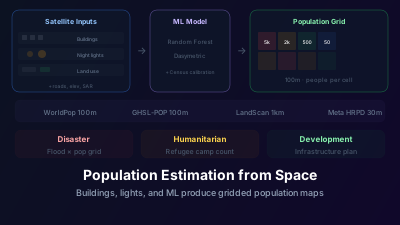
Quick Answer: Satellites can't count individual people, but they can map the built environment that people inhabit. Building footprint density, building height, land use type, and nighttime light intensity all correlate with population density. Machine learning models trained on census data and satellite features produce gridded population estimates at 100m-1km resolution. Key datasets include WorldPop, GHSL-POP, and LandScan. These estimates are critical for humanitarian response, disaster risk assessment, and development planning in countries with outdated or incomplete census data. Uncertainty grows sharply as you zoom in: a national or provincial total is largely fixed by the census the model is redistributing, while an individual 100m or 1km cell is a model output rather than a measurement — so aggregate over your area of interest before drawing conclusions, and check each product's own validation for the country you are working in.
The last census in the Democratic Republic of Congo was conducted in 1984. For a country of over 100 million people experiencing rapid urbanization, conflict-driven displacement, and resource allocation challenges, having population data four decades old is a severe governance handicap. Traditional census operations in conflict-affected, infrastructure-poor regions are expensive, dangerous, and often impossible.
Satellite-based population estimation doesn't replace a census. But it provides the best available spatial population data for places where census data is absent, outdated, or unreliable — which describes a significant portion of the world's population.
The Logic: From Buildings to People
Satellites can't see people directly (individual humans are far too small for most satellite sensors). But satellites can map the physical structures where people live and work, and those structures are strong predictors of population:
More buildings → more people: The density of residential buildings in a satellite image correlates strongly with population density.
Larger buildings → more people: Multi-story apartment buildings house more people per unit ground area than single-story dwellings. Building height (estimated from shadow length or SAR) provides a vertical population indicator.
Building type matters: Residential, commercial, and industrial buildings have different population implications. A factory may have a large footprint but house few residents.
Nighttime lights → occupied buildings: Artificial light at night indicates human presence and activity. Brighter areas generally have more people (and more economic activity).
Key Input Data
Building Footprints
AI-derived building footprint datasets have transformed population estimation:
Google Open Buildings: ~1.8 billion building footprints across Africa, South/Southeast Asia, and Latin America, extracted from VHR satellite imagery using deep learning.
Microsoft Building Footprints: Global coverage of building footprints extracted from Bing Maps imagery.
OpenStreetMap: Volunteer-mapped building footprints with variable completeness.
These footprint datasets provide the spatial foundation — knowing where buildings are and how dense they are.
Nighttime Light Intensity
VIIRS Day/Night Band measures artificial light emission:
- Bright urban cores with high-rise development → high population density
- Dim suburban areas → moderate density
- Unlit rural areas → low or zero population
- Refugee camps and informal settlements may be dim despite high population density
Land Use / Land Cover
Satellite-derived land use classification distinguishes:
- Residential areas (high population)
- Commercial/industrial (daytime population, low nighttime)
- Agricultural land (low population density)
- Forest/water (zero or very low population)
Other Satellite Indicators
Road network density: More roads typically indicate more people. Vegetation fraction: Within urban areas, less vegetation often correlates with higher density. Building height from SAR: InSAR and SAR shadow analysis estimate building heights.
Methods
Dasymetric Mapping
The most common approach for producing gridded population data:
- Start with administrative population totals (census or estimates at district/province level)
- Use satellite-derived indicators (building density, land use, nighttime lights) to spatially distribute the population within each administrative unit
- Allocate population proportionally: Grid cells with more buildings and more light receive a larger share of the administrative unit's total population
The result: gridded population estimates at 100m to 1km resolution, constrained to match known administrative totals.
Bottom-Up Estimation
Where no census data exists at all:
- Map all buildings from satellite imagery
- Classify building types (residential vs. non-residential; single-story vs. multi-story)
- Apply occupancy rates: Average number of people per building type (from surveys in similar areas)
- Sum to get population estimates
This approach is particularly useful for refugee/displaced population estimation and for countries without recent census data.
Machine Learning
Random Forest, gradient boosting, or deep learning models trained on:
- Input features: Building count, footprint area, nighttime light, land use, road density, elevation, distance to facilities
- Target: Known population from census enumeration areas
- Output: Predicted population for any grid cell with the same input features
These models capture non-linear relationships that simple proportional allocation misses.
Major Gridded Population Datasets
WorldPop
- Resolution: 100m
- Coverage: Global
- Method: Random Forest dasymetric mapping using building footprints, land use, nighttime lights, and other covariates
- Updates: Annual
- Specialty: Detailed demographic breakdowns (age, sex) for many countries
GHSL-POP (Global Human Settlement Layer - Population)
- Resolution: 100m (R2023 release)
- Coverage: Global, multi-temporal (1975, 1990, 2000, 2015, 2020)
- Method: Dasymetric disaggregation using GHSL built-up surface data
- Strength: Consistent methodology across all epochs enables population change analysis
LandScan
- Resolution: ~1km
- Coverage: Global
- Method: Multi-source dasymetric modeling (satellite, geospatial, survey data)
- Specialty: Ambient population (daytime distribution including commuters)
Meta (Facebook) High Resolution Population Maps
- Resolution: 30m
- Coverage: Most countries
- Method: Building detection from VHR imagery + census disaggregation
- Strength: Very high spatial resolution
Accuracy
Population estimation from satellite data has inherent uncertainty, and the single most important thing to understand about it is that uncertainty grows sharply as you zoom in. A national or provincial total is largely fixed by the census that constrains it, so the satellite model is only redistributing a known number. At district level the redistribution starts to matter. At the level of an individual 100 m or 1 km grid cell, the estimate is a model output rather than a measurement, and the error on any one cell can be a large fraction of its value — even when the aggregate over a few hundred cells is close to right.
The practical rule that follows: aggregate before you conclude. A gridded population product is designed to be summed over an area of interest — a flood footprint, a catchment, a service radius — not read off cell by cell. Accuracy is best where recent census data exists and worst where satellite data must estimate the total as well as the distribution. Every major product publishes its own validation; check it for the country you are working in rather than assuming a global figure.
Specific challenges:
- Informal settlements: High-density slums may be underestimated if building detection algorithms miss closely packed structures
- Multi-story buildings: Without height information, a 10-story apartment building may be counted the same as a single-story house
- Seasonal/temporary populations: Nomadic populations, seasonal workers, and displaced people are poorly captured
- Night shift workers: Nighttime light intensity may not reflect residential population in industrial areas
Humanitarian Applications
Disaster Response
Gridded population data is essential for estimating affected populations:
- Overlay flood extent with population grid → estimated people affected
- Earthquake shaking intensity + population grid → casualty estimates (USGS PAGER)
- Evacuation zone + population grid → people to evacuate
Refugee and IDP Estimation
Building detection in satellite imagery over refugee camps and informal settlements provides:
- Shelter count (number of structures)
- Estimated population from shelter count × average occupancy
- Change detection as camps grow or shrink
Disease Outbreak Response
Population distribution data drives:
- Vaccine allocation (doses needed per area)
- Healthcare facility accessibility analysis
- Epidemic modeling (transmission dynamics depend on population density)
Development Planning
Infrastructure investment decisions require population data:
- Where to build schools, clinics, water points
- Electrical grid extension planning
- Road network prioritization
For many developing countries, satellite-derived population estimates are the most spatially detailed and current population data available — more useful for planning than a decade-old census that predates rapid urbanization and displacement.
Satellite-based population estimation is not a replacement for comprehensive censuses — censuses collect demographic detail (age, sex, education, occupation, ethnicity) that no satellite can observe. But for the critical question of "how many people are where" — especially in data-poor environments where this information matters most for saving lives and allocating resources — satellite data provides the best available answer.

Remote sensing specialist with 10+ years in satellite data processing and AI. Founder of Off-Nadir Lab. Ph.D. in Informatics (Yokohama National University, 2026). Master's in Earth System Science and Technology (Kyushu University). Co-author, Remote Sensing Encyclopedia. More about the author →