
Monitoring Reservoir Water Levels from Space with Satellite Altimetry
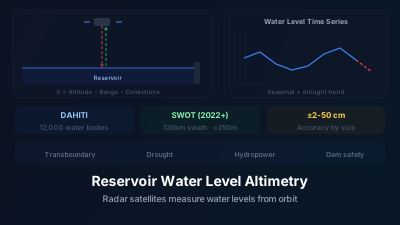
Quick Answer: Satellite radar altimeters measure water surface elevation by timing how long a radar pulse takes to travel from the satellite to the water surface and back. Accuracy is best on large lakes — a few centimetres, around ±2-5 cm for Sentinel-6 and Jason-3 — and degrades on smaller, narrower, or land-contaminated targets, so the precision you can expect depends on the size and setting of the water body rather than on the sensor alone. Sentinel-6, Jason-3, and ICESat-2 provide regular measurements for thousands of water bodies worldwide. The DAHITI and G-REALM databases offer free time series of lake/reservoir levels. Applications include transboundary water monitoring, drought assessment, hydropower management, and dam safety surveillance — particularly valuable where ground-based gauges are absent or data is not shared internationally.
The Mekong River flows through six countries, and what happens upstream directly affects water availability downstream. When a large dam fills its reservoir in one country, water levels drop downstream in another. Ground-based monitoring data is often considered a national security asset and not shared across borders. But satellite altimeters measure water levels from space — and that data is available to everyone.
This is perhaps the most politically significant application of satellite hydrology: providing transparent, impartial water data in shared river basins where information asymmetry fuels conflict.
How Satellite Altimetry Works
The Principle
A satellite radar altimeter emits microwave pulses straight down and measures the time for the pulse to return after reflecting off the surface:
Range = (Speed of light × Round-trip time) / 2
The satellite's orbital altitude is known precisely from GNSS tracking. Subtracting the range from the orbital altitude gives the surface elevation:
Water surface elevation = Satellite altitude − Range − Corrections
The corrections account for atmospheric delay (troposphere and ionosphere), tides, and geoid undulation.
Measurement Precision
| Satellite | Water Body Size | Typical Accuracy |
|---|---|---|
| Sentinel-6 / Jason-3 | Large lakes (>100 km²) | ±2-5 cm |
| Sentinel-3 | Medium lakes (10-100 km²) | ±5-15 cm |
| ICESat-2 (laser) | Small lakes (>0.1 km²) | ±5-10 cm |
| SWOT | Rivers and small lakes | ±10 cm |
These are order-of-magnitude expectations, not guarantees: accuracy degrades sharply on small, narrow, or land-contaminated targets, and the figure published for any specific lake depends on the validation gauge it was compared against. For water resource management that is usually acceptable, because seasonal water level fluctuations in a reservoir are typically measured in metres — an error of a few tens of centimetres still leaves the seasonal signal and any abnormal trend clearly visible.
Repeat Coverage
Altimetry satellites follow specific ground tracks that repeat at fixed intervals:
- Jason-3 / Sentinel-6: 10-day repeat cycle, ~300 km track spacing
- Sentinel-3A/B: 27-day repeat, ~100 km spacing
- ICESat-2: 91-day repeat, but with 6 beams providing dense sampling
A given lake only gets measured when a satellite ground track crosses it. Large lakes are crossed by multiple tracks; small lakes may only be crossed by one track (or none).
SWOT: The Game Changer
NASA/CNES's Surface Water and Ocean Topography (SWOT) mission, launched in December 2022, represents a paradigm shift:
- Wide swath: 120 km swath (vs. nadir-only for conventional altimeters)
- Resolution: Maps water surface elevation at ~100 m resolution
- Coverage: Observes virtually all lakes >250 m × 250 m and rivers >100 m wide
- Repeat: 21-day exact repeat cycle
SWOT transforms satellite altimetry from sparse point measurements to full surface mapping of water bodies worldwide.
Global Water Level Databases
DAHITI (Database for Hydrological Time Series of Inland Waters)
Maintained by the Technical University of Munich:
- Water level time series for tens of thousands of lakes, reservoirs, and rivers (the catalogue has grown steadily since the service launched, so check the current target count on the site)
- Multi-mission data (Jason, Sentinel-3, ICESat-2, Envisat, etc.)
- Updated regularly
- Free access: dahiti.dgfi.tum.de
G-REALM (Global Reservoir and Lake Monitor)
USDA/NASA partnership:
- Near-real-time water level monitoring for a few hundred of the world's largest reservoirs and lakes
- Based on Jason/Sentinel-6 altimetry
- Refreshed as each altimeter repeat cycle is processed, so a given target updates on the order of days to a few weeks rather than continuously
- Focus on agricultural water resources
Hydroweb
LEGOS/CNES (France):
- Water level time series for lakes, reservoirs, and rivers
- Multi-satellite data fusion
- Thousands of targets, mostly river "virtual stations" where a ground track crosses a channel
Applications
Transboundary Water Management
In shared river basins, satellite altimetry provides:
- Independent monitoring: Water levels observable by all parties, regardless of data-sharing agreements
- Dam filling surveillance: When an upstream country fills a new dam, downstream impacts are quantifiable from satellite data
- Treaty compliance: Satellite data can verify whether agreed water level or flow conditions are being maintained
The Nile, Mekong, Indus, and Euphrates basins all have active satellite water monitoring programs driven partly by transboundary concerns.
Drought Monitoring
Reservoir levels are a direct indicator of water availability:
- Declining water levels relative to the historical range indicate developing water scarcity
- Comparison across reservoirs in a region reveals whether drought is localized or widespread
- Multi-year trends distinguish temporary drought from long-term depletion
Hydropower
Water level in hydropower reservoirs directly determines generating capacity:
- Real-time satellite monitoring supplements ground gauge data
- Useful for energy market analysis and grid planning
- Identifies reservoirs approaching minimum operating levels (reducing generation capacity)
Dam Safety
Abnormal water level changes can indicate dam safety issues:
- Unexpected rapid filling during storms
- Failure to draw down to safe levels before flood season
- Seepage-induced water level discrepancies between upstream and downstream measurements
While satellite altimetry doesn't replace ground-based dam monitoring instruments, it provides an independent check — particularly for the thousands of dams worldwide that lack comprehensive instrumentation.
Agricultural Water Supply
Irrigation-dependent agriculture relies on reservoir storage. Satellite water level monitoring combined with reservoir capacity curves (elevation-area-volume relationships) estimates available water supply:
- Will reservoir storage last through the irrigation season?
- Is rationing necessary?
- How does current storage compare to historical norms?
Combining Altimetry with Optical Area
Satellite altimetry measures water level (elevation). Optical satellites (Sentinel-2, Landsat) measure water surface area. Combining both provides water volume estimates:
- Altimetry: Water level at date X
- Optical: Water surface area at date X
- Elevation-Area relationship: Derived from DEM or from multi-date altimetry-area pairs
- Volume estimation: Integrate the elevation-area curve
This approach enables satellite-based monitoring of reservoir storage volumes — without any ground instrumentation.
Limitations
Small water bodies: Conventional altimeters struggle with water bodies smaller than ~1 km² due to contamination from surrounding land in the radar footprint. SWOT extends coverage to much smaller water bodies.
Temporal resolution: 10-27 day repeat cycles miss rapid water level changes (flash floods, emergency releases). Daily water level data requires ground gauges.
Accuracy for small changes: Inter-annual trends of a few centimeters per year are at the edge of measurement accuracy. Detecting subtle long-term trends requires long time series.
River levels: Conventional altimeters provide point measurements where ground tracks cross rivers. SWOT's wide swath maps river surface elevation along river reaches, but narrow rivers (<100 m) remain challenging.
Despite these limitations, satellite altimetry has democratized water level monitoring. Before satellite altimetry, water level data existed only where countries invested in ground gauges and chose to share the data. Now, any water body on Earth larger than a few hundred meters across can be monitored from space, freely and openly. For water-stressed regions where data scarcity compounds physical scarcity, this transparency is transformative.

Remote sensing specialist with 10+ years in satellite data processing and AI. Founder of Off-Nadir Lab. Ph.D. in Informatics (Yokohama National University, 2026). Master's in Earth System Science and Technology (Kyushu University). Co-author, Remote Sensing Encyclopedia. More about the author →