
Wetland Mapping with Satellite Data: Combining SAR and Optical for Complex Ecosystems
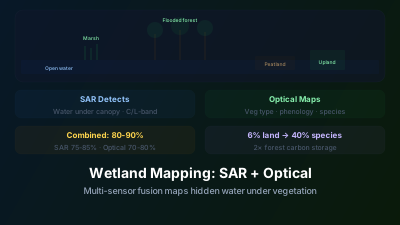
Quick Answer: Wetlands are among the most challenging ecosystems to map from satellites because they exist on the land-water continuum with highly variable seasonal extent. SAR penetrates vegetation canopy to detect standing water beneath — the double-bounce signal from flooded forests and marshes is a diagnostic indicator. C-band SAR (Sentinel-1) detects flooding under short vegetation; L-band SAR (ALOS-2, NISAR) penetrates taller canopy. Optical imagery maps emergent vegetation type and open water extent. Combined SAR-optical classification consistently outperforms either sensor alone, with the largest gains for forested and seasonal wetlands, though published accuracies are not comparable across studies because they depend on the typology, class count, region, and reference data. Global datasets include ESA CCI Land Cover, which carries wetland classes within a consistent global time series, alongside Ramsar site monitoring.
Wetlands defy simple classification. They're not quite land and not quite water — they oscillate between these states seasonally, creating a mapping challenge that frustrates purely optical approaches. A forested wetland may look identical to upland forest in a summer optical image, because the trees have the same spectral signature regardless of whether their roots are standing in water. Only SAR, which penetrates the canopy to detect the water surface below, reveals the difference.
This is why wetland mapping benefits more from SAR-optical fusion than perhaps any other land cover type.
Why Wetlands Are Hard to Map
Spectral Ambiguity
In optical imagery:
- Forested wetlands look like forests (same canopy, same NDVI)
- Wet meadows look like grassland (similar spectral signature)
- Seasonal wetlands alternate between looking like water and looking like land
- Emergent marsh (reeds, cattails) has a unique spectral signature but is easily confused with tall crops
Temporal Variability
Wetland extent changes:
- Seasonally: Maximum extent during wet season/spring snowmelt; minimum during dry season
- Inter-annually: Wet years produce larger wetlands; drought years shrink them
- Tidally: Coastal wetlands vary with tidal cycle (hours-scale variation)
A single-date image captures one snapshot of this dynamic system. Multi-temporal analysis is essential.
Definition Complexity
"Wetland" encompasses diverse ecosystems:
- Open water (ponds, shallow lakes)
- Emergent marsh (herbaceous plants standing in water)
- Forested wetland (swamp)
- Peatland/bog (water-saturated organic soil, may or may not have standing water)
- Tidal flat (exposed during low tide, submerged at high tide)
- Wet meadow (seasonally saturated soil without standing water)
Each type requires different detection approaches.
SAR for Wetland Detection
The Double-Bounce Signal
When radar waves penetrate vegetation canopy and hit a smooth water surface below, a distinctive double-bounce occurs: the wave bounces off the water surface horizontally, then reflects off vertical tree trunks back toward the satellite.
This double-bounce produces:
- Bright returns in HH polarization (or VV in Sentinel-1)
- Enhanced return compared to unflooded forest (by 3-8 dB)
- The signal is diagnostic: bright forested areas with smooth water below = flooded forest/wetland
C-Band vs. L-Band
C-band SAR (Sentinel-1, 5.6 cm wavelength):
- Penetrates short vegetation (grass, low shrubs, young crops)
- Detects flooding under emergent marsh and short vegetation
- Limited penetration through dense forest canopy
- Best for: open water, emergent marsh, flooded grassland
L-band SAR (ALOS-2 at 23.6 cm, NISAR at ~24 cm):
- Penetrates forest canopy to detect understory flooding
- Detects flooding under closed-canopy swamp forest
- Essential for: forested wetlands, mangroves, flooded tropical forest
- Less sensitive to small-scale surface roughness
The combination of C-band and L-band provides the most comprehensive wetland mapping — C-band for short vegetation and L-band for forested wetlands.
Temporal SAR Analysis
Multi-temporal SAR analysis reveals wetland hydroperiod:
- Permanent water: Consistently dark (open water) or consistently bright double-bounce (permanently flooded forest)
- Seasonal wetland: SAR signal varies between wet (double-bounce) and dry (volume scattering) seasons
- Ephemeral flooding: Brief flooding events detected in individual SAR acquisitions
Sentinel-1's 6-12 day revisit enables characterization of flooding dynamics throughout the year.
Optical Contributions
While SAR detects water presence, optical data maps vegetation type:
Vegetation classification: Spectral differences between emergent marsh species, floating vegetation, submerged aquatic vegetation, and upland species
Water quality indicators: Turbidity, chlorophyll, colored dissolved organic matter in wetland waters
Phenology: Temporal NDVI patterns distinguish wetland vegetation (which may green up later or senesce differently than surrounding upland vegetation)
Thermal: Wetlands are typically cooler than surrounding dry land during summer due to evapotranspiration and thermal inertia of water — detectable in Landsat thermal data
Combined SAR-Optical Classification
The most effective wetland mapping uses both data sources:
- SAR-based flood detection: Identify areas with surface water at any time during the monitoring period
- Optical vegetation classification: Classify vegetation type in the wetland areas
- Hydroperiod characterization: From multi-temporal SAR, determine flooding frequency and duration
- Combined classification: Integrate SAR flooding information with optical vegetation type to produce wetland type maps
Published accuracies for wetland classification vary enormously between studies, because they depend on the wetland typology used, the number of classes, the region, and how the reference data was collected — a two-class open-water map and a seven-class wetland-type map are not comparable even when both report a single accuracy percentage. What is consistent across the literature is the direction: combining SAR with optical outperforms either alone, and the improvement is largest for forested wetlands (where optical alone fails outright) and seasonal wetlands (where single-date analysis fails regardless of sensor).
Which Sensor Detects Which Wetland Type
| Wetland Type | C-band SAR (Sentinel-1) | L-band SAR (ALOS-2/NISAR) | Optical (Sentinel-2) | Easiest to map overall? |
|---|---|---|---|---|
| Open water (permanent) | Excellent — specular reflection (dark) | Excellent | Excellent — NDWI | Yes — all three sensors agree |
| Emergent marsh (reeds, cattails) | Good — double-bounce with shallow water | Excellent | Moderate — confused with tall crops | Yes, with SAR leading |
| Forested wetland / swamp | Limited — canopy blocks water detection | Excellent — penetrates closed canopy | Poor — same NDVI as upland forest | Only with L-band SAR |
| Peatland / bog | Poor (no open water double-bounce) | Moderate — soil moisture signal | Moderate — multi-temporal NDVI + phenology | No — hardest class |
| Tidal flat | Excellent — smooth exposed surface | Excellent | Good — combined with tidal timing | Yes, if tide state is known |
| Wet meadow (seasonal saturation) | Poor — no standing water surface | Moderate — soil moisture proxy | Moderate — multi-temporal NDVI anomaly | No — needs dense time series |
| Mangrove | Good — VH canopy scattering | Excellent — understory water | Good — CMRI, NDVI location constraint | Yes, with SAR-optical fusion |
Carbon implications of mapping accuracy: peatlands and forested wetlands are among the most carbon-dense ecosystems on land, and they are also the hardest to map from optical data alone — precisely the classes where optical-only methods lose extent. Any systematic underestimate of their area propagates directly into a carbon inventory error, which is why L-band SAR matters disproportionately for carbon accounting in these ecosystems relative to their share of wetland area.
Global Wetland Datasets
ESA CCI Land Cover
ESA's Climate Change Initiative does not publish a standalone global wetland product, but its Land Cover dataset carries wetland classes within a consistent global time series:
- Consistent global annual land cover maps at 300 m resolution from 1992 to 2020
- Built from a succession of sensors (AVHRR, SPOT-Vegetation, PROBA-V, Sentinel-3) with a change-detection analysis at 1 km
- Uses the UN Land Cover Classification System, whose simplified IPCC typology includes a wetlands class alongside cropland, forest, grassland, settlements and other lands
The coarse resolution makes it suitable for continental and global accounting rather than site-level delineation, for which Sentinel-1/Sentinel-2 analysis of the specific wetland is the better route.
Ramsar Sites Monitoring
The Ramsar Convention designates internationally important wetlands. Satellite monitoring tracks:
- Extent changes at designated sites
- Water level and quality indicators
- Land use change in surrounding buffer zones
National Wetland Inventories
Many countries maintain satellite-derived wetland inventories:
- US National Wetland Inventory (NWI) — partially satellite-derived
- Canadian Wetland Inventory
- Various European national programs
Conservation Applications
Carbon Accounting
Peatlands and wetlands store vast quantities of carbon — approximately twice as much carbon as all the world's forests combined. Wetland drainage for agriculture or development releases this carbon as CO₂ and methane. Satellite monitoring of wetland extent change directly informs carbon budget estimates.
Biodiversity
Wetlands support disproportionate biodiversity — they cover roughly 6% of the land surface but support approximately 40% of all species. Mapping wetland extent and condition is fundamental to biodiversity conservation planning.
Water Purification
Wetlands filter pollutants, trap sediments, and reduce nutrient loads in waterways. Monitoring wetland extent and connectivity supports watershed management and water quality protection.
Flood Attenuation
Wetlands absorb and slowly release flood water, reducing downstream flood peaks. Loss of wetland area increases flood risk. Satellite-based wetland mapping supports flood risk assessment and natural flood management strategies.
Wetland mapping from satellites has progressed enormously with the availability of free, frequent SAR data from Sentinel-1. The ability to detect water beneath vegetation canopy — something impossible from optical imagery alone — has transformed our capacity to map and monitor these ecologically critical, spatially complex ecosystems at global scale.

Remote sensing specialist with 10+ years in satellite data processing and AI. Founder of Off-Nadir Lab. Ph.D. in Informatics (Yokohama National University, 2026). Master's in Earth System Science and Technology (Kyushu University). Co-author, Remote Sensing Encyclopedia. More about the author →