
Estimating Evapotranspiration from Satellites: The Invisible Water Flux
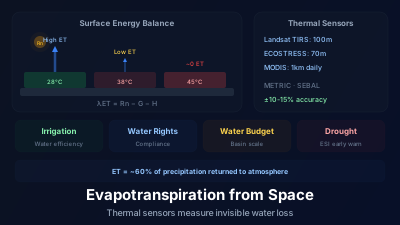
Quick Answer: Evapotranspiration (ET) is the largest consumptive water use on Earth — crops, forests, and landscapes return ~60% of precipitation to the atmosphere. Satellites estimate ET using the surface energy balance: ET = Net radiation - Ground heat flux - Sensible heat flux. Land surface temperature from thermal sensors (Landsat, ECOSTRESS) is the key input — cooler surfaces (well-watered vegetation) have higher ET than warmer surfaces (stressed or bare). METRIC and SEBAL algorithms produce field-scale ET maps at 30-100m resolution. ET maps identify over-irrigated and under-irrigated fields, quantify basin water consumption, and support water rights enforcement.
Satellites estimate evapotranspiration — the combined water loss from soil and plants — by reading land surface temperature and solving the surface energy balance, turning an invisible flux into field-scale maps of actual water use. If you could see water leaving the landscape in real-time, you'd see an invisible river flowing upward from every field, forest, and wetland — water molecules departing plant stomata, evaporating from soil surfaces, and rising into the atmosphere. This process — evapotranspiration (ET) — is the largest consumptive use of water on Earth, yet it's invisible to the eye and nearly impossible to measure directly over large areas.
Satellite-based ET estimation makes this invisible flux visible, transforming water management from guesswork to data-driven decision-making.
What is evapotranspiration?
Evapotranspiration (ET) is the combined loss of water from a landscape through two paths: evaporation from soil and wet surfaces, and transpiration through plant stomata. It is the largest consumptive use of water on Earth, returning roughly 60% of land precipitation to the atmosphere. Its two components behave differently:
Evaporation: Direct conversion of liquid water to vapor from soil surfaces, water bodies, and wet vegetation surfaces. Driven by available energy and vapor pressure deficit.
Transpiration: Water absorbed by plant roots, transported through stems, and released through leaf stomata during photosynthesis. Plants "spend" water to acquire CO₂ — typically 200-500 grams of water per gram of CO₂ fixed.
Together, ET returns approximately 60% of global terrestrial precipitation to the atmosphere. In irrigated agriculture, ET is the primary consumptive water use — the water that doesn't return to rivers or aquifers.
How do satellites estimate ET?
Satellites estimate ET by solving the surface energy balance rather than measuring water directly. Evaporating water consumes energy (latent heat of vaporization: ~2.45 MJ/kg), so whatever energy is left after net radiation heats the ground and the air must have gone into ET. Land surface temperature from a thermal sensor supplies the missing term. The balance at the surface:
Rn = G + H + λET
Where:
- Rn = Net radiation (incoming solar and longwave minus reflected and emitted)
- G = Ground heat flux (energy stored in the soil)
- H = Sensible heat flux (energy warming the air)
- λET = Latent heat flux (energy used for evapotranspiration)
Rearranging: λET = Rn − G − H
Satellites estimate each component:
- Rn: From incoming solar radiation (weather data) and surface albedo (satellite)
- G: Estimated as a fraction of Rn based on land cover type
- H: Proportional to the temperature difference between the surface and the air. This is where satellite thermal data becomes essential — land surface temperature (LST) from Landsat or ECOSTRESS provides the surface temperature; air temperature comes from weather stations or reanalysis data.
The key insight: surfaces that are actively transpiring (well-watered vegetation) are cooler than surfaces that aren't (dry soil, stressed crops). Temperature is the proxy for ET.
Major Satellite ET Algorithms
METRIC (Mapping Evapotranspiration at High Resolution with Internalized Calibration)
Developed at the University of Idaho:
- Uses Landsat thermal data (100m resolution)
- Self-calibrating: selects "hot" (dry, no ET) and "cold" (well-watered, maximum ET) reference pixels within each image to anchor the energy balance
- Produces field-scale ET maps
- Widely used in western US water management
SEBAL (Surface Energy Balance Algorithm for Land)
Similar to METRIC but with some methodological differences:
- Also uses the hot/cold pixel calibration approach
- Applied globally in numerous countries
- Available as commercial software (eLEAF)
SSEBop (Simplified Surface Energy Balance)
Developed by USGS:
- Simplified version using pre-defined reference ET and thermal anomaly fraction
- Produces the operational FEWS NET ET product for drought monitoring
- Available as gridded ET data through USGS Earth Explorer
PT-JPL (Priestley-Taylor Jet Propulsion Laboratory)
Uses satellite NDVI and meteorological data without thermal imagery:
- Estimates potential ET from radiation and temperature
- Scales by vegetation index and moisture availability
- Produces the ECOSTRESS ET product
ECOSTRESS: Dedicated ET Mission
NASA's ECOSTRESS (ECOsystem Spaceborne Thermal Radiometer Experiment on Space Station) is specifically designed for ET estimation:
- Resolution: 70m thermal
- Platform: International Space Station (variable overpass time — captures different times of day)
- Products: LST, ET, Evaporative Stress Index (ESI), Water Use Efficiency
- Key advantage: Multiple daily overpasses capture the diurnal ET cycle, unlike Landsat's fixed overpass time
Applications
Irrigation Management
The most direct application: identifying fields that are using too much or too little water, the core of satellite irrigation management:
Over-irrigated fields: Lower LST than neighboring fields of the same crop → higher ET → wasting water
Under-irrigated fields: Higher LST than neighbors → lower ET → crop stress, yield loss risk
Irrigation scheduling: ET maps tell farmers how much water their crop actually consumed since the last irrigation, directly informing the next application amount.
Water Rights and Allocation
In water-scarce regions, water rights define how much water each user may consume. Satellite ET provides:
- Independent measurement of actual water consumption per parcel
- Verification that users aren't exceeding their allocation
- Basin-wide water balance accounting
Several western US states (Idaho, Nevada, Oregon) use satellite ET operationally for water administration.
Water Budget Accounting
At basin scale: Precipitation = ET + Runoff + Storage change
Satellite ET provides the largest and hardest-to-measure term in this equation. Combined with satellite precipitation (GPM) and storage change (GRACE gravity data), satellite-based water budgets enable:
- Assessment of sustainable water use
- Detection of groundwater depletion (when ET exceeds precipitation + runoff for extended periods)
- Climate change impact on water resources
Drought Early Warning
The Evaporative Stress Index (ESI) — actual ET divided by potential ET — provides early drought indication:
- ESI near 1.0: Vegetation is transpiring at potential rate (no water stress)
- ESI declining: Vegetation is water-stressed (ET decreasing despite energy availability)
- ESI << 1.0: Severe water stress
ESI typically responds to developing drought before NDVI shows visible crop stress, because transpiration decreases (stomata close) before canopy greenness changes. The size of that lead time varies with crop, soil water-holding capacity, and how quickly the deficit develops.
How accurate is satellite ET?
Accuracy is normally assessed against eddy-covariance flux towers — ground instruments that directly measure the turbulent exchange of water vapor, heat, and CO₂ — and the single most important thing to know is that the answer depends on the accumulation period, not just the algorithm.
Daily estimates are the noisiest. A satellite sees one instant, and converting that instant to a 24-hour total requires an assumption about the shape of the diurnal curve. Monthly and seasonal totals are substantially more accurate, because random errors of opposite sign cancel as they accumulate. This is why satellite ET is trusted for seasonal water accounting and irrigation-season budgets long before it is trusted for "how much water did this field use yesterday."
Two practical implications:
- Match the accumulation period to the decision. Allocation and water-rights accounting are seasonal questions and are well served. Day-to-day irrigation scheduling asks more of the data than a single overpass can support, and should be combined with soil moisture or in-field sensing.
- Validation figures published for one algorithm in one climate do not transfer. Energy-balance models with internal hot/cold pixel calibration (METRIC, SEBAL) behave differently in humid climates than in the arid, strongly advective conditions they were developed for. Check for a validation study in a climate resembling yours before adopting a published error bar as your own.
Sanity-Checking a Satellite ET Map
A satellite ET map is far easier to trust once you have something to compare it against. Three checks catch most errors without needing published reference tables:
1. Compare against the crop's own potential ET, not against a number from a book. ET deficit = potential ET minus actual ET. A field whose actual ET sits well below the potential ET computed from the same day's weather is water-stressed, and a sustained deficit through the growing season is the signal that maps onto yield loss risk. This comparison is internally consistent — both terms come from the same day and the same site — so it survives disagreements about absolute accuracy.
2. Compare fields against their neighbours. Two fields of the same crop, on the same soil, under the same weather, should consume similar water. A field that is persistently higher is the over-irrigation candidate; one that is persistently lower is the stress candidate. Relative comparisons are much more robust than absolute ones, because most systematic error is shared across the scene and cancels.
3. Compare seasonal totals against delivery records. Where irrigation districts meter deliveries, the district-scale seasonal sum is the strongest available cross-check on satellite ET. Agreement at district scale is the practical basis on which satellite ET is used for basin water accounting; disagreement usually points at either a land-cover misclassification or an unaccounted water source.
Absolute per-crop reference values do exist — the FAO-56 crop coefficient framework is the standard source — but they are climate-specific, and applying a value from one region to another is a common way to convince yourself the satellite is wrong when it is not.
Limitations
Temporal resolution: Landsat provides thermal data every 16 days — many days are cloudy. Actual cloud-free ET observations may occur only a few times per month. Gap-filling models interpolate between observations.
Instantaneous to daily scaling: A satellite captures one moment in the day. Scaling this instantaneous ET to daily total requires assumptions about the diurnal ET curve (typically using the evaporative fraction method, which assumes the ratio of ET to available energy remains approximately constant throughout the day).
Spatial resolution vs. frequency trade-off: Landsat (100m thermal, 16-day) provides field-scale detail; MODIS (1km thermal, daily) provides temporal frequency. Neither provides both. ECOSTRESS partially bridges this gap.
Wind and advection: In arid irrigated areas, hot dry air blowing over cool irrigated fields enhances ET beyond what the surface energy balance predicts without accounting for this "oasis effect." Advanced algorithms account for this, but it remains a source of error.
Satellite-based ET estimation transforms an invisible process into a mappable, quantifiable water resource variable. In water-scarce regions — which include much of the world's irrigated agriculture — this capability is not academic. It's the foundation for fair water allocation, efficient irrigation, and sustainable water management at scales that no network of ground instruments could achieve. Track ET for a defined field or basin over time — the same principle behind any satellite area monitoring workflow — and these snapshots become an operational record of water use.

Remote sensing specialist with 10+ years in satellite data processing and AI. Founder of Off-Nadir Lab. Ph.D. in Informatics (Yokohama National University, 2026). Master's in Earth System Science and Technology (Kyushu University). Co-author, Remote Sensing Encyclopedia. More about the author →