
Tracking Groundwater Depletion from Space: The GRACE Gravity Mission
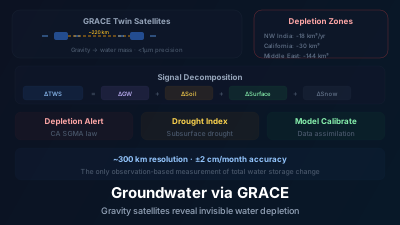
Quick Answer: GRACE (2002-2017) and GRACE-FO (2018-present) measure monthly changes in Earth's gravity field caused by redistribution of water mass. When a region loses groundwater, its gravity decreases — detectable as changes in the distance between twin satellites flying in formation. After subtracting surface water, snow, and soil moisture (estimated from models), the residual gravity change reveals groundwater storage trends. Major findings: northwestern India losing 17.7 ± 4.5 km³/year (Rodell et al., 2009); sustained, predominantly groundwater storage loss in California's Central Valley through the 2012-2016 drought; and the Tigris-Euphrates basin among the fastest-depleting regions globally. Resolution is coarse (~300 km), but GRACE provides the only observation-based measurement of total water storage change at continental scale.
Groundwater is invisible. It sits in pore spaces and fractures hundreds of meters below the surface, and its depletion is detectable at the surface only after decades of over-extraction cause wells to run dry, land to subside, or ecosystems to collapse. For most of human history, groundwater depletion was noticed only when it was too late.
GRACE changed this. By measuring the gravity of the Earth itself, GRACE detects the removal of water mass from underground aquifers — providing the only observation-based method for monitoring groundwater depletion at regional to continental scales. As NASA's Jet Propulsion Laboratory puts it, the GRACE missions effectively "weigh" Earth's water by tracking minute changes in gravity from orbit.
How GRACE Works
The Concept
Two identical satellites fly in formation, separated by ~220 km, in low Earth orbit (~500 km altitude). They continuously measure the distance between themselves using a microwave ranging system accurate to better than 1 micrometer.
As the satellites orbit, they pass over regions of slightly different gravity. When the leading satellite approaches a mass concentration (more water, rock, or ice), it accelerates slightly, increasing the inter-satellite distance. When it passes the mass concentration, the trailing satellite experiences the same acceleration, and the distance decreases.
These tiny distance variations — smaller than the diameter of a human hair — encode the gravity field of the Earth below. Monthly maps of the gravity field reveal how mass is redistributed on and within the Earth.
How does GRACE convert gravity into groundwater?
On timescales of months to years, water redistribution is the main thing that changes Earth's gravity. GRACE measures the total water column, so isolating the groundwater share means subtracting model estimates of everything else. The dominant monthly signals it picks up are:
- Seasonal monsoon loading in Asia
- Snow accumulation and melt in high latitudes
- Reservoir filling and draining
- Ice sheet mass loss in Greenland and Antarctica
- Groundwater extraction and recharge
The total water storage change (ΔTWS) measured by GRACE includes all water in the column — surface water, soil moisture, snow, ice, and groundwater. To isolate the groundwater component:
ΔGroundwater = ΔTWS(GRACE) − ΔSoil moisture(model) − ΔSurface water(model/satellite) − ΔSnow(model)
The surface components are estimated from land surface models (Noah, CLM) or direct satellite observations (snow from MODIS, surface water from radar altimetry).
How precise is GRACE?
GRACE's spatial resolution is inherently coarse — approximately 300 km (the wavelength at which gravity signals are strong enough to be measured reliably). This means GRACE can't see individual wells or aquifers smaller than about 100,000 km². It operates at the scale of major aquifer systems, river basins, and countries.
Accuracy for monthly total water storage change: approximately ±2 cm of equivalent water height over a 300 km region. Over a year, trends of ±5 mm/year are detectable.
Major Findings
India: The World's Largest Groundwater User
GRACE data revealed that northwestern India was losing groundwater at a rate entirely unsustainable given recharge. The study that established this reported depletion of 17.7 ± 4.5 km³ per year over Rajasthan, Punjab and Haryana (including Delhi) between August 2002 and October 2008.
This finding was significant because:
- India's well monitoring network was incomplete and data was contested
- The depletion rate was higher than previous estimates
- The data was publicly available, creating pressure for policy response
California Central Valley
During the 2012-2016 drought, GRACE measured sustained water storage loss in California's Central Valley — the most productive agricultural region in the United States. The loss was predominantly groundwater, as farmers drilled deeper wells to compensate for reduced surface water allocations — the same pressure that irrigation monitoring from space tracks field by field.
This data contributed to California's landmark 2014 Sustainable Groundwater Management Act (SGMA), the first statewide regulation of groundwater in the state's history.
Middle East
GRACE identified the Tigris-Euphrates basin (Turkey, Syria, Iraq, Iran) as one of the fastest-depleting regions globally. A GRACE analysis of the Tigris-Euphrates-Western Iran region found a total water storage loss of 143.6 km³ between January 2003 and December 2009, of which 91.3 ± 10.9 km³ was groundwater. The loss reflects both surface water reduction (upstream dam construction) and groundwater depletion. Sustained extraction on this scale also drives measurable land subsidence, which InSAR maps at far finer resolution than GRACE.
Amazon Basin
GRACE captures the massive seasonal water storage cycle of the Amazon — approximately 1,000 km³ of water storage variation between wet and dry seasons. This seasonal signal is the largest on any continent and provides a unique calibration dataset for hydrological models.
Ice Sheets
GRACE's most dramatic finding may be the mass loss from Greenland and Antarctic ice sheets: Greenland losing approximately 280 billion tons of ice per year (2002-2020), contributing directly to sea level rise. While not a groundwater application, this demonstrates the power of gravity-based mass monitoring — a complement to the optical glacier-retreat monitoring that tracks ice loss at the margins.
GRACE-FO and the Future
The original GRACE mission (2002-2017) was succeeded by GRACE Follow-On (2018-present), which:
- Continues the gravity monitoring time series
- Adds a laser ranging interferometer for improved inter-satellite distance measurement
- Provides continuity for long-term water storage monitoring
The gap between GRACE and GRACE-FO (June 2017 - May 2018) interrupted the continuous record — a reminder that satellite continuity is not guaranteed.
Mass Change (MC) Mission
ESA is planning a next-generation gravity mission (Mass Change) with improved resolution and accuracy. If funded and launched, it would enable:
- Higher spatial resolution (~200 km)
- Better separation of surface and groundwater signals
- More accurate monthly solutions
Applications Beyond Depletion Detection
Drought Monitoring
GRACE-based total water storage anomalies provide a comprehensive drought indicator:
- Integrates all water storage components (soil, ground, surface, snow)
- Detects drought conditions before surface indicators (NDVI, soil moisture) respond
- The GRACE-based US Drought Monitor supplement shows subsurface drought conditions invisible to other indicators
Because GRACE sees storage the surface hides, it complements the higher-resolution optical signals behind continuous area monitoring: the gravity signal flags a deficit weeks before vegetation stress becomes visible in a field or basin being watched from orbit.
Flood Potential Assessment
High total water storage (saturated soils, full aquifers) before a rainfall event increases flood risk. GRACE-based storage anomalies indicate antecedent wetness conditions at the basin scale.
Hydrological Model Calibration
Land surface models simulate the full water cycle but accumulate errors over time. GRACE total water storage data constrains these models — if the model's storage trend diverges from GRACE observations, the model parameters need adjustment. This data assimilation improves model predictions of streamflow, soil moisture, and groundwater recharge.
Climate Change Impact
Multi-decadal GRACE records reveal how climate change affects water storage:
- Accelerating ice sheet mass loss
- Changing seasonal water storage patterns
- Increasing drought frequency in some regions
- Shifts in monsoon water storage
How to Read a GRACE Depletion Rate
A depletion rate on its own tells you very little. What makes it interpretable is the comparison to recharge, and the distinction between two fundamentally different situations:
- Over-drafted renewable aquifers are being pumped faster than they refill, but they do refill. The Indo-Gangetic Plain and the North China Plain are in this category: the deficit is a policy problem, and reducing extraction can, in principle, stabilize them.
- Effectively non-renewable ("fossil") aquifers receive negligible modern recharge — the Arabian aquifer system and much of the Ogallala/High Plains are the standard examples. Here the ratio of extraction to recharge is not a meaningful control knob, because any extraction is depletion. The relevant question is not whether the aquifer will be exhausted but when, and what happens to the agriculture built on top of it.
GRACE is what turns this from an argument into an observation. Its value for policy is the trend and its sign, at basin scale, independent of well-reporting: the magnitude is approximate, because the groundwater signal is a residual left after model estimates of soil moisture, snow, and surface water are subtracted, and every error in those models propagates into it. Where a published GRACE-derived rate is quoted, check which study produced it, over which years, and with which land surface model — those choices move the number.
Limitations
Coarse resolution: 300 km resolution means GRACE can't distinguish individual aquifers within a basin or identify which specific wells are causing depletion. It provides the total signal for large regions.
Signal separation: Isolating groundwater from soil moisture, surface water, and snow requires models that introduce their own errors. The groundwater signal is a residual — errors in all other components propagate to the groundwater estimate.
Temporal resolution: Monthly solutions can't capture rapid events (individual storms, flash droughts). Sub-monthly solutions exist but with reduced accuracy.
No depth information: GRACE measures total storage change but can't determine at what depth the change occurs. A gravity decrease could be from a shallow aquifer, a deep aquifer, or a combination.
Indirect measurement: GRACE measures gravity change, not water directly. Non-hydrological mass changes (tectonic, volcanic, post-glacial rebound) must be corrected for — though these are generally small and well-modeled.
Despite these limitations, GRACE and GRACE-FO have fundamentally changed our understanding of global water resources. For the first time, we can observe — not estimate, not model, but observe — how total water storage is changing across every continent. The finding that many of the world's major aquifers are being depleted faster than they're replenished is one of the most consequential environmental discoveries of the 21st century. It gives governments, water managers, and researchers the evidence needed to confront groundwater depletion before the consequences become irreversible.

Remote sensing specialist with 10+ years in satellite data processing and AI. Founder of Off-Nadir Lab. Ph.D. in Informatics (Yokohama National University, 2026). Master's in Earth System Science and Technology (Kyushu University). Co-author, Remote Sensing Encyclopedia. More about the author →