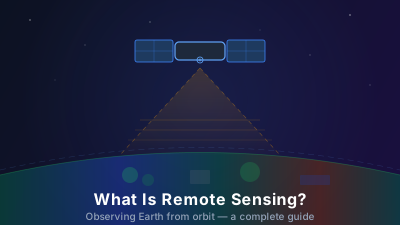
What Is Remote Sensing? A Plain-Language Guide for 2025
Quick Answer: Remote sensing is the science of gathering information about an object or area from a distance, typically using satellites or aircraft. Passive sensors (like cameras) record reflected sunlight; active sensors (like radar) emit their own energy. Applications span agriculture, disaster response, urban planning, and climate science. Modern cloud platforms have made satellite data accessible to non-specialists.
Remote sensing is the practice of measuring Earth's surface from a distance — usually from satellites or aircraft — by recording the energy it reflects or emits. NASA's Earthdata program puts it even more plainly: "Remote sensing is the acquiring of information from a distance." That one sentence covers the whole field.
The textbook definition — "the acquisition of information about an object without making physical contact" — doesn't actually help anyone understand what remote sensing does in practice.
Here is a more useful way to put it.
The Elevator Version
You know how a doctor uses an X-ray to see inside your body without cutting you open? Remote sensing does something similar for Earth. Satellites orbiting 700 kilometers above us collect information about the surface — what's growing, what's flooded, what's been built — without anyone needing to walk out there with a measuring tape.
That's it. Everything else is details.
How Does Remote Sensing Actually Work?
Satellite sensors measure the energy that Earth's surface reflects or emits, across multiple wavelengths. Every material — soil, water, vegetation, concrete, snow — interacts with light in a slightly different way: healthy vegetation absorbs red light for photosynthesis but strongly reflects near-infrared, while bare soil does neither particularly well. By analyzing which wavelengths come back strong and which come back weak, we can identify what's on the ground.
This is the core principle. A sensor records energy; the patterns are then interpreted. (If you're curious about the mechanics of the sensors themselves, there's a separate piece on how satellites capture images.)
Passive vs. Active Sensors
There are fundamentally two approaches:
Passive sensors rely on an external energy source — usually the sun. They record sunlight reflected off Earth's surface. Optical satellites like Sentinel-2 and Landsat work this way. The limitation is obvious: no sunlight (nighttime) or blocked sunlight (clouds) means no useful data.
Active sensors bring their own energy source. Synthetic Aperture Radar (SAR) satellites like Sentinel-1 transmit microwave pulses toward the ground and record what bounces back. Because they generate their own illumination, they work at night and through clouds. The trade-off is that radar images require more interpretation skill — they don't look like photographs.
| Feature | Passive (Optical) | Active (SAR) |
|---|---|---|
| Energy source | Sun | Satellite's own transmitter |
| Cloud penetration | No | Yes |
| Night operation | No | Yes |
| Image appearance | Natural-looking | Grainy, requires training |
| Best for | Land cover, vegetation | Flooding, deformation, soil moisture |
The Electromagnetic Spectrum (Brief Version)
Satellites don't just see visible light. They can record energy across a wide range of wavelengths:
- Visible (0.4–0.7 μm): What your eyes see. Good for true-color images.
- Near-infrared (0.7–1.3 μm): Invisible to us, but vegetation is highly reflective here. This is how we calculate vegetation indices like NDVI.
- Shortwave infrared (1.3–3.0 μm): Useful for distinguishing soil types, detecting burn scars, and identifying minerals.
- Thermal infrared (3–15 μm): Measures surface temperature. Used for urban heat island studies, volcanic monitoring, and fire detection.
- Microwave (1 mm–1 m): The domain of radar. Penetrates clouds, sensitive to surface roughness and moisture.
Most Earth observation satellites carry sensors that cover several of these ranges simultaneously. Sentinel-2, for instance, has 13 spectral bands spanning visible through shortwave infrared. For a deeper look at why each region behaves the way it does, see the guide to the electromagnetic spectrum in remote sensing.
What Can You Actually Do With It?
Across these categories, the applications that deliver the most practical value are:
Agriculture
Farmers use satellite data to monitor crop health across large areas. NDVI maps highlight which fields are stressed before the damage becomes visible to the naked eye. In commercial agriculture, this translates to targeted fertilizer application and early pest detection.
Disaster Response
After a flood, SAR imagery can map inundation extent within hours — even if the area is still under cloud cover. Emergency responders use these maps to prioritize rescue operations, and the same workflow is applied routinely wherever seasonal storms and typhoons cause widespread flooding.
Urban Planning
City planners track urban expansion, monitor construction activity, and assess green space coverage. Nighttime light data from VIIRS reveals economic activity patterns and helps estimate population distribution.
Environmental Monitoring
Deforestation alerts in the Amazon rely on optical satellite data. Glacier retreat in the Himalayas and Alps is tracked year over year. Oil spill extent in oceans is mapped using SAR's sensitivity to surface roughness changes.
Climate Science
Long-term satellite archives — Landsat has been collecting data since 1972 — provide the baseline measurements needed to quantify climate change. Sea surface temperature, ice sheet extent, vegetation greenness trends, and atmospheric composition are all monitored from space.
What Are the Four Types of Resolution?
Satellites have four kinds of resolution: spatial (pixel size), temporal (revisit frequency), spectral (number of wavelength bands), and radiometric (sensitivity to brightness differences). When someone asks "what resolution is that satellite?" they usually mean spatial resolution — how small an object you can see — but all four affect what a dataset can and cannot do:
- Spatial: The ground area each pixel represents. Sentinel-2 gives you 10 meters; commercial satellites like WorldView can reach 30 centimeters.
- Temporal: How often the satellite revisits the same spot. Sentinel-2 returns every 5 days; daily coverage requires a constellation of satellites.
- Spectral: How many wavelength bands the sensor records. More bands mean more information about surface materials.
- Radiometric: How finely the sensor distinguishes between energy levels. Higher radiometric resolution means better sensitivity to subtle differences.
There's always a trade-off. You can't have the best of everything. High spatial resolution typically comes with lower temporal frequency and narrower coverage.
How Much Satellite Data Is Free?
More than most people realize. The Copernicus program (Sentinel-1, Sentinel-2) distributes its full archive at no cost through the Copernicus Data Space Ecosystem, and NASA/USGS do the same for Landsat — together providing free global coverage. Not long ago, this kind of data was sold per scene rather than given away. The main options are catalogued in a separate guide to free satellite data sources.
Today, the barrier isn't data availability — it's the skill to process and interpret it. That's where browser-based tools have changed the equation. Instead of downloading gigabytes of raw data and processing it in desktop GIS software, you can now search, visualize, and analyze satellite imagery directly in a web browser.
The Data Is Already There
One thing that surprises most people new to the field: the volume of data already available.
Sentinel-2 images the entire land surface systematically, tiling it into 100 × 100 km scenes with 13 spectral bands at 10–20 meter resolution — every one of them archived and accessible at no cost. Sentinel-1 does the same with radar. Together the Sentinel archive holds many millions of acquisitions stretching back to 2014, and it grows every day whether or not anyone has asked for a particular scene.
Landsat extends the record further. Continuous data collection began in 1972, giving researchers and analysts over 50 years of consistent observations across most of Earth's land surface.
Practical implication: For any location you care about, there are probably dozens to hundreds of existing satellite acquisitions already archived, already processed, and already available for free. You don't commission new observations or wait for a satellite pass. The data almost certainly already exists — the question is whether you can access and interpret it efficiently.
This scale is what makes satellite remote sensing fundamentally different from other observation methods. Surveying a thousand agricultural fields on the ground means a thousand site visits, and the cost scales with the number of fields. Satellite analysis of the same thousand fields is close to the same computing effort as analyzing one — the marginal cost of each additional area is near zero. That asymmetry is what makes it valuable.
The real barrier today isn't data or cost — it's the skill to know which questions to ask and how to interpret what the data shows. That gap is closing rapidly as platforms abstract away the hard parts (projection, atmospheric correction, data format handling) and put analysis directly in the browser.
Common Misconceptions
"Satellite imagery is like Google Earth." Google Earth shows static, pre-processed mosaics. Remote sensing works with time-stamped individual acquisitions that let you compare the same location across different dates.
"You can read license plates from space." This is a movie trope. Even the highest-resolution commercial satellites resolve objects around 30 cm — enough to count cars, not read their plates.
"It only works in clear weather." True for optical sensors, but radar works through clouds, rain, and at night. The two sensor types are complementary — see SAR vs optical for a side-by-side comparison.
"You need a PhD to use it." Increasingly false. Modern platforms abstract away the hard parts — atmospheric correction, projection, data format handling — and let users focus on the analysis.
Where to Start
If you're new to this field, start with a specific question rather than trying to learn everything at once. "Is this forest shrinking?" or "Which fields need irrigation?" gives you a concrete goal to work toward.
Pick one satellite — Sentinel-2 is a good starting point for optical data, Sentinel-1 for radar — and explore one area you know well. Familiarity with the ground truth makes it much easier to interpret what you're seeing in the imagery. And before you draw conclusions from your first images, it's worth knowing the five mistakes beginners most often make.
The technology has matured to the point where the limiting factor isn't access or cost — it's knowing what questions to ask. And that's a much better problem to have.

Remote sensing specialist with 10+ years in satellite data processing and AI. Founder of Off-Nadir Lab. Ph.D. in Informatics (Yokohama National University, 2026). Master's in Earth System Science and Technology (Kyushu University). Co-author, Remote Sensing Encyclopedia. More about the author →