Estimating Forest Biomass from Satellite Data: Carbon Stock Mapping from Space
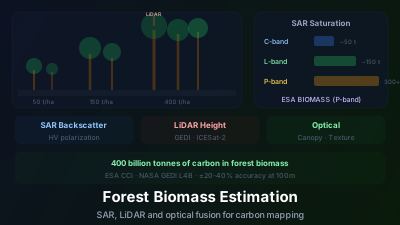
Quick Answer: Forest biomass — the dry weight of living trees — is the largest terrestrial carbon pool after soils. Satellites estimate biomass through three complementary approaches: (1) SAR backscatter intensity correlates with biomass up to saturation limits (C-band: ~50 t/ha, L-band: ~150 t/ha, P-band: ~300+ t/ha), (2) LiDAR-derived canopy height strongly predicts biomass (taller trees = more biomass), (3) Optical indices and texture capture canopy structure. Global biomass maps at 100m resolution now exist (ESA CCI Biomass, NASA GEDI+). Error is strongly scale-dependent: largest for a single pixel, falling as you aggregate to landscape and national scale because pixel errors of opposite sign partially cancel — which is why a product can be defensible for a national inventory and not for a single project boundary. ESA's Biomass mission (P-band SAR, launched 29 April 2025) is the first satellite specifically designed for forest biomass estimation.
Forests hold hundreds of billions of tonnes of carbon in their living biomass — trunks, branches, roots, and leaves — making it the largest terrestrial carbon pool after soils. When forests are cleared or degraded, this carbon enters the atmosphere as CO₂. When forests grow, they absorb CO₂ and store it as biomass. Quantifying this carbon pool — knowing how much biomass is where — is fundamental to climate science, carbon markets, and forest management.
The problem is that you can't weigh a forest. Traditional biomass measurement requires destructive sampling: felling trees, drying them, and weighing the pieces. This has been done for thousands of individual trees worldwide, but extrapolating point measurements to entire continents requires satellites.
How Biomass Relates to What Satellites See
SAR Backscatter and Biomass
Radar signals interact with forest structure in ways that correlate with biomass:
Volume scattering: Radar waves penetrate the forest canopy and scatter off branches, trunks, and leaves. Denser forests with more woody material produce more backscatter — up to a saturation point where adding more biomass doesn't increase backscatter further.
Saturation levels by wavelength:
- C-band (Sentinel-1, 5.6 cm): Saturates at ~50 t/ha. Useful for young forests and plantations but insufficient for mature tropical forests (200-400+ t/ha).
- L-band (ALOS-2, 23.6 cm): Saturates at ~100-150 t/ha. Penetrates deeper into the canopy; sensitive to larger branches and trunks.
- P-band (BIOMASS mission, 69 cm): Saturates at ~300+ t/ha. Penetrates to the forest floor; interacts with trunks and large branches. The only SAR frequency sensitive to the full biomass range of tropical forests.
HV polarization is most sensitive to biomass because volume scattering from randomly oriented branches depolarizes the radar signal, producing strong cross-polarized (HV) returns.
LiDAR Canopy Height
LiDAR measures canopy height directly by timing laser pulses. Forest height is the single strongest predictor of biomass — tall trees have thick trunks and large crowns containing most of the biomass.
GEDI (Global Ecosystem Dynamics Investigation): NASA's spaceborne LiDAR on the ISS measures forest canopy height at 25m footprint diameter, sampling billions of points across the tropics and temperate zones (±51.6° latitude).
ICESat-2: Photon-counting LiDAR providing canopy height profiles along orbital tracks globally (including polar regions that GEDI doesn't cover).
The allometric relationship between height and biomass varies by forest type:
- Tropical rainforest: 50m trees may contain 300-500 t/ha
- Boreal forest: 20m trees may contain 80-150 t/ha
- Plantation: 30m trees in uniform stands may contain 150-250 t/ha
Optical Indicators
Optical satellite data contributes to biomass estimation through:
Canopy cover: NDVI and related indices estimate the fraction of ground covered by tree canopy. Dense canopy cover indicates more trees (but not necessarily taller or thicker trees).
Texture: Image texture measures (variance, entropy, correlation of pixel values within a window) capture canopy structure — rough texture indicates large crowns and gaps; smooth texture indicates uniform canopy.
Phenology: Seasonal NDVI patterns distinguish forest types with different biomass densities.
Estimation Methods
Empirical Models
Statistical relationships between satellite features and field-measured biomass:
- Establish field plots with measured biomass (from allometric equations applied to tree diameter and height measurements)
- Extract satellite features (SAR backscatter, canopy height, optical indices) at plot locations
- Fit regression models (linear, power-law, Random Forest, gradient boosting)
- Apply the model wall-to-wall across the satellite coverage
Physical Models
Radar backscatter models (like the Water Cloud Model) simulate how radar interacts with forest structure. By inverting these models, biomass can be estimated from observed backscatter.
Multi-Sensor Fusion
The most accurate biomass estimates combine multiple data sources:
- LiDAR height (strongest individual predictor, but spatially sparse from GEDI)
- SAR backscatter (continuous spatial coverage, but saturates)
- Optical data (canopy structure, forest type classification)
The approach: use GEDI LiDAR as training data to build wall-to-wall biomass maps from SAR and optical data that have complete spatial coverage.
Global Biomass Maps
ESA CCI Biomass
- Resolution: 100m
- Coverage: Global
- Epochs: 2010, 2017, 2018, 2019, 2020
- Method: Integration of SAR (ALOS PALSAR, Sentinel-1, Envisat ASAR), LiDAR (GEDI, ICESat-2), and optical data
- Product: Above-ground biomass (AGB) in tonnes of dry matter per hectare
NASA GEDI L4B
- Resolution: 1km
- Coverage: ±51.6° latitude (GEDI coverage)
- Method: GEDI-derived height + allometric models
- Strength: Direct height measurement foundation
GlobBiomass
- Resolution: 100m
- Coverage: Global
- Epoch: 2010
- Method: SAR-based (ALOS PALSAR + Envisat)
The ESA BIOMASS Mission
ESA's Biomass satellite launched on 29 April 2025 carrying, in ESA's words, "a novel P-band synthetic aperture radar" — the first P-band radar in space:
- Wavelength: 69 cm — penetrates entire forest canopy to interact with trunks
- Polarimetry: Full quad-pol (HH, HV, VH, VV) providing complete polarimetric information
- Tomography: Multi-baseline InSAR enabling 3D imaging of forest vertical structure
- Coverage: Global forest areas
BIOMASS addresses the fundamental C-band and L-band saturation limitation. For tropical forests where most forest carbon resides (and where C-band saturates at ~50 t/ha and L-band at ~150 t/ha), P-band sensitivity extends to 300+ t/ha — covering the full biomass range.
Applications
National Greenhouse Gas Inventories
Countries report forest carbon stocks and changes under the UN Framework Convention on Climate Change (UNFCCC). Satellite biomass maps provide:
- Spatially explicit carbon stock estimates
- Change detection for emissions/removals
- Independent verification of reported values
REDD+ (Reducing Emissions from Deforestation and Degradation)
Carbon credit programs that pay countries or communities for avoiding deforestation need:
- Baseline biomass maps (how much carbon is at risk)
- Monitoring of biomass change (did the carbon stay or leave?)
- Measurement, Reporting, and Verification (MRV) systems
Satellite biomass maps are the primary data source for REDD+ MRV at national and project scales.
Forest Management
Commercial forestry uses biomass estimates for:
- Timber volume estimation (biomass relates to merchantable wood volume)
- Growth rate monitoring
- Harvest planning
- Certification compliance (sustainable forest management standards)
Sensor Performance by Forest Type
Understanding which sensor contributes most by forest type helps prioritize data sources for regional biomass mapping:
| Forest Type | Typical AGB (t/ha) | C-band Performance | L-band Performance | P-band / GEDI Performance |
|---|---|---|---|---|
| Young plantation (< 10 years) | 20–80 | Good (below saturation) | Excellent | Overkill; C-band sufficient |
| Mature temperate broadleaf | 100–200 | Poor (saturated) | Moderate (near saturation) | Good |
| Boreal conifer | 50–150 | Poor (saturated) | Good | Good; GEDI limited by latitude |
| Tropical secondary forest | 80–200 | Poor | Moderate | Good |
| Mature tropical rainforest | 200–400+ | Very poor (saturated at 50) | Poor (saturated at ~150) | Only P-band / LiDAR sufficient |
| Mangrove | 100–300 | Moderate (waterline signal) | Good | Good; complex tidal correction |
| Degraded tropical forest | 50–150 | Moderate | Good | Good |
The carbon accounting bottleneck: The very forests that store the most carbon — old-growth tropical rainforest — are precisely where C-band and L-band SAR are least informative. The Amazon, Congo Basin, and Southeast Asian tropical forests hold the largest carbon stocks (200–400+ t/ha), but Sentinel-1 C-band saturates at ~50 t/ha and provides essentially no biomass information above that threshold. This is why the ESA BIOMASS P-band mission represents a critical gap-filler: without P-band or LiDAR height data, tropical forest carbon stocks must be estimated from coarse height models or field allometrics extrapolated to continental scales.
Accuracy: The Scale Dependence Is the Whole Story
Biomass map error is strongly scale-dependent, and quoting a single accuracy figure for a product without stating the scale is meaningless. The ordering is consistent across products:
- Single pixel: the worst case. Pixel-level error is large relative to the value being estimated, because the model is extrapolating from a sparse calibration sample and the underlying satellite signal saturates.
- Plot to landscape: error falls as you aggregate, because pixel errors of opposite sign partially cancel. This is arithmetic, not improved physics.
- National: the best case, and the scale at which satellite biomass products are generally considered fit for purpose.
The practical consequence is the accounting mismatch at the heart of forest carbon markets: national inventories operate at the scale where these maps are reliable, while project-level REDD+ verification operates at the scale where they are not. A product that is defensible for a UNFCCC submission may not be defensible for a single project boundary, and the difference is not a matter of the vendor's quality but of how error aggregates. Always read the validation statistics published with the specific product, at the specific scale you intend to use it.
The quest for accurate forest biomass estimation drives some of the most sophisticated satellite remote sensing science. The combination of radar backscatter, LiDAR height, and optical structure information — calibrated against extensive field measurement networks — continues to improve both accuracy and coverage. With Biomass now flying and adding P-band capability, the saturation limitation that has constrained tropical forest carbon estimates has a direct instrumental answer for the first time.

Remote sensing specialist with 10+ years in satellite data processing and AI. Founder of Off-Nadir Lab. Ph.D. in Informatics (Yokohama National University, 2026). Master's in Earth System Science and Technology (Kyushu University). Co-author, Remote Sensing Encyclopedia. More about the author →