Mapping Burn Severity After Wildfires: NBR and Satellite-Based Assessment
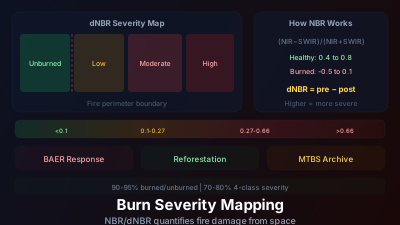
Quick Answer: Burn severity — the degree to which fire has altered the ecosystem — is mapped from satellites using the Normalized Burn Ratio (NBR), which exploits the contrast between NIR (decreases when vegetation burns) and SWIR (increases when vegetation burns and soil is exposed). The differenced NBR (dNBR = pre-fire NBR − post-fire NBR) classifies severity into categories from unburned to high severity. Landsat and Sentinel-2 are the primary sensors at 20-30m resolution. The USGS Monitoring Trends in Burn Severity (MTBS) program has mapped every large US fire since 1984 using Landsat. Timing matters: immediate post-fire imagery captures fire effects, but delayed assessment (1 year later) captures ecosystem response.
Burn severity — how much a fire has altered vegetation and soil — is mapped from satellites with the Normalized Burn Ratio (NBR), a simple index built from near-infrared and shortwave-infrared reflectance. Comparing NBR before and after a fire (differenced NBR, or dNBR) classifies the landscape from unburned to high severity, and Landsat and Sentinel-2 supply the free 20–30m imagery to do it. It is the difference between a strategic map produced in weeks and a ground survey that would take years.
After a severe wildfire season, resource managers face an urgent question: where exactly did the fires burn, and how severely? The answer determines everything from erosion risk assessment to reforestation planning to insurance claims processing. Ground survey of a landscape that burned across hundreds of thousands of hectares is impractical at that scale, which is why satellite-based burn severity mapping became the operational answer.
What is burn severity?
Burn severity describes the degree of ecological change a fire causes, from a surface fire that only singes ground litter to a stand-replacing burn that kills the canopy and exposes mineral soil. It is distinct from fire intensity (the energy released while the fire burns): severity is the lasting effect on the ecosystem, which is what post-fire management responds to. Field crews and satellites both sort it into classes:
Unburned/Very Low: Fire didn't reach this area, or surface fire passed through without significantly affecting vegetation or soil.
Low Severity: Surface fire consumed ground litter and some understory vegetation. Overstory trees survived. Soil is largely intact.
Moderate Severity: Understory consumed, some overstory mortality. Mix of surviving and killed trees. Some soil organic matter consumed.
High Severity: Complete canopy mortality. All surface organic matter consumed. Mineral soil exposed. Root systems killed.
The distinction matters because high-severity burns fundamentally change the ecosystem for decades — destroying seed banks, eliminating soil biota, increasing erosion risk dramatically, and often converting forest to shrubland.
How does the Normalized Burn Ratio (NBR) work?
NBR is the fire-mapping counterpart to NDVI: it contrasts the near-infrared and shortwave-infrared bands, both of which respond strongly to burning but in opposite directions. As the USGS, which documents the index, puts it, "NBR is used to identify burned areas and provide a measure of burn severity." The formula exploits two spectral responses that change dramatically with fire:
NIR (Band 8A in Sentinel-2, ~865 nm): Healthy vegetation reflects strongly in NIR. Burned vegetation absorbs NIR. Dead trees and charred surfaces have very low NIR reflectance.
SWIR (Band 12 in Sentinel-2, ~2190 nm): Healthy vegetation absorbs SWIR moderately. Burned areas, exposed soil, and charred surfaces reflect SWIR more strongly.
NBR = (NIR − SWIR) / (NIR + SWIR)
- Healthy forest: High NBR (0.4-0.8) — high NIR, moderate SWIR
- Burned area: Low or negative NBR (−0.5 to 0.1) — low NIR, high SWIR
Differenced NBR (dNBR)
The change in NBR between pre-fire and post-fire images:
dNBR = NBR_pre − NBR_post
| dNBR Range | Severity Class |
|---|---|
| < 0.1 | Unburned |
| 0.1 - 0.27 | Low severity |
| 0.27 - 0.44 | Moderate-low |
| 0.44 - 0.66 | Moderate-high |
| > 0.66 | High severity |
These thresholds are approximate — they vary by vegetation type, climate, and pre-fire condition. Local calibration against field plots improves accuracy.
Relativized dNBR (RdNBR)
Standard dNBR is biased by pre-fire vegetation condition: a high-biomass forest shows larger dNBR for the same severity than a sparse woodland simply because it had more to burn. RdNBR normalizes by pre-fire condition:
RdNBR = dNBR / √(|NBR_pre|)
This produces more comparable severity estimates across different vegetation types and pre-fire conditions.
When should burn severity be mapped?
Timing changes what a burn severity map actually measures, so the right window depends on the decision it will inform. Imagery captured within days to weeks of containment records the direct fire effect — charring, canopy consumption, exposed soil — and drives emergency response. Imagery from the first growing season afterward instead records the ecosystem's response, separating scorched-but-surviving trees from those that were killed, which is what long-term planning needs.
Immediate Assessment (Days to Weeks)
Using imagery acquired as soon as clouds and smoke clear after the fire:
- Captures the direct fire effect (charring, canopy consumption, soil exposure)
- May include actively smoldering areas and smoke residuals
- Best for: emergency response, erosion risk assessment, BAER (Burned Area Emergency Response)
Extended Assessment (1 Growing Season Later)
Using imagery from the first growing season after the fire:
- Captures vegetation response (what's regrowing vs. what's dead)
- More accurately reflects long-term ecological impact
- A tree that was scorched but survived will show green regrowth; one that was killed won't
- Best for: reforestation planning, ecological impact assessment, long-term monitoring
The USGS MTBS program produces both initial and extended assessment products for every large US fire.
Sentinel-2 vs. Landsat for Burn Severity
Both sensors are widely used:
| Feature | Sentinel-2 | Landsat 8/9 |
|---|---|---|
| Resolution | 20m (SWIR bands) | 30m |
| Revisit | 5 days | 16 days |
| Archive | 2015-present | 1984-present |
| SWIR bands | B11 (1610nm), B12 (2190nm) | B6 (1610nm), B7 (2190nm) |
Sentinel-2 advantage: Higher resolution and more frequent imaging increase the chance of a cloud-free post-fire observation. See the Sentinel-2 complete guide for band details.
Landsat advantage: The 40-year archive enables historical burn severity assessment back to 1984. The MTBS program uses this for comprehensive fire history analysis, as covered in the Landsat program guide.
Applications
Burned Area Emergency Response (BAER)
Within days of fire containment, burn severity maps drive emergency stabilization:
- High-severity areas → highest erosion and debris flow risk
- Prioritize erosion control treatments (mulching, log erosion barriers, channel protection)
- Identify infrastructure at risk from post-fire debris flows
- Determine watershed impacts on water supply
Reforestation Planning
Burn severity maps guide planting decisions:
- High severity: Active reforestation often needed (no surviving seed source)
- Moderate severity: Natural regeneration may be sufficient if seed trees survived
- Low severity: Monitoring only; forest will recover without intervention
Fire Effects Monitoring
Long-term monitoring of burn severity patterns reveals:
- Are fires getting more severe over time? (Yes, in many western US forests)
- What proportion of each fire burns at high severity?
- How does severity relate to pre-fire fuel conditions, weather, and topography?
Insurance and Damage Assessment
Satellite burn severity maps provide objective documentation of fire impact for:
- Property damage claims
- Agricultural loss assessment
- Timber loss quantification
- Infrastructure damage documentation
What Operational Burn Severity Products Look Like
Different agencies wrap the same NBR physics in different delivery timelines, and knowing which product you are looking at matters more than any single number:
- Crisis-mode mapping (Copernicus EMS, national civil protection) delivers a first burned-area and severity product within days of a request, at the cost of using whatever imagery is available through smoke and cloud.
- Programmatic mapping (USGS MTBS in the United States, national equivalents elsewhere) delivers both an initial and an extended assessment on a fixed schedule, prioritizing consistency across decades over speed.
- Research and post-hoc reanalysis refines severity with local field calibration, and usually reports better agreement with field plots than an operational product does — because it was tuned to that landscape.
The proportion of a fire that burns at high severity varies enormously between fire regimes: crown-fire-prone conifer forest and chaparral produce far larger high-severity fractions than savanna or surface-fire-adapted systems. Treat published high-severity fractions as regime-specific, not transferable.
The high-severity threshold matters for management decisions: In conifer and chaparral landscapes, areas mapped at high severity are at elevated risk of post-fire debris flows when rainfall arrives. Post-fire debris flow hazard assessments use satellite-derived burn severity as a direct input to identify the watersheds where emergency stabilization is most critical — a direct link from severity classification to emergency resource allocation.
Where the errors concentrate: Misclassification is not evenly spread. It clusters at adjacent-class boundaries — moderate mapped as high, or high as moderate-high — and in heterogeneous landscapes with mixed conifer/hardwood cover or complex topography, where spectral variability within a pixel is large. The practical implication is that burn severity maps should be used for strategic prioritization, not treated as ground truth at the individual pixel level.
Beyond NBR: Additional Indicators
NDVI change: Simpler than NBR but less sensitive to burn severity; more sensitive to vegetation response timing.
Burn Area Index (BAI): Designed to emphasize charcoal signal in the red-NIR spectral space.
SAR-based detection: Sentinel-1 coherence loss and backscatter change detect burned areas through smoke and clouds — useful when optical imagery is unavailable immediately post-fire.
Thermal anomalies: Active fire detection from MODIS and VIIRS maps fire progression in near-real-time, complementing post-fire severity assessment.
How accurate is satellite burn severity mapping?
Accuracy depends on how finely you slice the severity scale. Validation against field-measured Composite Burn Index (CBI) plots consistently shows the same ordering:
- Binary burned/unburned is the most reliable product — the spectral contrast between burned and unburned ground is large and unambiguous.
- Multi-class severity is meaningfully less reliable, because adjacent classes overlap spectrally.
- Continuous severity correlates with CBI, but the strength of that correlation varies by vegetation type, terrain, and how soon after the fire the image was taken; a relationship calibrated in one fire regime should not be assumed to hold in another.
Errors are highest at class boundaries (where moderate and high severity overlap spectrally) and in heterogeneous landscapes where small-scale severity variation occurs within single pixels. Local calibration against field plots is what turns a generic dNBR classification into a defensible severity map.
Burn severity mapping from satellites has become so routine and reliable that it's embedded in standard post-fire management workflows worldwide. The combination of well-understood physics (NBR), free satellite data (Landsat, Sentinel-2), and established operational programs (MTBS, Copernicus EMS) means that every significant wildfire on Earth can be mapped to a consistent standard — providing the spatial intelligence that post-fire landscape management requires. Burn severity is the post-fire half of a wider picture: pair it with a live active-fire map to track a blaze as it burns, and with forest degradation monitoring to catch the understory fires that leave the canopy standing but the forest changed.

Remote sensing specialist with 10+ years in satellite data processing and AI. Founder of Off-Nadir Lab. Ph.D. in Informatics (Yokohama National University, 2026). Master's in Earth System Science and Technology (Kyushu University). Co-author, Remote Sensing Encyclopedia. More about the author →