Electromagnetic Spectrum in Remote Sensing: Bands & Uses
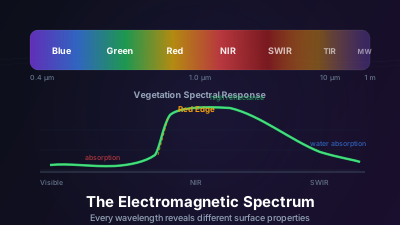
Quick Answer: Different wavelengths of the electromagnetic spectrum interact uniquely with Earth's surface materials. Visible bands (0.4–0.7 μm) produce natural-looking images; near-infrared (0.7–1.3 μm) is critical for vegetation analysis; shortwave infrared (1.3–3.0 μm) detects moisture and minerals; thermal infrared (3–15 μm) measures temperature; and microwaves (1 mm–1 m) penetrate clouds for all-weather imaging. Understanding which bands to use is the foundation of satellite data analysis.
Open a Landsat scene in a near-infrared band expecting something like a photograph, and the result is disorienting. Crop fields are blindingly bright, because healthy leaf tissue reflects most of the near-infrared that reaches it. Water is jet black, because it absorbs near-infrared almost completely. Roads flatten into the background, because dry, unvegetated surfaces have no comparable contrast in this part of the spectrum.
That is the practical introduction to spectral bands — and to the fact that Earth looks completely different depending on which slice of the electromagnetic spectrum you're observing.
The Spectrum at a Glance
The electromagnetic spectrum is the full range of energy wavelengths, from gamma rays shorter than an atom to radio waves longer than a football field. Remote sensing uses a specific portion of this range — from visible light through microwave — because these wavelengths pass through the atmosphere (at least partially) and interact meaningfully with surface materials.
Here's the breakdown of what each region tells us:
| Spectral Region | Wavelength | What It Reveals |
|---|---|---|
| Blue | 0.45–0.52 μm | Water depth, atmospheric scatter |
| Green | 0.52–0.60 μm | Vegetation vigor, turbidity |
| Red | 0.63–0.69 μm | Chlorophyll absorption (vegetation health) |
| Red Edge | 0.70–0.78 μm | Vegetation stress transition zone |
| Near-Infrared (NIR) | 0.78–1.3 μm | Vegetation density, water boundaries |
| Shortwave Infrared (SWIR) | 1.3–3.0 μm | Moisture content, minerals, burn scars |
| Thermal Infrared (TIR) | 3–15 μm | Surface temperature |
| Microwave | 1 mm–1 m | Surface roughness, moisture, structure |
Visible Bands: The Familiar View
Blue, green, and red bands combined produce what we call "true color" — an image that looks roughly like a photograph. This is useful for orientation and communication with non-technical audiences, but it's actually the least informative combination for analysis.
Each visible band does carry specific information:
Blue (Band 1 in most sensors) penetrates water deeper than other visible bands, making it useful for bathymetry in clear coastal waters. It's also the most affected by atmospheric scattering (Rayleigh scattering scales with λ⁻⁴, so blue light at ~450 nm is scattered roughly 4× more than red light at ~650 nm), which is why distant mountains look blue to your eyes and why uncorrected satellite images can have a bluish haze.
Green reflects strongly from healthy vegetation (that's why plants look green), and it penetrates water reasonably well. Useful for mapping submerged features in shallow water and assessing vegetation vigor in a general sense.
Red is absorbed heavily by chlorophyll. Healthy plants look dark in the red band because they're consuming that light for photosynthesis. Stressed or dying plants absorb less red light and start to look brighter. This absorption feature is half the foundation of NDVI.
Near-Infrared: Where Vegetation Shines
If one spectral region defines remote sensing, it is the near-infrared (NIR). The interaction between NIR and vegetation is dramatic and physically well-understood.
Healthy leaves contain internal structures called spongy mesophyll cells. These cells scatter near-infrared light strongly, causing it to reflect back toward the sensor. The result: vegetation appears extremely bright in NIR imagery — much brighter than anything else in the landscape.
A false color composite puts that NIR brightness on screen, and the Sentinel-2 viewer can show any scene that way.
This reflectance difference between red (strongly absorbed) and NIR (strongly reflected) is what makes vegetation indices work. NDVI is simply:
NDVI = (NIR − Red) / (NIR + Red)
When both values are similar (bare soil, water), NDVI is near zero. When NIR is much higher than Red (healthy vegetation), NDVI approaches +1.
Water, by contrast, absorbs nearly all NIR energy. In any NIR image, water bodies appear pure black. This makes NIR the go-to band for delineating coastlines, lake boundaries, and river channels.
Red Edge: The Stress Detector
The "red edge" is the narrow wavelength region between 700 and 780 nm where vegetation reflectance transitions sharply from low (red absorption) to high (NIR reflection). This transition point shifts depending on plant health.
Stressed vegetation shows a blue-shifted red edge — the transition happens at shorter wavelengths. Healthy, nitrogen-rich vegetation shows a red-shifted edge. The shift is subtle, typically just 5–20 nm, but sensors with dedicated red edge bands (like Sentinel-2's Bands 5, 6, and 7) can detect it.
Red edge information becomes critical when you need to distinguish between "reduced vigor" and "dying" — a distinction that standard NDVI often misses. Precision agriculture teams rely heavily on red edge indices for this reason.
Shortwave Infrared: Moisture and Minerals
SWIR bands are workhorses for geological and moisture-related applications. Two key interactions:
Water absorption: Liquid water absorbs SWIR energy. Wet soil appears darker in SWIR than dry soil. Vegetation with high water content (healthy crops at full turgor) reflects less SWIR than stressed, dehydrated vegetation. This makes SWIR bands essential for drought monitoring.
Mineral signatures: Clay minerals, iron oxides, and carbonates each have distinctive absorption features in the SWIR range. Geologists use band ratios involving SWIR to map mineral deposits without ever visiting the site. Iron oxide absorbs around 0.87 μm; clays show features near 2.2 μm.
SWIR is also crucial for burn scar mapping. Burned areas have reduced vegetation (lower NIR) and altered soil properties (different SWIR response), making the Normalized Burn Ratio (NBR = (NIR − SWIR) / (NIR + SWIR)) an effective fire damage metric.
Thermal Infrared: Measuring Temperature
Everything above absolute zero emits thermal radiation. Satellites with thermal bands measure this emission to estimate surface temperature.
Applications are surprisingly diverse:
- Urban heat islands: Cities are typically 2–8°C warmer than surrounding countryside. Thermal imagery quantifies this difference at the building-block scale.
- Volcanic monitoring: Rising surface temperatures near volcanoes can indicate magma movement weeks before an eruption.
- Fire detection: NASA's FIRMS system uses thermal bands on MODIS and VIIRS to detect active fires globally, updated multiple times daily.
- Water temperature: Sea surface temperature from thermal sensors feeds into weather models and fisheries management.
The major limitation: thermal bands have coarse spatial resolution. Landsat's thermal band is 100 meters (resampled to 30 m); MODIS is 1 kilometer. You can map temperature patterns across a city, but not individual rooftops.
Microwave: Seeing Through Everything
Microwave wavelengths (roughly 1 mm to 1 m) form the basis of radar remote sensing. Unlike all the bands discussed above, microwaves penetrate clouds, rain, smoke, and darkness. This all-weather, day-night capability makes radar indispensable for monitoring areas with persistent cloud cover — the tropics, for instance, or disaster zones during storms.
Radar sensors measure something fundamentally different from optical sensors. Instead of reflected sunlight, they measure the roughness and dielectric properties of the surface. Smooth surfaces (calm water, paved roads) reflect radar energy away like a mirror — they appear dark. Rough surfaces (forest canopy, urban buildings) scatter energy back — they appear bright.
Different radar wavelengths penetrate differently:
- X-band (~3 cm): Interacts with small features like leaves and twigs. Useful for agriculture.
- C-band (~5.6 cm, Sentinel-1): Penetrates light vegetation, good for crop monitoring and flood mapping.
- L-band (~24 cm, NISAR): Penetrates deeper into vegetation canopy, reaching trunks and branches. Better for forest structure and under-canopy flooding.
Atmospheric Windows
Not all wavelengths reach the ground. Earth's atmosphere absorbs specific wavelength ranges — water vapor blocks much of the mid-infrared; ozone absorbs ultraviolet; CO₂ and methane have their own absorption bands.
Satellite sensors are designed to operate within "atmospheric windows" — wavelength ranges where the atmosphere is relatively transparent. This is why you don't see satellite sensors operating at, say, 6.3 μm (a strong water vapor absorption band) for surface studies. That wavelength is used instead for measuring atmospheric water vapor itself.
Understanding atmospheric windows matters because it explains why certain spectral bands exist where they do. The placement of Sentinel-2's 13 bands wasn't arbitrary — each was positioned within an atmospheric window to maximize surface information.
Practical Takeaway
When choosing which bands to work with, start with the question, not the data:
- "What's growing here?" → NIR + Red (NDVI), Red Edge for stress
- "How wet is the soil?" → SWIR bands
- "Is there flooding?" → SAR (microwave), or NIR for cloud-free conditions
- "What minerals are present?" → SWIR band ratios
- "How hot is this area?" → Thermal infrared
- "What happened under the clouds?" → Microwave (SAR)
The spectrum is a toolkit. Each wavelength range is a different instrument designed for a different job. The skill in remote sensing lies in knowing which tool to reach for.
Frequently asked questions
Which regions of the electromagnetic spectrum are used in remote sensing?
The main regions are visible light (0.4–0.7 μm), near-infrared (0.7–1.3 μm), shortwave infrared (1.3–3.0 μm), thermal infrared (3–15 μm), and microwave (1 mm–1 m). Each interacts differently with Earth's surface, so each reveals different information.
Why is near-infrared so important for vegetation analysis?
Healthy vegetation reflects near-infrared very strongly while absorbing red light for photosynthesis. That large contrast is the basis of vegetation indices, making near-infrared the single most useful band for assessing plant vigor and stress.
What does shortwave infrared reveal?
Shortwave infrared is sensitive to water content and mineralogy. It separates moist from dry surfaces, helps map soil and rock composition, and is valuable for detecting burn severity and drought stress.
What does thermal infrared measure?
Thermal infrared measures emitted rather than reflected radiation, which corresponds to surface temperature. It is used for heat mapping, urban heat islands, volcanic and fire monitoring, and evapotranspiration studies, and it works day or night.
Why can microwave and radar sensors see through clouds?
Microwave wavelengths are long enough to pass through clouds and rain with little attenuation, so radar provides all-weather, day-and-night imaging. This is why SAR is relied upon for flood mapping and monitoring persistently cloudy regions.

Remote sensing specialist with 10+ years in satellite data processing and AI. Founder of Off-Nadir Lab. Ph.D. in Informatics (Yokohama National University, 2026). Master's in Earth System Science and Technology (Kyushu University). Co-author, Remote Sensing Encyclopedia. More about the author →