
Why Use an Event-Intelligence Platform When You Already Have ChatGPT or Claude?
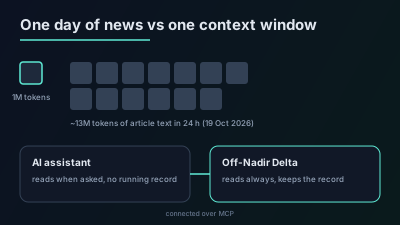
Quick Answer: A general AI assistant such as ChatGPT or Claude reads what it can fetch at the moment you ask, inside one context window, and keeps no running record of the events when the conversation ends. That is the wrong shape for watching the world. In the 24 hours to 19 October 2026, Off-Nadir Delta took in 15,122 articles, about 45 million characters of text, which is roughly 13 million tokens at Anthropic's figure of about 3.5 English characters per token, or more than ten 1M-token context windows for a single day. A bigger window does not close the gap either, because model accuracy drops as context grows. Delta does the work that has to happen whether or not anyone asks. It reads continuously, folds reports of the same event into one record, keeps what changed along with its source, places each event only as precisely as the reporting allows, and records events that never reach the news. It does not replace an assistant. Connected over MCP or the REST API, the assistant reasons over Delta's records instead of re-reading the news.
A general AI assistant reads what it can fetch at the moment you ask, inside one context window, and does not keep a running record of the events once the conversation ends. Off-Nadir Delta does the opposite. It reads world events continuously, whether or not anyone is asking, and keeps a record of them. The two are not rivals. The useful setup is an assistant that reasons over Delta's record instead of rebuilding it from search results every time you ask.
This article sets out where that line falls, with the numbers measured on the day of writing.
What can a general AI assistant already do with the news?
A current AI assistant can search the web, open articles, summarise them and reason about what they mean, and it does all of that well. Anthropic's documentation states that current Claude models have a context window of up to 1M tokens, which is enough to read a long report or a stack of articles in one go. For one question about one event that happened in the last few hours, an assistant with web search is often the fastest route to a readable answer.
The limits come from how that work is shaped. The assistant works when asked, on what it fetched for this question, inside one conversation. Watching the world needs work in a different shape: continuous, complete and remembered.
How much news is there in one day?
More than any single context window can hold. In the 24 hours to 10:24 UTC on 19 October 2026, Off-Nadir Delta ingested 15,122 articles and official reports. 12,738 of them had article text, with a median length of 3,120 characters and a mean of 3,567, so about 45 million characters for one day.
Anthropic's glossary states that a token represents approximately 3.5 English characters on earlier Claude models, and that newer models produce about 30 percent more tokens for the same text. At 3.5 characters per token, one day of this text is roughly 13 million tokens, or more than ten 1M-token context windows. The newer tokenizer makes the gap wider, not narrower. That count is for one day only, before last week, before last month, and before the question of what changed between them.
Would a bigger context window solve it?
No. A larger window holds more text, but it does not make the model use all of that text equally well. Anthropic's own documentation states it directly:
"More context isn't automatically better. As token count grows, accuracy and recall degrade, a phenomenon known as context rot." (Anthropic, Context windows)
Peer-reviewed research found the same pattern earlier. In Lost in the Middle: How Language Models Use Long Contexts (Liu et al., Transactions of the Association for Computational Linguistics), performance "significantly degrades when models must access relevant information in the middle of long contexts", including in models built for long inputs.
Even with unlimited context, three problems would remain. The assistant would still have to fetch everything. It would still start from nothing in the next conversation. And every user would pay to have the same articles read again for every question.
What does an assistant miss when it only searches the news?
It misses events that the news does not carry yet, or never carries. Search returns ranked results for the words in your question, and events that never became articles do not appear in those results at all.
Delta measured one such case on 5 September 2026. About 6.5 hours after Anak Krakatau sent an ash plume to FL500 (roughly 50,000 ft) and aviation authorities issued SIGMET volcanic-ash warnings, a widely used open global event dataset built from news had 29,838 rows for that window and none mentioning Krakatau. The aviation warning existed. The news record did not.
For that reason Off-Nadir Delta does not rely on news alone. It also records measured events, events made from instrument data or official records instead of reporting. Examples include heat sources measured by satellite near registered facilities, changes in ship transits through 28 straits and canals, night-light drops over listed cities, and volcanic-ash advisories. Each one states what was recorded and never claims a cause.
Why does it matter that the record is kept over time?
Most intelligence questions are about change: is this getting worse?, is this the same strike or a new one?, what is new since yesterday? An assistant answers them by searching again and reading what ranks now. Some assistant apps remember facts about you between conversations, or can repeat a request on a schedule, but neither keeps a record of each event with its earlier values and the source of every change.
Off-Nadir Delta's current record starts on 23 September 2026. As of 19 October 2026 it holds roughly half a million ingested documents, folded into about 26,000 event records with about 55,000 recorded changes (approximate table counts). Each recorded change keeps what the value was, what it became, and the source behind the change. Rewording in a new article is not counted as a change. Watches on the Watchlist are checked every hour, so a change in an event you follow comes to you without anyone asking.
What does Delta work out that an assistant would have to redo every time?
The steps that make a pile of articles usable as evidence:
| Step | What a general assistant does | What Off-Nadir Delta records |
|---|---|---|
| Same event, many articles | Reads whatever search returns. Fifty reprints can look like fifty confirmations | Folds reports of the same event into one record and counts distinct outlets, stating that syndicated reprints are not independent confirmation |
| Where it happened | Writes a place name in prose | Resolves the place only as far as the reporting allows, on a three-step ladder (reported, localized, pinpointed), and says why it stopped |
| Casualty and damage figures | Repeats a figure from whichever article it read | Keeps the article each figure came from, and leaves out a large figure that only one report states |
| Could a satellite check it? | Cannot tell without the place's precision and the size of the mark | States whether the event is observable from orbit and why not when it is not, and searches the satellite scenes over its footprint on request |
| Linked places | Infers from names in the text | Links events to a registry of facilities, saying whether the reporting named the place or the event was only near it |
The rules behind each column are published on the methodology page. That page also states which decisions are made by fixed rules rather than by a model, including the outlet count, how far a place is resolved and whether an event is observable.
Is Off-Nadir Delta more accurate than an AI assistant?
That is not a claim this article makes, and it is not the right comparison. Off-Nadir Delta uses language models too, to read each article for what happened, where and when, so it can make mistakes. The difference is that the mistakes are checked and published. Delta runs automated consistency checks over the whole record every day and shows the result as it is. At 00:32 UTC on 19 October 2026, 47 of 58 checks passed, and the methodology page lists each check that did not pass with its number of cases. An assistant's answer in a chat window has no equivalent record that can be audited.
How do Off-Nadir Delta and an AI assistant work together?
Connect them. Off-Nadir Delta runs a Model Context Protocol (MCP) server, so Claude, ChatGPT and other MCP clients can call it as a tool. The setup guide covers each client. Code can use the same records through the REST API and the Python SDK.
Consider a hypothetical scenario: an analyst asks their assistant whether shipping through the Bab el-Mandeb strait has changed this week. Without Delta, the assistant searches, reads whichever articles rank highest, and summarises them. With Delta connected, it can read the strait's measured transit level against its own usual range, the events already linked to that strait, and what changed in each one along with its source, and then do what assistants do well: explain what it means and answer the follow-up questions.
In that split, Delta does the continuous reading, the folding, the placing and the remembering, and the assistant does the reasoning and the conversation. Each side does the part it is built for.
Related: Track world events with ChatGPT or Claude · How to give an AI agent live world-event awareness · Can AI read a satellite image? · Glossary

Remote sensing specialist with 10+ years in satellite data processing and AI. Founder of Off-Nadir Lab. Ph.D. in Informatics (Yokohama National University, 2026). Master's in Earth System Science and Technology (Kyushu University). Co-author, Remote Sensing Encyclopedia. More about the author →