
How to Give an AI Agent Live World-Event Awareness (MCP + REST API)
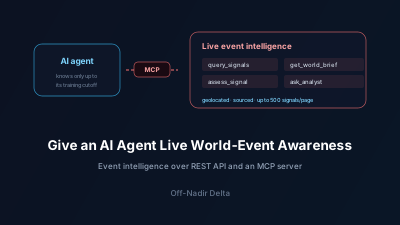
Quick Answer: A language model's knowledge ends at its training cutoff, so it cannot answer 'what is happening in the world today' on its own. Two integration surfaces fix that. A REST API (under /api/v1) lets your own code pull geolocated world event signals, the Daily World Brief, and AI analysis; it uses bearer API-key auth, is metered on a token balance, and is cursor-paginated up to 500 signals per page. A Model Context Protocol (MCP) server exposes the same intelligence to AI agents as tools (query_signals, search_imagery, get_world_brief, get_usage, assess_signal, ask_analyst and more — the MCP docs list the roster that is live right now), and resources (brief://latest, signals://schema, usage://current) — so an MCP-capable client like Claude Code can use it conversationally after a one-line setup. Both surfaces are available on every plan, including Free: the only gate is your token balance, and get_world_brief plus get_usage cost no tokens. Use REST for backends and dashboards; use MCP to give an agent situational awareness.
Ask a general-purpose AI assistant what happened in the world this morning and it will tell you it does not have real-time information. Its knowledge stops at its training cutoff. The fix is not a bigger model — it is giving the model a way to fetch current, sourced events. This post shows the two surfaces that do that: an event intelligence REST API for your own code, and a Model Context Protocol (MCP) server for AI agents.
Why can't an AI model answer "what is happening today" on its own?
Because a language model is trained once, up to a fixed cutoff date, and has no live connection to the world after that. It can reason fluently about events it was trained on, but it cannot know about a strike, a flood, or a border movement that happened this week. To answer current questions it must call an external tool that returns fresh data — which is exactly what an API or an MCP server provides. Grounding a model in retrieved, cited facts also reduces the tendency to fabricate specifics it does not actually know.
What is the difference between a REST API and an MCP server?
A REST API is for your code; an MCP server is for AI agents. With REST, you write the integration — issue HTTP requests, parse JSON, handle pagination. With MCP, you register the server once and the agent discovers and calls the tools itself, conversationally. Both hit the same data and the same token wallet underneath.
| REST API | MCP server | |
|---|---|---|
| Consumer | Your backend / scripts | An AI agent or assistant |
| Interface | HTTP endpoints + JSON | Tools and resources |
| You write | The integration code | A one-line registration |
| Best for | Dashboards, feeds, pipelines | Giving an agent situational awareness |
| Transport | HTTPS request/response | Streamable HTTP (MCP) |
The Model Context Protocol is an open standard for connecting AI applications to external tools and data; see the MCP specification for the protocol itself. Off-Nadir Delta implements an MCP server so any MCP-capable client can consume its event intelligence directly.
What can the event intelligence REST API return?
The REST API exposes a growing set of endpoints under /api/v1, each authenticated with a bearer API key and metered on your token balance. The core ones — see the API reference for the complete, current list:
GET /api/v1/signals— geolocated world event signals (geopolitical, security, disaster, infrastructure), each with coordinates, a severity score, source links, and a collection recommendation. Filter by bounding box, date window, and category; up to 500 rows per page, cursor-paginated. A differential mode (updated_since/created_since) returns only signals (re-)enriched after a timestamp, so a polling agent fetches deltas instead of re-reading the whole window.GET /api/v1/brief— the AI-synthesized Daily World Brief (headline, summary, top developments, Key Judgments). Free of token charges, so it doubles as a key-verification call.GET /api/v1/usage— your remaining token balance and plan capabilities. Free — call it before a metered request to check what you can spend.POST /api/v1/assess— an AI remote-sensing assessment for a single event: what to observe and which sensor to task.POST /api/v1/analyst— pose an OSINT/GEOINT question and get a structured, cited brief from an agentic analysis.
Responses carry rate-limit headers (X-RateLimit-Remaining, X-RateLimit-Reset), the signals endpoint is cursor-paginated (meta.next_cursor, meta.has_more), and metered calls accept an Idempotency-Key so a retry is charged only once. A machine-readable OpenAPI 3.1 spec is available for codegen. Full parameters and examples are in the API & MCP reference.
What does the MCP server expose to an agent?
The MCP server, at /api/v1/mcp over Streamable HTTP, presents the same intelligence as MCP tools and resources:
- Tools —
query_signals,search_imagery,get_world_brief,get_usage,assess_signal, andask_analyst, among others; the roster has grown since this post was written, and the MCP docs list what is live right now. These are the actions the agent can take. Every result carries a one-line natural-languagesummaryplus structured output carrying the full result. - Resources — among them
brief://latest, the templatedbrief://{date},signals://schema, andusage://current. These are readable context the agent can pull in, including the field schema so it knows what it can reason over.
With these, an agent can go from "what is happening in the world today" to a specific, sourced assessment — reading the brief, querying events near an area of interest, and asking the analyst — with no custom glue code.
How do I connect the MCP server to Claude Code?
Issue an API key from Account → Developer API, then register the server as an HTTP transport with your key as a bearer header. In Claude Code:
claude mcp add --transport http off-nadir-delta \
  https://offnadir-delta.com/api/v1/mcp \
  --header "Authorization: Bearer ond_..."
Any MCP client that supports HTTP transports connects the same way — point it at https://offnadir-delta.com/api/v1/mcp and pass the Authorization header. Because the server uses the same API key and token balance as the REST API, you revoke a key to cut off access, and usage is capped by your balance — so you stay in control of what an agent can spend.
Which plans include the API and MCP server, and what does it cost?
Every plan, including Free — the only gate is your token balance. The API key and MCP server run on the same token wallet as the app, so a metered call simply spends from your monthly allowance. get_world_brief and get_usage cost no tokens; query_signals and search_imagery are billed per query; and assess_signal and ask_analyst are billed per call (the analyst is usage-based, and each response reports the exact charge in meta.tokens). There is no separate seat license or per-image contract. Call get_usage — or read the usage://current resource — to see your remaining balance and plan capabilities before spending on a metered call. When the balance runs out, calls return a clear error until it resets or you top up.
When should I use each surface?
Use the REST API when you are building something deterministic — a dashboard, a common operating picture, an area-watch alert that polls a bounding box on a schedule, or a report generator that pulls the brief and Key Judgments. Use the MCP server when you are giving an assistant situational awareness — so it can answer current questions grounded in sourced, geolocated events instead of a training snapshot. The two are not exclusive: the same API key can feed a dashboard over REST while an agent reaches the same data over MCP.
Both draw on the same event layer that powers the Delta Watchfloor and the Delta Agent — Delta Signals, geolocated events distilled from global news media. For the standards behind the analysis those tools return, see what a daily intelligence report is, and the glossary for OSINT, GEOINT, and tip-and-cue. For the product overview of both surfaces, see the event intelligence API and the MCP server pages.

Remote sensing specialist with 10+ years in satellite data processing and AI. Founder of Off-Nadir Lab. Ph.D. in Informatics (Yokohama National University, 2026). Master's in Earth System Science and Technology (Kyushu University). Co-author, Remote Sensing Encyclopedia. More about the author →