
From News Feed to Intelligence Report: What Key Judgments and Confidence Add
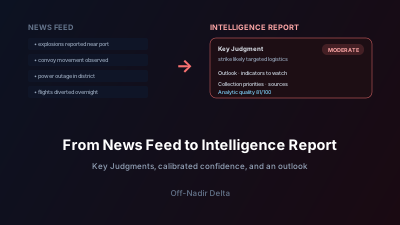
Quick Answer: An intelligence report differs from a news feed by adding assessment. Where a feed says 'explosions reported near a port,' a report offers a Key Judgment ('the strike likely targeted logistics infrastructure — moderate confidence'), an outlook, and the indicators that would confirm it. The structure comes from intelligence-community analytic standards (ODNI ICD 203): bottom-line-up-front Key Judgments, an explicit confidence level (high / moderate / low) stated separately from the judgment itself, consideration of alternatives, and relevance to a decision. Off-Nadir Delta publishes one daily intelligence report per day, distilled from geolocated global event signals, with an analytic-quality score and PDF export. The public daily brief is free to read, including a per-day archive.
A news feed tells you what happened. An intelligence report tells you what it means, how firmly, and what to watch next. That gap — between a list of events and an assessment you can act on — is the whole reason intelligence reports exist. This post explains the pieces that close it: Key Judgments, analytic confidence, and an outlook, using the same standards professional analysts work to.
What is the difference between a news feed and an intelligence report?
A news feed is a chronological list of reported events; an intelligence report is a structured assessment of what those events mean. Where a feed states "explosions reported near a port," a report states a judgment — "the strike likely targeted logistics infrastructure (moderate confidence)" — and adds an outlook and the observable indicators that would confirm or break it. The feed reports; the report assesses, calibrates, and points to what to collect next.
| News feed | Intelligence report | |
|---|---|---|
| Unit | Individual events, newest first | An assessment of the day as a whole |
| Answers | What happened | What it means, and how firmly |
| Confidence | Implicit / absent | Stated explicitly per judgment |
| Forward view | None | Outlook + indicators to watch |
| Sourcing | A single article | Multiple sources, weighed for reliability |
What are Key Judgments?
Key Judgments are the most important analytic conclusions of a report, stated up front before the supporting detail — a structure often called BLUF (bottom line up front). Rather than making a reader hunt for the takeaway, the report leads with three to six judgments that carry the assessment. The US Office of the Director of National Intelligence codifies this in Intelligence Community Directive 203 (Analytic Standards), which requires finished analysis to be "objective," to "properly distinguish between underlying intelligence and analysts' assumptions and judgments," and to express uncertainty clearly.
A Key Judgment is not a headline. "Port hit overnight" is a fact; "the strike likely signals a shift to targeting logistics rather than front-line units (moderate confidence)" is a judgment — an inference that goes beyond the reporting, and that a reader can agree or disagree with.
What is analytic confidence, and why is it separate from the judgment?
Analytic confidence is an explicit rating — commonly high, moderate, or low — of how much trust to place in a judgment, based on the quality of the sources and the strength of the reasoning. Critically, it is stated separately from the judgment. ICD 203 directs analysts to distinguish "confidence in the analytic judgment" from "the likelihood of an event," so a strongly worded conclusion held on thin evidence is never mistaken for an established fact.
The distinction matters because two failure modes look identical without it: an accurate hedge read as certainty, and a genuine warning buried in caveats. Stating confidence as its own value keeps "we assess X will likely happen" (a calibrated forecast) from being read as "X is happening" (a report of fact). See the glossary for the related terms GEOINT, OSINT, and tip-and-cue.
What makes an assessment "well-produced" rather than just confident?
A well-produced assessment is auditable, not merely assertive: each judgment is sourced, its confidence is calibrated, alternative explanations are weighed, and the analysis is relevant to a decision. ICD 203 lists nine tradecraft standards — including proper sourcing, expression of uncertainty, distinguishing intelligence from assumptions, incorporation of alternatives, and logical argumentation. The test of a report is not how boldly it asserts, but whether you can trace every conclusion back to what was observed.
Off-Nadir Delta's daily report is scored against these criteria before publication. Each report carries an analytic-quality score produced by an automated second-pass review of its tradecraft — a separate model pass that did not write the report, not a third-party assessment — asking whether each judgment is properly sourced, whether confidence is calibrated, whether alternatives are considered, and whether the analysis is decision-relevant. That score travels with the report, so a reader can see how firmly the day's analysis holds together. A draft that scores below the threshold — or that carries a fatal tradecraft issue, or fails a deterministic grounding check — is revised once against the critique before publication.
How is Off-Nadir Delta's daily report structured?
Each daily report follows the same professional structure end to end: Key Judgments first, then an outlook and indicators, then collection priorities. The building blocks are:
- Key Judgments — the bottom-line conclusions about the day, each with a stated confidence level.
- Outlook & indicators — likely trajectories in probabilistic language, plus the observable indicators and warnings that would confirm or break each line.
- Collection priorities — where imaging or further collection would pay off most: the areas and questions worth tasking a satellite sensor against next.
- Quality score — an analytic-quality rating from an automated second-pass review of the report's tradecraft (a separate model pass, not a third-party assessment).
The report is distilled from Delta Signals — geolocated geopolitical and security events drawn from global news media and continuously enriched — the same event layer that powers the Delta Watchfloor. Every judgment cites the underlying events, so you can trace it back to what was reported. For the product overview, see what is a daily intelligence report.
How do I read the daily report — and is it free?
You read it two ways. The public daily brief at /brief is the free daily narrative, with a permanent per-day archive you can cite. The full Daily Report at /reports adds the analyst-grade layer: Key Judgments with confidence, an interactive world signal map, the quality score, and PDF export — pick any day from a calendar. How far back the archive goes scales with your plan.
One feature is worth calling out. PDF export renders any daily report as a formatted document with a signal map and trend charts, suitable for a morning brief or an archive. If you want the machine-readable version for your own tooling, the same brief and signals are available through the event intelligence API.
Why does this matter for OSINT and situational awareness?
Because volume is not the constraint — assessment is. Open sources produce more event data every day than any analyst can read; the value is in distilling it into a small number of calibrated judgments about what actually matters and how much to trust them. That is the difference between geospatial OSINT as a firehose and as a discipline. A daily report structured to ICD-203-style standards turns "here is everything that was reported" into "here is what we assess is happening, how confident we are, and what to watch" — the form of a briefing you can act on.

Remote sensing specialist with 10+ years in satellite data processing and AI. Founder of Off-Nadir Lab. Ph.D. in Informatics (Yokohama National University, 2026). Master's in Earth System Science and Technology (Kyushu University). Co-author, Remote Sensing Encyclopedia. More about the author →