
Tracking Urban Expansion from Space with NDBI
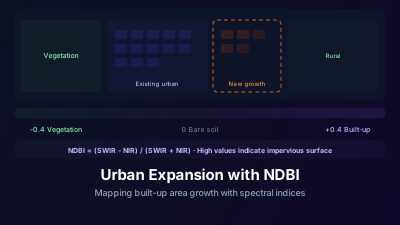
Quick Answer: NDBI uses the contrast between SWIR and NIR reflectance to highlight built-up areas. Impervious surfaces like concrete and asphalt reflect more SWIR than NIR, producing positive NDBI values. Vegetation shows negative NDBI. Combining NDBI with NDVI creates a simple but effective urban/vegetation classifier. Multi-date NDBI comparison reveals urban expansion patterns over time.
Why Urban Mapping Matters
Urban areas cover less than 3% of Earth's land surface but house over half the global population. Understanding where and how fast cities grow affects infrastructure planning, environmental assessment, and climate adaptation.
Traditional urban mapping relies on high-resolution imagery and manual digitization — accurate but slow and expensive. Spectral indices like NDBI offer an automated alternative that scales to continental and global levels.
How NDBI Works
The Normalized Difference Built-up Index exploits a spectral characteristic of impervious surfaces:
- Built-up materials (concrete, asphalt, rooftiles) reflect more SWIR than NIR
- Vegetation reflects more NIR than SWIR (the same property NDVI uses)
NDBI = (SWIR - NIR) / (SWIR + NIR)
For Sentinel-2: (B11 - B8) / (B11 + B8)
Notice that NDBI is essentially the inverse of many vegetation indices. Where vegetation dominates, NDBI is negative; where built-up surfaces dominate, NDBI is positive.
| Surface Type | NDBI Value |
|---|---|
| Dense vegetation | -0.4 to -0.1 |
| Water | -0.5 to -0.2 |
| Bare soil | -0.1 to +0.2 |
| Low-density urban | 0.0 to +0.2 |
| High-density urban | +0.1 to +0.4 |
| Industrial/commercial | +0.2 to +0.5 |
The NDBI-NDVI Combination
NDBI alone can't perfectly separate built-up areas from bare soil — both have similar SWIR/NIR ratios. The classic solution is to combine NDBI with NDVI:
- Built-up: NDBI > 0, NDVI < 0.2
- Vegetation: NDBI < 0, NDVI > 0.3
- Bare soil: NDBI slightly positive, NDVI < 0.15
- Water: both strongly negative
A simple Built-up Index (BUI) can be calculated as:
BUI = NDBI - NDVI
Areas where BUI is strongly positive are almost certainly built-up. This two-index approach significantly reduces confusion between urban areas and bare soil.
Mapping Urban Growth Over Time
The real power of NDBI emerges in multi-temporal analysis. Compare NDBI from two dates to identify urban expansion:
What to Look For
- Pixels that changed from negative to positive NDBI — Vegetation or farmland converted to built-up surface
- Pixels where positive NDBI increased further — Urban densification (low-rise to high-rise, green suburbs to dense commercial)
- Directional patterns — Urban expansion typically follows transportation corridors and radiates from city centers
Choosing Comparison Dates
- Use same-season imagery to avoid phenological confusion (green summer farmland vs brown winter farmland)
- 5-10 year intervals show clear urban growth patterns
- The Sentinel-2 archive begins in 2015, providing over a decade of data
Practical Applications
Urban Heat Island Assessment
Built-up surfaces absorb and re-emit more heat than vegetation. NDBI maps correlate with land surface temperature, making them useful for identifying urban heat island hotspots and prioritizing urban greening efforts.
Infrastructure Planning
Rapid urban expansion often outpaces infrastructure development. NDBI time-series can identify areas of recent growth that may need new roads, water supply, or waste management services.
Environmental Impact Assessment
Converting farmland or forest to urban areas is irreversible for practical purposes. NDBI-based change detection quantifies how much natural land has been lost to development over specific periods.
Land Use Regulation Compliance
Compare actual built-up expansion (from NDBI) against permitted development zones to identify potential unauthorized construction.
Limitations to Be Aware Of
Bare Soil Confusion
The biggest limitation of NDBI is confusion with bare soil, particularly in:
- Construction sites (actually related to urbanization, but not yet "built-up")
- Agricultural fallow periods
- Desert fringes
The NDBI-NDVI combination mitigates this, but doesn't eliminate it entirely.
Mixed Pixels at Urban Edges
At 10-20m Sentinel-2 resolution, pixels at the urban-rural boundary contain both built-up and vegetation signals. These mixed pixels produce intermediate NDBI values that are hard to classify definitively.
Seasonal Variation
Urban surfaces have relatively stable NDBI year-round, but surrounding vegetation changes seasonally. A winter NDBI map may show "more urban area" simply because deciduous trees have lost their leaves, reducing the contrast between urban and vegetated pixels.
Complementary Approaches
Nighttime Lights
VIIRS nighttime lights data provides an independent measure of urbanization based on artificial lighting rather than surface reflectance. Areas with increasing nighttime brightness that also show positive NDBI changes are almost certainly experiencing genuine urbanization.
SAR-Based Urban Detection
Buildings produce strong double-bounce reflections in SAR imagery, creating distinctive bright signatures in Sentinel-1 data. SAR-based urban detection is complementary to NDBI — it works through clouds and responds to building structure rather than surface material.
Try It in Off-Nadir Delta
Off-Nadir Delta includes NDBI as a built-in visualization for Sentinel-2 imagery:
- Load Sentinel-2 data over a city or metropolitan area
- Switch to NDBI visualization — bright areas indicate built-up surfaces
- Compare with NDVI visualization to confirm the urban/vegetation boundary
- Load imagery from different years and toggle between them to see urban expansion
- Use change detection for systematic multi-date comparison
