
Seerist vs Dataminr: How the Risk Intelligence Tools Compare
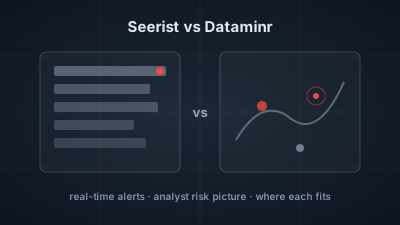
Quick Answer: Seerist and Dataminr both alert security teams to world events, but they are built differently. Dataminr is an AI-first real-time alerting platform that says it reads more than 1 million public data sources in 150 languages and aims for the earliest warning. Seerist, launched in 2022 from Geospark Analytics and Control Risks, pairs AI event detection with analyst-curated and analyst-verified intelligence for operational, travel and geopolitical risk. Everbridge and Crisis24 wrap risk intelligence into critical event management, mass notification and travel risk services; Base Operations focuses on street-level crime and unrest data for planning. None publishes full prices; all are demo-led.
Seerist and Dataminr answer the same question, what is happening that affects my people and sites?, from opposite starting points. Dataminr starts from machine detection across public data and sells speed: its home page says the platform "delivers the earliest warnings on high impact events and critical information". Seerist starts from analyst judgement and adds AI on top: it describes itself as "curated by analysts", with Control Risks analysts embedded in the product.
This article compares the two, then Everbridge, Crisis24 and Base Operations, which come up in the same searches. Every product statement comes from the vendor's own pages, opened on 12 November 2026. It does not repeat customer counts or performance claims, and it does not rank the tools. Off-Nadir Delta, the product this site publishes, is included at the end with what it does not do.
What is Seerist?
Seerist is a risk intelligence platform for security, intelligence and operations teams that combines AI event detection with human analysis. The company says it "Launched August 2022 as combination of Geospark Analytics and Control Risks" (Seerist: company). Its home page says the product embeds "200+ Control Risks analysts" and that "Seerist is curated by analysts" (Seerist).
On the AI side, Seerist lists EventsAI, which "detects and categorizes emerging events at global scale, while Verified Events add human confirmation, source validation, and event-level context" (Seerist platform), and an assistant called AskAnna, "the analyst-trained AI inside Seerist". Its Monitor product describes "Open-source feeds and in-region analyst verification, distilled into one auditable stream" with "alerts, geofences, asset-bound risk surfaces" (Seerist Monitor). The solutions menu covers operational security, travel security, supply chain risk and geopolitical intelligence. Access is by demo; no price list was found.
What is Dataminr?
Dataminr is an AI platform for real-time alerts on events, threats and risks, sold to corporate security teams, governments and cyber defenders. Its home page describes "Multi-Modal Fusion AI for discovery, Generative AI for description, and Agentic AI for context" across "1M public data sources" (Dataminr). The corporate security product, Dataminr Advanced for Corporate Security, says it synthesises "text in 150 languages, image, video, audio, and sensor signals across 1M+ public data sources", using "more than 60 purpose-built, specialized LLMs" (Dataminr for Corporate Security).
Dataminr's product family also includes First Alert for the public sector and Dataminr for Cyber Defense. In October 2025 Dataminr announced its intent to acquire ThreatConnect, which it describes as "a premier intelligence management platform for contextualizing and prioritizing threats" (Dataminr, 21 October 2025); in March 2026 it released "the first unified solution from the acquisition of ThreatConnect" (Dataminr, 23 March 2026). Maps come through an Esri integration that lets teams "visualize events, threats, and risks alongside critical infrastructure". Dataminr publishes no prices and offers demos.
How does Seerist compare to Dataminr?
Seerist compares to Dataminr as an analyst-led risk picture compares to a machine-led alert stream. Dataminr's pitch is breadth and speed: very many public sources, many languages and modalities, and automated detection meant to arrive first. Seerist's pitch is judgement: AI detection paired with analyst verification, Control Risks reporting written for the platform, and scores and context meant for planning as well as response. Both say they use AI and both put events on a map.
| Seerist | Dataminr | |
|---|---|---|
| Starting point | Analyst-curated intelligence with AI detection | AI detection across public data |
| What it says it reads | "Open-source feeds and in-region analyst verification" | "1M+ public data sources", text in 150 languages, image, video, audio, sensor signals |
| Human analysts | Control Risks analysts embedded; "Verified Events add human confirmation" | Not the emphasis on the pages opened |
| AI named on its pages | EventsAI, PulseAI scores, AskAnna assistant | Multi-Modal Fusion AI, Generative AI, Agentic AI; 60+ specialised LLMs |
| Typical jobs named | Operational security, travel security, supply chain risk, geopolitical intelligence | Corporate security alerting, public-sector first alerts, cyber defence |
| Maps | Geofences and "asset-bound risk surfaces" | Esri integration |
| Ownership notes | Launched 2022 from Geospark Analytics and Control Risks | Acquired ThreatConnect (announced Oct 2025; first combined product Mar 2026) |
| Pricing | Not published; demo | Not published; demo |
A practical way to choose is to ask which failure costs you more. If missing the first minutes of an incident is the larger risk, a detection-first service like Dataminr is built for that. If acting on an unverified or out-of-context report is the larger risk, an analyst-verified service like Seerist is built for that. A fair test is to trial both against the same past incidents in your own regions and compare what each surfaced, when, and with what context.
Everbridge vs Dataminr: which is better for risk intelligence?
Everbridge and Dataminr do different jobs, and one can feed the other. Everbridge is a critical event management company: it alerts and communicates with staff and the public, tracks travellers and runs incident response, and adds risk intelligence to that. Its Risk Intelligence product is "Powered by thousands of trusted global data sources, continuous AI-powered monitoring, and a global team of intel analysts" (Everbridge Risk Intelligence).
Everbridge's Visual Command Center lists "Risk event data from trusted partners like International SOS, Dataminr, NC4, and Anvil" among its data feeds (Everbridge Visual Command Center). So Dataminr can be one input to an Everbridge operating picture rather than a rival to it. Thoma Bravo completed its acquisition of Everbridge on 2 July 2024 (Everbridge newsroom), and in September 2026 Everbridge announced it had acquired Open Measures, which collects signals "across more than 45 digital sources, including mainstream and alternative social media platforms" (Thoma Bravo).
If the need is detecting events early, compare on detection. If the need is acting on events (notifying people, accounting for travellers, running the response), Everbridge's core is the response side.
Everbridge vs Crisis24: how do they compare?
Everbridge and Crisis24 are the closest pair in this list: both combine risk intelligence with mass notification, travel risk management and critical event management. Crisis24, whose parent company is GardaWorld (Crisis24), describes its Horizon platform as "combining global risk intelligence, travel risk management, people and site visibility, mass notification, critical event management, and around-the-clock assistance" (Crisis24 Horizon).
The difference in emphasis is services. Crisis24's pages put human operations forward: alerts from "230+ analysts backed by AI threat detection technology" and around-the-clock assistance from its operations centres. Everbridge's pages put the software platform forward, with risk intelligence feeding a common operating view. Neither publishes a full price list. For an organisation that wants assistance on the ground (evacuation support, help for travellers), the services side weighs more than the alert feed.
What is Base Operations, and how does it compare to Dataminr?
Base Operations is a crime and unrest intelligence platform for corporate security teams, built for planning rather than live alerting. It describes itself as a "Street-level crime and unrest intelligence platform aggregating 250M+ mapped incidents from 25,000+ global sources", drawing on "local police departments, national law enforcement agencies, 911 call data, government feeds", news, NGOs and social channels (Base Operations: LLM info).
Base Operations positions itself against alerting tools in its own words: it offers "Proactive intelligence for planning vs. reactive alerts" and says it "complements (rather than replaces) real-time alert platforms like Dataminr, Everbridge, and AlertMedia". That is a vendor's framing, but it matches the products: Base answers how risky is this street or site, and how has that changed?, while Dataminr answers what just happened? Base offers a free first Base Report ("First report is free", Base Operations product); the platform itself is sold through sales.
Which risk intelligence tool fits which job?
The tools above overlap less than their marketing suggests. Matching the tool to the job is usually clearer than comparing feature lists:
- Earliest possible alert on breaking events, many sources and languages: Dataminr.
- Analyst-verified events and geopolitical context for security and operations teams: Seerist.
- Notifying staff, accounting for travellers and running the response: Everbridge or Crisis24 (Crisis24 adds assistance services).
- Street-level crime and unrest history for site selection and planning: Base Operations.
- Checking where a reported event actually is, who reported it, and whether a satellite can look: see the next section.
For more options, including free data projects such as ACLED and GDELT, see Dataminr Alternatives.
Where does Off-Nadir Delta fit?
Off-Nadir Delta is not a replacement for any of these alerting or response platforms. It is a geospatial event record for analysts who want to check where an event is, how precisely it is placed, what the reporting says, and whether a satellite could confirm it. On the Watchfloor, reports of the same real-world event are folded into one event, and each event sits on a three-step placement ladder: Reported (country or province), Localized (town or city) or Pinpointed (street block or facility). Events placed too coarsely are labelled as too coarse to image rather than drawn as precise points.
From a located event you can open Sentinel-1 radar and Sentinel-2 optical imagery of the place on a free account, and Delta Agent (the AI analyst, metered in tokens) can say when a satellite can next image it. Alongside news-reported events, the record carries events measured by satellite or official feeds, such as significant earthquakes and volcanic ash advisories. Changes to a watched event, area or site can be sent to Slack, Discord or a signed webhook from the Watchlist. The method is described in How Delta Signals stays source-linked and auditable.
What does Off-Nadir Delta not do?
Off-Nadir Delta does not ingest social media posts, so it will not see an event before it reaches published reporting or an official feed. It has no human analyst desk verifying events, which Seerist and Crisis24 both describe having. It does not send mass notifications to staff, manage travel risk, or provide security or medical assistance. On a free account the Watchfloor shows the last few days up to the end of the previous day; today's events in real time, an event's full detail and its source links are on paid plans.
Product descriptions are taken from each vendor's own pages as opened on 12 November 2026 and can change. Off-Nadir Delta is an independent project and is not affiliated with Seerist, Control Risks, Dataminr, Everbridge, Crisis24, GardaWorld or Base Operations.

Remote sensing specialist with 10+ years in satellite data processing and AI. Founder of Off-Nadir Lab. Ph.D. in Informatics (Yokohama National University, 2026). Master's in Earth System Science and Technology (Kyushu University). Co-author, Remote Sensing Encyclopedia. More about the author →