
Evidence-Based Event Intelligence: How Delta Signals Stays Source-Linked and Auditable
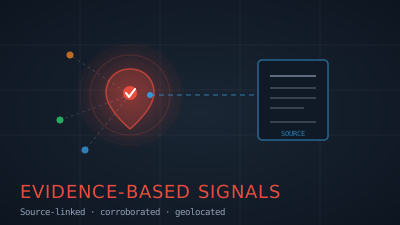
Quick Answer: Delta Signals is evidence-based event intelligence: every signal keeps a link to the original news report it was distilled from, consolidates coverage from multiple outlets into a single real-world event, and carries a location extracted from the article text and checked for geographic consistency. Low-relevance or weakly-corroborated items are filtered out before they surface. The result is an event layer you can open, check, and share — the same auditability standard that separates rigorous open-source intelligence from rumor.
An automated event feed is only as good as the evidence behind it. Delta Signals is evidence-based: every signal keeps a link to the original news report it came from, merges coverage from many outlets into a single real-world event, and carries a location extracted from the article text and checked for geographic consistency before it reaches the map. Weakly-supported noise is filtered out before anything surfaces. In short, you can open, check, and share the evidence behind any signal — you never have to take the feed's word for it.
This post explains the methodology. For a feature-level tour of what Delta Signals does, see Introducing Delta Signals. For the wider discipline it sits inside, see what is geospatial OSINT.
Why does auditability matter for event intelligence?
In open-source intelligence, a finding earns trust by being checkable. As the practice of geospatial OSINT makes clear, an open-source finding can be shown, shared, and checked by others — that auditability is what separates analysis from rumor. A claim you cannot trace back to a source is not intelligence; it is a guess with confidence attached.
Automated feeds often break this principle. They summarize, score, and rank — then hide the trail. You get a headline and a dot on a map, but no way to answer the two questions that matter before you act on it: where did this come from, and is the location right? Delta Signals is designed so those questions always have an answer.
What evidence does each Delta Signal carry?
Every signal carries four pieces of evidence, each answering a specific "can I trust this?" question:
| Evidence property | What it lets you do |
|---|---|
| Link to the original source | Open the news report and read it yourself |
| Multi-source consolidation | See real-world events, not the volume of coverage |
| Verified location | Confirm the event is placed where it actually occurred |
| Relevance threshold | Trust that low-signal noise was filtered out first |
The rest of this post takes each one in turn.
Can I trace a signal back to its source?
Yes — every signal keeps a link to the original news report it was distilled from. Open any signal in the feed, on the map, or in a Delta Agent finding, and you can follow the link to the source article and read it in full. The AI-generated summary is a convenience, never a substitute: the primary source travels with the signal so you can verify the summary against it. This is the single most important property of the feed — it is the difference between "trust us" and "here is the evidence."
How does consolidating multiple sources make signals stronger?
A significant event generates dozens or hundreds of news articles. Delta Signals identifies reports that describe the same real-world occurrence — even when the framing, named actors, or reporting time differ — and consolidates them into one signal. Two things follow from this:
- The feed reflects events, not coverage volume. One major incident appears once, not two hundred times, so the map shows the actual number of events.
- Corroboration is built in. An event reported independently by multiple outlets carries that corroboration with it. Multi-source reporting is a classic verification signal in OSINT, and consolidation preserves it rather than flattening it away.
The consolidation is deliberately tuned so a fast-moving story still surfaces while it is breaking, rather than waiting for hundreds of outlets to pick it up — a low headline count early in an event is not the same as low importance.
How is a signal's location verified?
Location is where automated feeds most often go wrong: many raw event records are attributed only to a country or a broad region, and some place an event where it was reported from rather than where it happened. Delta Signals corrects for both:
- The most specific location in the article text is extracted — the place the event actually occurred, not the dateline of the outlet that reported it.
- That location is resolved to precise coordinates, making the signal useful at sub-national scale instead of dropping a dot in the middle of a country.
- The result is checked for geographic consistency before the signal is placed on the map, so the coordinates and the named location agree.
Because the location is verified this way, a Delta Signal is safe to correlate against satellite imagery: when you pull Sentinel-1 SAR or Sentinel-2 optical over a signal's coordinates, you are looking at the right place.
What keeps low-quality noise out of the feed?
Not every news item deserves to surface. Delta Signals applies a relevance threshold before enrichment: an item is only enriched and shown if it has clear geospatial significance — a physical location where satellite observation is meaningful — or it is reported by multiple sources. Pure diplomatic communications, financial-policy commentary, and opinion pieces are filtered out.
Each surfaced event is also scored on two dimensions that help you judge it at a glance: a severity score from 1 to 10 reflecting intensity, and an OSINT relevance score from 1 to 10 reflecting analytical value for satellite monitoring. These scores are produced systematically and consistently, without the fatigue that affects manual review at scale — but they never replace the source link. The score tells you how much to care; the link lets you check for yourself.
Putting it together: an event layer you can defend
Evidence-based means the audit trail travels with the signal. When a Delta Signal informs a decision, you can open its source, confirm its location, and hand the same evidence to a colleague — nothing is locked inside the system. That is the standard the Delta Watchfloor is built to: browse the day's prioritized global picture for free, and every event you see is one click from the report behind it and one map view from whatever imagery exists for it — including, often, the honest answer that no post-event scene covers it yet.
To go deeper on the discipline and the workflow:
- Introducing Delta Signals — what the event layer does and how analysts use it
- What is geospatial OSINT? — the wider practice of geolocating, corroborating, and confirming open-source reports with imagery
- Off-Nadir Delta glossary — definitions for SAR, NDVI, OSINT, and other terms used here
Delta Signals uses publicly available event data enriched through an AI analysis pipeline developed by Off-Nadir Delta. Signals retain attribution to their original sources. The platform is an independent project and is not affiliated with any organization or institution.

Remote sensing specialist with 10+ years in satellite data processing and AI. Founder of Off-Nadir Lab. Ph.D. in Informatics (Yokohama National University, 2026). Master's in Earth System Science and Technology (Kyushu University). Co-author, Remote Sensing Encyclopedia. More about the author →