
Satellite Orbit Types: SSO, Polar & GEO Explained
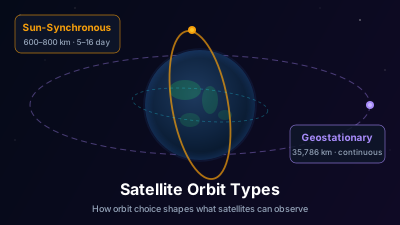
Quick Answer: Earth observation satellites use sun-synchronous orbits (SSO) to maintain consistent lighting conditions, crossing the equator at the same local time each pass. This enables meaningful temporal comparisons. Geostationary satellites (GEO) at 35,786 km provide continuous coverage of one hemisphere but at lower resolution. Polar orbits cover the entire globe over time. Most free satellite data (Sentinel, Landsat) comes from SSO satellites at 600–800 km altitude.
Sentinel-1 images of the same field look different depending on whether the satellite was traveling north (ascending) or south (descending). Same sensor, same field, different viewing geometry — and therefore a different measurement. That is where orbit mechanics stops being an abstract concept and becomes something a data user has to understand.
Why Orbit Matters for Your Data
The orbit a satellite follows determines four things that directly affect your analysis:
- When the satellite observes a location (time of day, revisit frequency)
- From what angle it views the surface (incidence angle, look direction)
- How much area it covers in a single pass (swath width)
- What lighting conditions are present (solar elevation, shadow patterns)
If you're comparing images from different dates — which is most of what remote sensing involves — these factors need to be consistent. Otherwise, you're comparing apples to oranges.
Sun-Synchronous Orbit (SSO)
This is the orbit used by almost every Earth observation satellite you've heard of: Sentinel-1, Sentinel-2, Landsat, SPOT, WorldView, and dozens more.
The concept: The satellite's orbital plane rotates at exactly the same rate as Earth orbits the Sun — about 1° per day. This means the satellite crosses any given latitude at the same local solar time on every pass.
Sentinel-2, for example, crosses the equator at approximately 10:30 AM local time (descending node). Whether it's January or July, the scene is illuminated by roughly the same sun angle. This consistency is critical for vegetation monitoring, where you need to compare NDVI across seasons without illumination changes contaminating the signal.
Key characteristics of SSO:
- Altitude: Typically 600–800 km
- Inclination: Near-polar, usually 97–99°
- Period: About 95–100 minutes per orbit (~15 orbits/day)
- Coverage: Global, pole-to-pole
- Revisit time: Days to weeks (depends on swath width and constellation size)
Ascending vs. Descending
SSO satellites cross each latitude twice per day — once heading north (ascending pass) and once heading south (descending pass). For optical satellites, the descending pass (morning, heading south) is the useful one because it's daytime.
For SAR satellites like Sentinel-1, both passes produce usable data since radar doesn't need sunlight. But here's the catch: ascending and descending passes view the surface from different angles. This matters for terrain effects, layover, and shadow in mountainous areas.
If you're doing SAR change detection, always compare images from the same orbit direction. Mixing ascending and descending passes introduces geometric artifacts that look like real changes but aren't.
Polar Orbit
A purely polar orbit has an inclination of exactly 90° — the satellite passes directly over both poles. In practice, most "polar" orbits are actually slightly off (97–99°) to achieve sun-synchronous properties.
True polar orbits are used by some weather and research satellites. The key advantage is complete global coverage: as Earth rotates beneath the satellite, every point on the surface eventually passes under the orbital track.
The trade-off is that equatorial regions get less frequent coverage than polar regions. Near the poles, orbital tracks converge, so any given point is revisited more often. At the equator, the tracks are spread farther apart.
Geostationary Orbit (GEO)
Place a satellite at exactly 35,786 km above the equator, and something elegant happens: its orbital period matches Earth's rotation. The satellite appears to hover motionless over one point on the equator.
Weather satellites like GOES (US), Himawari (Japan), and Meteosat (Europe) use geostationary orbits. They image the same hemisphere continuously — every 10–15 minutes for full-disk images, as frequently as every 30 seconds for targeted regions.
The trade-off is resolution. At 35,786 km altitude, spatial resolution is inherently limited. GOES-16 achieves about 500 meters to 2 km, far coarser than Sentinel-2's 10 meters from 786 km.
| Property | SSO (Sentinel-2) | GEO (GOES-16) |
|---|---|---|
| Altitude | 786 km | 35,786 km |
| Spatial resolution | 10 m | 500 m – 2 km |
| Temporal resolution | 5 days | 10–15 minutes |
| Coverage | Global (strip by strip) | One hemisphere (continuous) |
| Best for | Detailed surface analysis | Weather, rapid event monitoring |
Medium Earth Orbit (MEO)
Between LEO and GEO lies medium Earth orbit, roughly 2,000–35,786 km. GPS satellites operate here at about 20,200 km. MEO isn't commonly used for Earth observation imaging, but it's worth knowing because some newer satellite concepts are exploring MEO for improved revisit times without sacrificing too much resolution.
Constellation Design
Single satellites have limited revisit capability. Sentinel-2A alone revisits every 10 days; adding Sentinel-2B halved that to 5 days. Commercial companies like Planet have taken this further — their constellation of over 200 small satellites achieves daily global coverage at 3-meter resolution.
The math is straightforward: more satellites in the same orbital plane reduce the gap between successive passes. Satellites in different orbital planes cover different swaths, filling in the gaps faster.
For SAR, Sentinel-1 originally operated as a two-satellite constellation (1A and 1B) providing 6-day revisit. After Sentinel-1B suffered a power anomaly in late 2021 (formally decommissioned August 2022), revisit dropped to 12 days until Sentinel-1C launched in December 2024 to restore the original cadence. The constellation has kept turning over since: ESA opened Sentinel-1D user data on 17 April 2026, with three SAR satellites operating simultaneously for a transition period. The arithmetic below is unchanged — each satellite flies a 12-day repeat cycle and a two-satellite constellation halves the effective revisit — but check which units are prime before quoting a revisit figure for a specific date.
Key Mission Orbit Parameters at a Glance
Having a reference for actual mission parameters helps when choosing data sources or understanding metadata:
| Mission | Type | Altitude | Inclination | Equatorial Crossing | Repeat Cycle |
|---|---|---|---|---|---|
| Sentinel-2A/B | SSO (optical) | 786 km | 98.6° | 10:30 AM (descending) | 10 days/satellite |
| Sentinel-1A/C | SSO (SAR) | 693 km | 98.2° | ~6:00 AM (descending) | 12 days/satellite |
| Landsat 8/9 | SSO (optical) | 705 km | 98.2° | 10:00 AM (descending) | 16 days |
| NISAR | SSO (SAR) | 747 km | 98.4° | 6:00 AM | 12 days |
| Planet SuperDove | SSO (optical) | ~500 km | 97.4° | Varies by orbital plane | ~1 day (constellation) |
| GOES-16/18 | Geostationary | 35,786 km | 0° (equatorial) | Continuous | N/A |
The equatorial crossing time is particularly important for optical data. Sentinel-2's 10:30 AM crossing was chosen to balance two requirements: late enough that morning fog and cloud has mostly cleared (especially over land), but early enough to avoid afternoon cumulus convection common in tropical regions. Landsat's slightly earlier 10:00 AM crossing reflects the same tradeoff, optimized for its era and target applications.
Repeat Cycle vs. Revisit Time
These terms are often confused:
Repeat cycle is the number of days until the satellite returns to the exact same orbital track. For Sentinel-2, this is 10 days per satellite.
Revisit time is how often a specific point on the ground is observed. Because of swath overlap, locations away from the equator may be revisited more frequently than the repeat cycle suggests. At 45°N latitude, Sentinel-2 revisit can be 2–3 days with both satellites.
This distinction matters for time-sensitive applications. If you're monitoring a flood in Norway (high latitude), you might get Sentinel-1 coverage every 2–3 days. The same flood at the equator would wait 6 days between passes.
To see how this works out for one specific place, satellite pass prediction computes when Sentinel-1, Sentinel-2, Landsat and NISAR next cover a given location.
Practical Implications
When choosing satellite data for a project, orbit determines what's available:
- Need daily monitoring? → Planet (large constellation), or geostationary for coarse resolution
- Need consistent illumination for vegetation time series? → SSO satellites (Sentinel-2, Landsat)
- Need all-weather, day-night coverage? → SSO SAR satellites (Sentinel-1)
- Monitoring a polar region? → SSO satellites have excellent coverage near poles
- Need continuous observation of a weather event? → Geostationary
The orbit isn't something most users think about, but it silently shapes every dataset you work with. Understanding it helps you choose the right data and avoid comparing images that aren't actually comparable.
Related reading
Orbit determines when a satellite can see a place; whether it can actually measure the ground once it gets there is a separate question. Working out when a place can next be imaged covers turning repeat cycles into a decision about waiting versus tasking, and layover and shadow covers why two passes over the same terrain are not interchangeable.

Remote sensing specialist with 10+ years in satellite data processing and AI. Founder of Off-Nadir Lab. Ph.D. in Informatics (Yokohama National University, 2026). Master's in Earth System Science and Technology (Kyushu University). Co-author, Remote Sensing Encyclopedia. More about the author →