
Mapping Tree Canopy Height from Space: LiDAR, SAR, and the Global Canopy Height Map
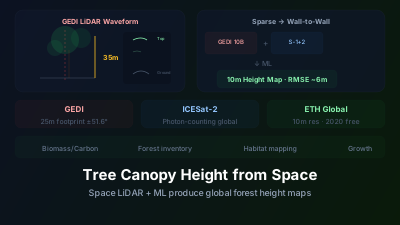
Quick Answer: Tree height is a fundamental forest attribute — it predicts biomass, indicates forest maturity, and structures habitat. Spaceborne LiDAR (GEDI at 25m footprint, ICESat-2 photon-counting) directly measures canopy height along orbital tracks but leaves gaps between tracks. Wall-to-wall canopy height maps at 10-30m resolution are produced by training machine learning models on LiDAR height samples using Sentinel-2 optical and Sentinel-1 SAR as predictors. The ETH Global Canopy Height Map (2020) at 10m resolution achieved ~6m RMSE globally. InSAR phase height from TanDEM-X provides another height estimation pathway. These maps enable global forest structure characterization for the first time.
For centuries, measuring tree height meant standing at the base and looking up with a clinometer. This works for individual trees but tells you nothing about the height of forests across entire continents. The question "how tall is the forest?" — seemingly simple — was unanswerable at large scales until satellite LiDAR and machine learning changed the equation.
Today, we have wall-to-wall maps of canopy height for the entire planet at 10-meter resolution. This represents one of the most remarkable achievements in Earth observation — and it happened quietly, without the fanfare that accompanied earlier satellite milestones.
Why Tree Height Matters
Biomass prediction: Height is the single strongest predictor of above-ground biomass. Taller trees have thicker trunks and larger crowns. The allometric relationship between height and biomass is well-established for most forest types.
Forest maturity: Height indicates forest age and successional stage. Old-growth forests are tall; young regenerating forests are short. Height maps reveal the age structure of entire forest landscapes.
Habitat structure: Many animal species are associated with specific canopy height ranges. Canopy height maps support biodiversity assessment and habitat suitability modeling.
Carbon dynamics: Height change over time indicates whether forests are growing (carbon sink) or declining (carbon source). Multi-epoch height maps quantify forest growth rates.
Spaceborne LiDAR: Direct Height Measurement
GEDI (Global Ecosystem Dynamics Investigation)
NASA's GEDI instrument on the International Space Station fires laser pulses at the forest and records the returned waveform:
Measurement principle: The laser pulse hits the top of the canopy first, then penetrates through gaps to hit the ground. The time difference between the canopy return and ground return equals the canopy height.
Specifications:
- Footprint diameter: 25m
- Along-track spacing: 60m between footprints
- Coverage: ±51.6° latitude (ISS orbit limitation)
- Mission period: 2019-2023 (with data archive)
- Total footprints: ~10 billion
What GEDI measures: For each footprint, GEDI provides relative height percentiles (RH25, RH50, RH75, RH95, RH98) describing the vertical distribution of canopy material. RH98 (height below which 98% of the waveform energy returns) is the best estimate of maximum canopy height.
ICESat-2
NASA's ICESat-2 uses a photon-counting LiDAR with different characteristics:
Measurement principle: Emits individual photons and records the precise time and location of each returned photon. Canopy photons return before ground photons, with the difference indicating height.
Specifications:
- 6 beams in 3 pairs
- Small footprint (~17m)
- Global coverage (including poles)
- Continuous operation since 2018
Complementarity with GEDI: ICESat-2 covers polar regions that GEDI cannot reach and has a different sampling pattern, making the two datasets highly complementary for global height mapping.
From Sparse LiDAR to Wall-to-Wall Maps
LiDAR provides accurate height measurements but only along orbital tracks — leaving most of the Earth's surface unmeasured. The solution: use LiDAR samples as training data for models that predict height from wall-to-wall satellite data.
The Machine Learning Approach
- Training data: Extract GEDI/ICESat-2 canopy height at millions of locations
- Predictor variables: For each LiDAR location, extract features from:
- Sentinel-2: Spectral bands, NDVI, red-edge indices, texture metrics
- Sentinel-1: VV and VH backscatter, VH/VV ratio
- DEM: Elevation, slope (topographic context)
- Climate: Temperature, precipitation (bioclimatic context)
- Model training: Random Forest, gradient boosting (XGBoost, LightGBM), or deep learning (CNNs)
- Prediction: Apply the trained model to every pixel of Sentinel-1/2 imagery globally
ETH Global Canopy Height Map
Produced by ETH Zurich using this approach:
- Resolution: 10m
- Coverage: Global
- Year: 2020
- Training data: GEDI RH98
- Predictors: Sentinel-2 optical features
- Accuracy: the published validation reports an RMSE of 6.0 m over all validation samples (Lang et al., Nature Ecology & Evolution, 2023). Errors are not uniform — they grow in tall, dense canopy where the optical predictors saturate
- Freely available: Published as open data
Meta/WRI Global Forest Canopy Height
Another global product using similar methodology:
- Resolution: 1m (derived from commercial very-high-resolution imagery)
- Uses deep learning on high-resolution satellite imagery
- Provides unprecedented detail for forest structure characterization
InSAR-Based Height Estimation
SAR interferometry provides an independent height measurement pathway:
TanDEM-X
The TanDEM-X mission (DLR) flew two SAR satellites in close formation, measuring the interferometric phase difference that encodes surface elevation. Over forests, the X-band radar scatters primarily from the upper canopy, so the TanDEM-X elevation over forests represents approximately the canopy surface.
Canopy height estimation: TanDEM-X elevation minus a bare-earth DEM (from LiDAR or other sources) gives canopy height. The method works well in areas where a reliable bare-earth DEM exists.
PolInSAR
Polarimetric SAR interferometry separates the scattering contributions from different vertical layers (canopy top, volume, ground). By modeling the vertical structure of the scattering, PolInSAR estimates canopy height without requiring a separate bare-earth DEM.
The upcoming ESA BIOMASS mission will include PolInSAR capability at P-band, providing forest height estimates that penetrate the full canopy depth.
Accuracy Considerations
| Method | Best Conditions | Limitations |
|---|---|---|
| GEDI RH98 | Moderate canopy density | Slope bias, cloud gaps |
| ICESat-2 | Open to moderate canopy | Dense canopy noise |
| ML wall-to-wall | Temperate forests | Saturates in tall tropical forest |
| TanDEM-X | Uniform canopy | Requires bare-earth DEM |
Direct LiDAR height retrievals (GEDI, ICESat-2) are generally more accurate than model-predicted wall-to-wall maps, because the latter inherit the LiDAR error and add prediction error on top of it. Published error figures vary widely between studies, sites and validation datasets, so treat any single accuracy number as specific to the study that produced it rather than as a property of the method.
Errors are larger in:
- Very tall tropical forests (>40m) where optical features saturate
- Steep terrain where GEDI footprints are elongated and ground detection is difficult
- Mixed pixels at forest edges where height varies within a pixel
- Very short vegetation (<5m) where height differences approach measurement noise
Applications
National Forest Inventories
Countries can use canopy height maps to:
- Estimate growing stock volume (height × species-specific models)
- Stratify forests for field sampling (tall forests ≠ short forests in sampling design)
- Identify old-growth areas (tallest forests) for protection
Carbon Stock Estimation
Height is the primary predictor in biomass allometric models. Global canopy height maps enable:
- Wall-to-wall biomass estimation
- Carbon stock mapping for REDD+ and climate reporting
- Change detection for emissions monitoring
Ecological Research
- Global distribution of forest structural types
- Habitat suitability for canopy-dependent species
- Disturbance and recovery tracking (height loss and regrowth)
Forestry Operations
- Timber volume estimation
- Harvest planning (identifying mature stands)
- Growth monitoring (height change between map epochs)
The convergence of spaceborne LiDAR, free Sentinel data, and machine learning has produced something that seemed impossible a decade ago: a global map of how tall every tree on Earth is. The accuracy isn't perfect — ±6m globally means significant uncertainty for individual pixels — but at landscape to national scales, these maps provide unprecedented insight into forest structure. As multi-epoch maps become available, tracking how forest height changes over time will reveal the dynamics of forest growth, disturbance, and recovery at global scale.

Remote sensing specialist with 10+ years in satellite data processing and AI. Founder of Off-Nadir Lab. Ph.D. in Informatics (Yokohama National University, 2026). Master's in Earth System Science and Technology (Kyushu University). Co-author, Remote Sensing Encyclopedia. More about the author →