
Forest Type Classification from Satellite Imagery: Mapping What Grows Where
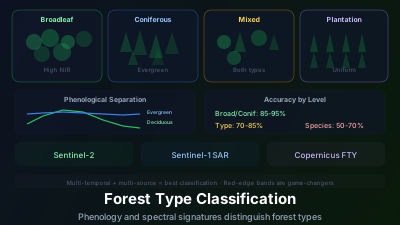
Quick Answer: Forest type classification distinguishes between major forest categories (broadleaf/coniferous, evergreen/deciduous) and, in favorable conditions, species groups. Sentinel-2's 13 spectral bands — especially the red-edge bands sensitive to chlorophyll and leaf structure — provide strong discrimination. Phenological time series (seasonal NDVI curves) are often more diagnostic than single-date spectral signatures: deciduous forests show dramatic seasonal NDVI swings while evergreen forests remain relatively stable. SAR contributes through structural differences (conifer plantations produce different backscatter than broadleaf forests). Accuracy falls off steadily as the classification gets more detailed: the broadleaf/coniferous split is reliably achievable almost everywhere, forest-type classes are harder, and individual species remain an open problem at 10 m — published percentages vary so widely with site, reference data, and class definitions that a number for your own area has to come from your own validation sample. Global forest type maps include the Copernicus Forest Type product at 10m resolution.
Satellite forest type classification reliably separates broadleaf from coniferous forest and, given a full year of imagery, can distinguish evergreen from deciduous stands and — in favorable conditions — dominant species. The strongest signal usually comes not from a single spectral snapshot but from how a forest changes through the seasons. Sentinel-2's red-edge bands and dense time series do most of the work; SAR adds structural detail that optical sensors miss.
Not all forests are equal. A boreal spruce forest, a temperate oak-beech woodland, a tropical dipterocarp rainforest, and a eucalyptus plantation are all "forest" — but they differ in biodiversity, carbon storage, fire behavior, timber value, and ecosystem services. Knowing what type of forest covers an area is as important as knowing whether forest is present at all. Satellite-based classification has progressed from a simple broadleaf-versus-coniferous split to increasingly detailed mapping of forest communities and, in some cases, dominant species — the same spectral and temporal cues that drive broader land cover change detection.
What Makes Forest Types Spectrally Distinct
Leaf Structure
Broadleaf trees have flat, broad leaves with strong NIR reflectance (high internal scattering within the spongy mesophyll layer). Their canopy creates a relatively smooth, closed surface.
Coniferous trees have needle-shaped leaves with lower NIR reflectance (needles scatter less internally). Their conical crowns create a rougher, more shadowed canopy surface.
This NIR reflectance difference is subtle — broadleaf stands typically read only slightly higher than conifers on NDVI — but it is measurable, particularly in Sentinel-2's red-edge and NIR bands.
Chlorophyll Content and Red-Edge
Sentinel-2's red-edge bands (B5: 705nm, B6: 740nm, B7: 783nm) are positioned on the steep slope between red chlorophyll absorption and NIR reflectance. The position and shape of this red-edge varies with:
- Chlorophyll concentration (differs between species)
- Leaf area index (denser canopies absorb more red)
- Leaf structure (needles vs. broad leaves)
Red-edge indices derived from these bands provide discrimination beyond what traditional NDVI offers.
Canopy Moisture
SWIR bands (Sentinel-2 B11, B12) are sensitive to leaf water content. Species differ in:
- Leaf water content per unit area
- Canopy density and total water content
- Seasonal water stress responses
These SWIR differences complement the visible/NIR information, improving classification.
Why is phenology more diagnostic than a single image?
For many forest types, the most diagnostic feature isn't a single spectral snapshot — it's the seasonal behavior pattern. A deciduous stand and an evergreen conifer can look nearly identical in a summer scene, yet their year-round NDVI curves diverge sharply: one collapses in autumn, the other holds steady. Tracking that trajectory across a full year, the way vegetation index time series monitoring does, turns an ambiguous single-date signature into a reliable one.
Deciduous vs. Evergreen
The simplest phenological classification:
- Deciduous: NDVI drops dramatically in autumn/winter (0.8 → 0.2 in temperate forests)
- Evergreen coniferous: NDVI remains relatively stable (0.5-0.7 year-round, slight winter dip)
- Evergreen broadleaf (tropical): NDVI relatively stable (0.7-0.85), slight seasonal variation related to dry season
A time series of 20+ Sentinel-2 observations across a full year captures this seasonal signature with high reliability.
Species-Level Phenological Differences
Within deciduous forests, species have different phenological timing:
- Early leafing: Birch, hazel (leaf-out 2-3 weeks before oak)
- Late leafing: Oak, ash (later spring flush)
- Early senescence: Birch (yellowing earlier than beech)
- Late senescence: Beech, hornbeam (retaining leaves longer)
These timing differences create brief windows (days to weeks) when species are spectrally distinguishable. Dense time series from Sentinel-2 can capture these windows, enabling species-level discrimination that single-date imagery cannot achieve.
Tropical Forest Types
In tropical forests without pronounced seasons, phenological classification is more challenging:
- Semi-deciduous forests show subtle dry-season NDVI decline
- Mangroves are distinguishable by location and tidal signature (see mangrove mapping from satellite imagery)
- Bamboo forests have distinctive growth and die-back cycles
- Seasonal flooding patterns differentiate igapó (blackwater-flooded) from terra firme forest
What does SAR add to forest type mapping?
SAR provides structural information independent of optical properties, so it separates forests by their physical architecture rather than their color. Because radar penetrates the canopy and responds to branch and trunk geometry, it distinguishes a uniformly spaced plantation from a structurally complex natural stand even when the two look spectrally similar — and it keeps working through cloud cover that blinds optical sensors. For the underlying trade-offs, see SAR vs. optical: when to use which.
Backscatter intensity: Conifer plantations (uniform structure, regular spacing) produce different backscatter patterns than natural broadleaf forests (irregular structure, variable gap sizes).
Texture: SAR image texture metrics capture canopy roughness and structural complexity. Old-growth forests have more textural variation than even-aged plantations.
Polarimetric decomposition: Quad-pol SAR (e.g., ALOS-2) decomposes backscatter into surface, double-bounce, and volume scattering components. The proportions differ between forest types — broadleaf forests typically show more volume scattering than conifer stands.
Seasonal SAR behavior: Deciduous forests show SAR backscatter changes with leaf fall (especially at C-band, which interacts primarily with leaves and small branches).
Classification Methods
Single-Date Multispectral
Using one cloud-free Sentinel-2 scene:
- Extract all 13 bands + derived indices (NDVI, red-edge indices, SWIR ratios)
- Apply supervised classification (Random Forest, SVM, deep learning)
- Adequate for the broadleaf/coniferous split in many landscapes, but the weakest of the three approaches
Multi-Temporal Spectral
Using 20+ Sentinel-2 scenes across a year:
- Extract spectral features at each date
- Compute phenological metrics (green-up date, peak NDVI, senescence timing, amplitude)
- Classify using the full temporal feature set
- Consistently outperforms single-date classification for forest type, because phenology carries information that no single scene contains. The size of the improvement depends on how phenologically distinct the classes are — large where deciduous and evergreen are mixed, small in uniform evergreen landscapes
Multi-Source (Optical + SAR)
Combining Sentinel-2 time series with Sentinel-1 SAR:
- Optical provides spectral/phenological information
- SAR provides structural information and cloud-gap filling
- Generally improves on optical alone, with the largest gains where structure differs between classes (plantation vs. natural stand) or where cloud leaves the optical time series sparse
How accurate is satellite forest type classification?
Accuracy falls off steadily as the classification gets more detailed, and the ordering below is far more portable than any specific percentage — published accuracies vary widely with the site, the reference data, and how the classes were defined, so treat figures from any one study as local to that study.
| Classification Level | How dependable |
|---|---|
| Forest / Non-forest | Highest — routinely operational |
| Broadleaf / Coniferous | High — achievable almost everywhere |
| Evergreen / Deciduous / Mixed | Good, given a full year of imagery |
| Forest type (5-10 classes) | Moderate — needs dense time series and good training data |
| Dominant species (10-20 classes) | Low to moderate — strongly site-dependent |
| Individual species | Lowest — an open research problem at 10 m |
The broadleaf/coniferous distinction is reliably achievable almost everywhere; individual species identification remains challenging and location-dependent. If you need a number for your own area, it has to come from your own validation sample — an accuracy reported for Central European forests says little about what you will achieve in Southeast Asia.
Global and Continental Products
Copernicus High Resolution Layer — Forest Type
- Resolution: 10m
- Coverage: European Economic Area
- Classes: Broadleaved, coniferous, mixed
- Method: Sentinel-2 time series + machine learning
- Update: Annual
ESA WorldCover
ESA WorldCover provides a global 10m land cover map derived from Sentinel-1 and Sentinel-2:
- Resolution: 10m
- Coverage: Global
- Forest classes: Tree cover (not differentiated by type in v1; improving in v2)
National Forest Inventories
Many countries produce detailed forest type maps:
- US NLCD includes forest type classes
- European national programs produce species-level maps
- Canada's EOSD land cover includes forest type
Global Forest Type Classification: Dataset Comparison
Published forest type datasets and their operationally relevant specifications:
| Product | Resolution | Coverage | Forest Classes | Method | Update Cycle | Access |
|---|---|---|---|---|---|---|
| Copernicus HRL Forest Type | 10m | Europe (EEA39) | Broadleaf / Coniferous / Mixed | Sentinel-2 ML | Annual | Free |
| ESA WorldCover v2 | 10m | Global | Tree cover (limited type detail) | Sentinel-1+2 | 2020, 2021 | Free |
| NLCD Forest Type (USA) | 30m | Contiguous USA | 7 forest type classes | Landsat + field data | ~5 years | Free |
| Global Forest Canopy Height (ETH) | 10m | Global | Height (not type) | Sentinel-2 + GEDI | 2020 baseline | Free |
| Finland Forest Inventory | 16m | Finland | 20+ species | ALS LiDAR + Sentinel | Annual | National |
| FAO Global Forest Resources Assessment | Country | Global | Broad categories | National reporting | 5 years | Free |
Where classification still fails: Individual species identification remains fundamentally limited at 10m resolution because:
- A single 10m pixel may contain 5–15 mature trees — each potentially different species
- Spectral differences between similar species (e.g., Norway spruce vs. Sitka spruce) are smaller than sensor noise in many conditions
- Phenological differences between closely related species can be a matter of days — narrower than the gap between usable cloud-free observations, so the diagnostic window is easily missed
The practical limit for satellite-based species classification is a dominant species in an even-aged, essentially single-species stand large enough to contain many clean pixels. Mixed-species stands remain the unsolved classification problem in operational forest mapping.
SAR texture as the plantation detector: The structural regularity of planted forests (uniform age, regular spacing) produces statistically more homogeneous SAR texture — lower GLCM variance, higher homogeneity — than natural forests. Adding Sentinel-1 texture to Sentinel-2 spectral data therefore helps separate plantation from natural forest, because it supplies a structural cue that the optical bands do not carry at all. How much it helps depends on how structurally distinct the plantations are from the surrounding natural stands.
Practical Considerations
Training data quality: Forest type classification is only as good as the training data. National forest inventories, field plots, and expert-interpreted aerial photos provide training labels. The quality and density of these labels largely determines classification accuracy.
Mixed pixels: At 10m resolution, pixels at forest type boundaries contain mixtures. A pixel at the edge of a conifer plantation adjacent to broadleaf forest will have intermediate spectral properties, leading to classification uncertainty.
Regional calibration: Spectral and phenological signatures vary with latitude, climate, and species composition. A classifier trained for Central European forests won't work in Southeast Asia without retraining.
Plantation vs. natural forest: This distinction is increasingly important for sustainability certification and carbon accounting. Spectral differences are subtle, but structural regularity (visible in SAR texture and VHR optical) and phenological uniformity (all trees same age = synchronized phenology) help distinguish plantations from natural forests.
Forest type classification from satellites serves the fundamental need to know not just where forests are, but what kind of forests they are. This information drives forest management, conservation planning, fire risk and burn severity assessment, and carbon accounting — applications where the distinction between a fire-resistant old-growth hardwood forest and a fire-prone young conifer plantation makes all the difference. It also underpins the harder problems of separating degradation from outright deforestation and running repeat classifications for area monitoring over time.

Remote sensing specialist with 10+ years in satellite data processing and AI. Founder of Off-Nadir Lab. Ph.D. in Informatics (Yokohama National University, 2026). Master's in Earth System Science and Technology (Kyushu University). Co-author, Remote Sensing Encyclopedia. More about the author →