
Post-Disaster Infrastructure Assessment: Roads, Bridges, and Lifelines from Space
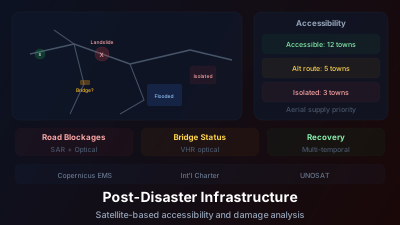
Quick Answer: After disasters, satellite imagery rapidly assesses infrastructure damage that blocks emergency response. Road blockages from landslides, bridge collapses, flooded transportation corridors, and damaged port facilities are identifiable from very-high-resolution optical imagery (<1m). SAR detects flooding over transportation routes through clouds. Accessibility analysis — combining detected blockages with road network data — identifies which communities are cut off and which alternative routes exist. Recovery monitoring tracks infrastructure reconstruction over weeks to months. The Copernicus EMS provides standardized infrastructure damage maps within hours of activation.
Satellite imagery can tell responders which roads are blocked, which bridges are down, and which communities are cut off within hours of a disaster — days before ground surveys cover the same area. SAR sees flooding through clouds; very-high-resolution optical imagery resolves individual bridges and blockages.
The need is concrete. After the 2024 heavy rainfall event in the Noto Peninsula region, dozens of roads were blocked by landslides, several bridges were damaged, and entire communities were temporarily inaccessible. Relief convoys needed to know: which roads are passable? Where are the blockages? Are there alternative routes? Ground survey of every road segment takes days. Satellite imagery provided preliminary answers within hours.
What Satellites Can Assess
Road Network Damage
Landslide blockages: Debris from landslides covering road segments is visible in VHR optical imagery and detectable as coherence/backscatter changes in SAR (landslide detection methods combine both). The combination of road network data (OpenStreetMap or national road databases) with landslide detection maps identifies which roads are blocked.
Flooding: SAR flood extent maps overlaid on road networks show which road segments are inundated and to what depth (estimated from surrounding terrain elevation).
Road surface damage: Cracks, subsidence, and pavement failure are theoretically detectable at sub-meter resolution but practically difficult to assess from satellite altitude. Only major damage (road washed away, large sinkholes) is reliably identified.
Bridge Assessment
Bridges are critical bottleneck points — losing a single bridge can isolate entire communities. Satellite-based bridge assessment:
Complete collapse: Visible in VHR optical as missing deck structure or debris in the watercourse below. Before/after comparison is usually definitive.
Partial damage: More difficult to assess. Misalignment, deck displacement, or structural deformation may be visible at 30-50 cm resolution but requires expert interpretation.
Approach damage: Landslides or erosion affecting bridge approaches are often more detectable than bridge structural damage itself.
Power and Communication Infrastructure
Transmission lines: Downed power lines are not directly visible from satellite, but collapsed transmission towers are detectable at VHR resolution. Utility corridor damage (cleared paths through forest) can indicate where lines have fallen.
Communication towers: Damaged or collapsed cell towers visible at sub-meter resolution. Post-disaster communication coverage estimation combines tower status with propagation modeling.
Power plants and substations: Flooding or structural damage at power generation and distribution facilities is assessable from VHR imagery.
Port and Airport Facilities
Port damage: Satellite imagery assesses quay wall integrity, crane damage, debris in harbor channels, and vessel displacement. Critical for maritime disaster response logistics.
Airport/airstrip damage: Runway integrity, terminal building damage, and debris on taxiways are assessable. Essential for establishing aerial logistics hubs.
What Is Accessibility Analysis?
Accessibility analysis converts damage observations into logistics answers: which communities can still be reached, from where, and by which routes. The most operationally valuable product after a disaster isn't a damage map — it's an accessibility map. It combines every detected blockage with the road network's connectivity to identify isolated settlements and the supply corridors that survived.
The workflow:
- Detect infrastructure damage (blockages, flooding, bridge failures)
- Overlay on transportation network (road database with connectivity information)
- Compute network accessibility: Which settlements can be reached from designated supply points? What's the shortest accessible route? Which communities are completely isolated?
- Prioritize: Isolated communities with large populations and no alternative access are highest priority for aerial supply or road-clearing operations.
This analysis transforms raw damage observations into actionable logistics intelligence. The Copernicus Emergency Management Service produces these accessibility products as standard outputs.
SAR or Optical: Which Works Better for Infrastructure Assessment?
Use both, sequenced: SAR first for weather-independent extent mapping in the first day or two, then VHR optical for detailed assessment once skies allow. SAR is, in NASA Earthdata's definition, "a type of active data collection where an instrument sends out a pulse of energy and then records the amount of that energy reflected back" — which is why it images day or night through any weather, while sub-meter optical resolves individual bridges and blockages but waits on clouds. (For the general trade-offs, see our SAR vs. optical comparison.)
| Aspect | SAR (Sentinel-1) | VHR Optical (WorldView, Pléiades) |
|---|---|---|
| Weather independence | Yes (critical advantage) | No (clouds block view) |
| Resolution | 5-20m | 0.3-0.5m |
| Bridge assessment | Limited | Detailed |
| Flood detection | Excellent | Good (if clear) |
| Road blockage | Moderate (large only) | Detailed |
| Building damage | Coherence-based | Visual identification |
| Availability | Free (Sentinel-1) | Commercial (costly) |
Typical operational approach: SAR for immediate extent assessment (day 1-2, regardless of weather), VHR optical for detailed infrastructure assessment (day 2-7, weather permitting).
How Is Recovery Monitored from Space?
Recovery monitoring uses repeat satellite observations to track reconstruction over weeks to months: radar coherence returning as roads reopen, temporary bridges appearing in optical imagery, vegetation re-establishing on landslide scars. Because Sentinel-1 and similar missions keep acquiring on a fixed schedule, progress can be measured consistently across the whole affected region rather than sampled site by site.
Road reopening: SAR coherence recovery or optical observation of cleared road segments. Progressive restoration of network connectivity visible through time series analysis.
Bridge reconstruction: Temporary bridges (Bailey bridges, pontoon bridges) visible in VHR optical imagery. Permanent reconstruction trackable over months.
Building reconstruction: Multi-temporal VHR imagery documents reconstruction progress at neighborhood and individual building level. Useful for verifying aid distribution and reconstruction program effectiveness.
Vegetation recovery: NDVI time series track revegetation of landslide scars and flood-affected areas, indicating landscape stabilization.
Standardized Products
Copernicus EMS Mapping Products
The Copernicus Emergency Management Service produces standardized cartographic products:
Reference Maps: Pre-disaster baseline showing infrastructure, population, and land use.
Delineation Maps: Extent of the disaster impact (flood extent, fire perimeter, earthquake-affected area).
Grading Maps: Damage severity classification for buildings and infrastructure (the building side of this is covered in our guide to earthquake damage assessment from satellite).
Monitoring Maps: Updated assessments showing changes since previous mapping (recovery, secondary hazards).
These products follow consistent symbology and format conventions, enabling field responders to read maps from any activation without additional training.
UNOSAT/UNITAR
The United Nations provides satellite-based damage assessment for humanitarian response:
- Rapid mapping within 24 hours of request
- Damage assessment products for buildings, infrastructure, and displacement camps
- Products tailored for UN humanitarian coordination mechanisms
Challenges
Temporal gap: The period between disaster occurrence and first usable satellite image ranges from hours (if a SAR satellite happens to pass shortly after) to days (if cloud cover prevents optical acquisition). During this gap, ground-based assessment must fill in.
Resolution vs. coverage trade-off: VHR optical provides detailed assessment but covers limited area per image. Sentinel-1/2 covers large areas but at lower resolution. Major disasters require both.
Baseline data quality: Accessibility analysis is only as good as the underlying road network data. In many developing countries, road databases are incomplete or outdated. OpenStreetMap quality varies significantly by region.
Damage ambiguity: Satellite imagery shows the surface condition. Whether a road that appears intact is actually passable (undermined foundation, weight restrictions) requires ground verification. Satellite assessment provides a first approximation, not a definitive engineering evaluation.
Cost and activation delays: While Sentinel data is free and open, VHR commercial imagery is priced per square kilometre, so covering a large disaster zone at sub-metre resolution is expensive — often prohibitively so outside a formal activation. Activation procedures (International Charter, Copernicus EMS) exist partly to solve that, but they involve administrative steps that add hours to response time.
Despite these constraints, satellite-based infrastructure assessment has become an integral part of modern disaster response. The ability to see across an entire disaster zone — hundreds or thousands of square kilometers — within days of the event, identifying which infrastructure is damaged and which communities are cut off, provides situational awareness that no amount of ground reconnaissance can match in the same timeframe.

Remote sensing specialist with 10+ years in satellite data processing and AI. Founder of Off-Nadir Lab. Ph.D. in Informatics (Yokohama National University, 2026). Master's in Earth System Science and Technology (Kyushu University). Co-author, Remote Sensing Encyclopedia. More about the author →