
Phenology Tracking: Monitoring Crop Growth Stages from Satellite Time Series
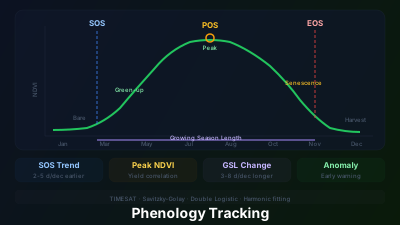
Quick Answer: Phenology is the study of seasonal biological events — for crops, this means emergence, tillering, heading, grain fill, and harvest. Satellite NDVI time series trace a characteristic curve through these stages. Key phenological metrics extracted from satellite data include Start of Season (SOS), Peak of Season (POS), End of Season (EOS), and Growing Season Length. These metrics detect year-to-year shifts caused by weather, climate change, or management. Earlier SOS trends (~2-3 days/decade in temperate regions) are a well-documented signal of warming. Sentinel-2's 5-day revisit provides sufficient temporal density for phenology extraction.
Every spring in central Japan, the cherry blossom forecast makes national news. The blooming date has shifted earlier by roughly 10 days over the past century — a visible marker of climate change. Satellite phenology tracking does the same thing for every vegetated surface on Earth, continuously, without human observers.
What Phenology Tells Us
Crop phenology — the timing of growth stages — controls nearly everything in agriculture:
- When to apply fertilizer depends on growth stage, not calendar date
- When to irrigate depends on whether the crop is in a water-sensitive stage
- When to harvest depends on maturity, which varies with weather
- Yield potential is largely set during specific phenological windows (flowering, grain fill)
Knowing where each field stands in its growth cycle, across an entire region, is extraordinarily valuable — and satellite time series provide exactly this information.
The NDVI Growth Curve
A typical crop NDVI time series follows a predictable shape:
- Pre-season baseline: Bare soil or residue. NDVI 0.10-0.20
- Green-up (emergence to rapid growth): NDVI rises from baseline toward peak. The slope of this rise indicates growth vigor.
- Peak (maximum canopy): NDVI plateaus at 0.75-0.90 for healthy, dense crops. Duration varies by crop — wheat peaks briefly, forest stays at peak for months.
- Senescence: Chlorophyll degrades, leaves dry. NDVI declines. The rate of decline indicates harvest timing or stress.
- Post-harvest: NDVI returns to baseline after harvest or leaf drop.
This curve shape is remarkably consistent for a given crop type at a given latitude, varying primarily in timing and amplitude from year to year.
Extracting Phenological Metrics
Start of Season (SOS)
The date when spring growth begins. Typically defined as the date when NDVI exceeds a threshold (e.g., 20% of the annual amplitude above baseline) or when the NDVI increase rate exceeds a threshold.
SOS is influenced by:
- Temperature accumulation (growing degree days)
- Soil moisture and snowmelt timing
- Planting date (for annual crops)
Peak of Season (POS)
The date of maximum NDVI. For crops, this correlates with maximum leaf area index and maximum light interception. POS timing is a strong indicator of crop type (winter wheat peaks in May; corn peaks in late July in temperate zones).
End of Season (EOS)
The date when NDVI falls below a threshold, indicating harvest, senescence, or dormancy. The interval SOS-to-EOS defines the growing season length.
Growing Season Length (GSL)
EOS minus SOS. Longer growing seasons generally correlate with higher cumulative productivity. Climate change is extending GSL in many temperate regions — earlier springs and later autumns.
Seasonal Amplitude
Peak NDVI minus baseline NDVI. Higher amplitude indicates more productive vegetation. Low amplitude in a typically high-amplitude area suggests stress or crop failure.
Rate of Green-Up / Brown-Down
The slope of the NDVI curve during green-up and senescence phases. Rapid green-up indicates vigorous early growth; rapid brown-down may indicate premature senescence from drought or disease.
Methods for Curve Fitting
Raw NDVI time series from satellites contain noise — cloud contamination, atmospheric variation, sensor artifacts. Smoothing is required before phenology extraction:
Savitzky-Golay Filter
A polynomial smoothing filter that preserves the shape and amplitude of the curve while removing high-frequency noise. Widely used because it's simple and doesn't assume a particular curve shape.
Double Logistic Function
Fits an asymmetric sigmoid function to the time series:
NDVI(t) = base + amplitude × [1/(1 + e^(-a₁(t-t₁))) − 1/(1 + e^(-a₂(t-t₂)))]
The parameters directly encode phenological dates (t₁ = green-up midpoint, t₂ = senescence midpoint) and rates (a₁, a₂). This model works well for single-season crops but struggles with double-cropping systems.
Harmonic Analysis (Fourier)
Fits sine/cosine functions to capture the seasonal cycle. Better for natural vegetation with gentle, symmetric seasonal curves. Less appropriate for crops with asymmetric growth patterns.
TIMESAT Software
The most widely used tool for satellite phenology extraction. Implements Savitzky-Golay, double logistic, and asymmetric Gaussian fitting methods. Produces standardized phenological metrics from any vegetation index time series.
Applications
Climate Change Detection
The most robust climate signal in satellite phenology is the trend in SOS: spring is arriving earlier in most temperate and boreal regions by 2-5 days per decade. This shift has cascading effects on agriculture, ecosystems, and water resources.
Growing season length is increasing by 3-8 days per decade in the Northern Hemisphere mid-latitudes. This extends the potential growing period but also increases water demand and pest/disease pressure.
Crop Calendar Mapping
Different crops have different phenological timing. Mapping SOS and POS across agricultural landscapes reveals the crop calendar — which fields were planted first, which crops mature earliest, where double-cropping occurs.
This information supports agricultural statistics (estimating planted area and crop type), supply chain planning (predicting harvest timing), and insurance (verifying that farming activities occurred as claimed).
Anomaly Detection
Comparing current-year phenology against the historical average reveals anomalies:
- Late SOS: Delayed planting due to wet spring or cold conditions
- Low peak NDVI: Reduced vigor from drought, nutrient deficiency, or pest damage
- Early EOS: Premature harvest due to drought or disease
- Extended peak: Favorable conditions allowing prolonged growth
These anomalies, detected in near-real-time, provide early warning of yield impacts.
Rangeland and Pasture Management
For livestock operations, knowing when pastures green up, peak, and senesce determines grazing rotation schedules. Satellite phenology tracking across large rangeland areas — often thousands of square kilometers — is the only practical monitoring approach.
Temporal Resolution Requirements
Phenology extraction requires frequent observations to capture the timing of transitions:
| Satellite | Revisit | Phenology Suitability |
|---|---|---|
| MODIS | Daily (but composited to 16-day) | Excellent for regional phenology |
| Sentinel-2 | 5 days | Good for field-level phenology |
| Landsat | 16 days | Marginal (misses rapid transitions) |
| Planet | Daily | Excellent (but commercial) |
The 5-day Sentinel-2 revisit is adequate for phenology extraction in most situations, though cloud gaps can create problems during critical transition periods. Combining Sentinel-2 with Sentinel-1 SAR (which tracks biomass changes through clouds) improves robustness.
Double Cropping and Complex Systems
In tropical and subtropical regions, multiple crop cycles per year create complex NDVI curves with multiple peaks. Detecting and characterizing each cycle requires:
- Sufficient temporal density (at least 3-4 cloud-free observations per crop cycle)
- Curve fitting methods that accommodate multiple peaks
- Local knowledge of common cropping patterns
Rice-wheat rotations in South Asia, corn-soybean successions in Brazil, and double rice crops in Southeast Asia all produce distinctive multi-peak NDVI signatures that satellite phenology can characterize.
Phenology is where time series satellite data becomes truly powerful — not just a snapshot of what the land looks like, but a record of how it changes through the seasons. This temporal dimension transforms satellite imagery from a mapping tool into a monitoring tool, capturing the pulse of vegetation across the planet.
