
Ocean Color Monitoring: What Satellite Sensors Reveal About Marine Ecosystems
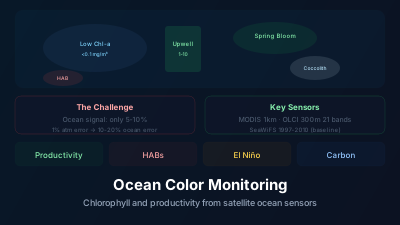
Quick Answer: Ocean color satellites measure the spectral properties of sunlight reflected from the upper ocean to estimate chlorophyll-a concentration (a proxy for phytoplankton biomass), dissolved organic matter, and suspended sediments. The signal is extremely weak — only 5-10% of the total radiance at the sensor comes from the ocean; the rest is atmospheric. Accurate atmospheric correction is critical. MODIS and OLCI (Sentinel-3) provide daily global ocean color at 300m-1km resolution. Chlorophyll maps reveal ocean productivity patterns, upwelling zones, harmful algal blooms, and the biological response to climate variability like El Niño.
The open ocean isn't uniformly blue. From space, you can see swirls of green where phytoplankton bloom, turquoise where coccolithophore shells scatter light, dark blue where nutrients are scarce and biology is sparse. These color differences, invisible from the deck of a ship (the scale is too large), tell the story of ocean productivity — and satellite sensors have been reading that story since the late 1970s.
What gives the ocean its color?
Three optically active constituents set the ocean's color: phytoplankton (through their chlorophyll-a), colored dissolved organic matter, and suspended particles. When sunlight enters the water, each absorbs and scatters different wavelengths, and the mix that reflects back out is what a satellite reads. When those constituents are scarce, pure water dominates and the ocean looks deep blue.
Phytoplankton (chlorophyll-a): Absorb blue (~440 nm) and red (~670 nm) light for photosynthesis; scatter green light. High chlorophyll makes water appear green.
Colored Dissolved Organic Matter (CDOM): Absorbs strongly in blue wavelengths. High CDOM gives water a yellow-brown appearance. Common in coastal waters near river inputs.
Suspended particulate matter: Scatters light broadly, increasing reflectance and making water appear turbid or milky.
Pure water: Absorbs red light strongly; scatters blue light weakly. Deep, clear ocean appears dark blue because blue is the only color not fully absorbed.
The combination of these constituents determines the spectral shape of the "water-leaving radiance" — the light that exits the ocean surface and travels toward the satellite.
Why is ocean color so hard to measure?
The ocean signal is tiny compared to the atmosphere. At a blue wavelength like 443 nm, only 5–10% of the radiance reaching the satellite actually left the water; the rest is atmospheric scattering and sun glint. Extracting a usable ocean signal means removing 90–95% of the measured light with high accuracy — far more demanding than land surface correction.
At a typical ocean color wavelength (443 nm), the total radiance measured by the satellite is approximately:
- 80-90%: Atmospheric scattering (Rayleigh + aerosol)
- 5-10%: Sun glint off the water surface
- 5-10%: Water-leaving radiance (the actual ocean signal)
Extracting a useful ocean signal requires removing 90-95% of the measured radiance with high accuracy. A 1% error in atmospheric correction translates to a 10-20% error in the ocean signal. This is why ocean color processing is far more demanding than land surface processing, and why dedicated ocean color sensors have much more stringent calibration requirements.
Key Ocean Color Sensors
MODIS (Aqua and Terra)
The workhorse of ocean color since 2002:
- Resolution: 1 km (ocean bands)
- Bands: 36 total, with several specifically designed for ocean color (412, 443, 488, 531, 547, 667, 678 nm)
- Coverage: Global daily
- Products: Chlorophyll-a, primary productivity, water clarity, sea surface temperature
MODIS ocean color products are freely available through NASA's Ocean Biology DAAC — see our MODIS data guide for the full band set.
OLCI (Sentinel-3)
The European successor to MERIS, carried on Sentinel-3:
- Resolution: 300 m (significantly better than MODIS 1 km)
- Bands: 21 bands optimized for ocean and land color
- Coverage: Global, 1-2 day revisit with two Sentinel-3 satellites
- Key advantage: 300 m resolution resolves coastal features that MODIS misses
SeaWiFS (historical)
Operated from 1997-2010, SeaWiFS established the modern ocean color record and provided the baseline against which current observations are compared.
What Ocean Color Reveals
Global Chlorophyll Maps
Satellite chlorophyll maps show the ocean's biological geography:
- Oligotrophic gyres (subtropical Pacific, Atlantic, Indian): Low chlorophyll (< 0.1 mg/m³). Deep blue water. Nutrients depleted by stratification.
- Upwelling zones (Peru, Benguela, California, Canaries): High chlorophyll (1-10 mg/m³). Cold, nutrient-rich water rises to the surface, fueling phytoplankton growth.
- Subpolar regions: Intense seasonal blooms when spring light meets winter-mixed nutrients. The North Atlantic spring bloom is one of the largest biological events on Earth.
- Coastal zones: Variable, often high chlorophyll from riverine nutrient inputs.
Seasonal Cycles
Ocean color time series reveal the annual productivity cycle:
- Spring bloom in temperate oceans: Chlorophyll increases 5-10× as day length and stratification increase
- Summer oligotrophy: Surface nutrients depleted; chlorophyll decreases
- Autumn mixing: Deepening mixed layer brings nutrients back to the surface
- Winter: Low light limits growth despite available nutrients
These patterns, repeated annually with climate-driven variation, control the ocean's carbon cycle and fisheries productivity — the kind of recurring signal that continuous area monitoring is built to track.
Harmful Algal Blooms
Certain phytoplankton species produce toxins that contaminate shellfish, kill fish, and threaten human health. Satellite detection:
- Red tides: Dense blooms visible as color anomalies (red-brown patches)
- Cyanobacteria: Detected using fluorescence bands and spectral shape algorithms
- Coccolithophore blooms: Produce extremely high reflectance (milky turquoise) from calcium carbonate shells — clearly visible in true color satellite imagery
For inland lakes and reservoirs, the same bloom signal is mapped at higher resolution with Sentinel-2 water quality methods, while operational marine advisories draw on NOAA's satellite ocean-color products.
Climate Variability
Ocean color responds to climate modes:
- El Niño: Reduces upwelling in the equatorial Pacific, decreasing chlorophyll. The 1997-98 El Niño produced a dramatic "biological desert" visible in SeaWiFS data.
- Pacific Decadal Oscillation: Shifts productivity patterns across the North Pacific
- Marine heatwaves: Suppress nutrient supply through enhanced stratification, reducing chlorophyll
Long-term ocean color records suggest a slight decrease in global ocean productivity over the satellite era — consistent with climate model predictions of increased stratification reducing nutrient supply.
Chlorophyll-a Concentration Reference: Ocean Zones
Satellite chlorophyll maps become interpretable once you know what the numbers mean ecologically:
| Ocean Zone / Region | Approx. Chl-a | Trophic State |
|---|---|---|
| Subtropical gyres (oligotrophic center) | ~0.01–0.05 mg/m³ | Ultra-oligotrophic |
| Open tropical ocean (e.g., tropical Pacific) | ~0.05–0.2 mg/m³ | Oligotrophic |
| Temperate open ocean (non-bloom) | ~0.2–0.5 mg/m³ | Mesotrophic |
| Subpolar / upwelling (productive) | ~0.5–5 mg/m³ | Eutrophic |
| Coastal / estuarine | ~2–20 mg/m³ | Highly eutrophic |
| Active upwelling (Peruvian, Benguela) | ~5–20+ mg/m³ | Hypertrophic |
| Bloom conditions | > 20 mg/m³ | Bloom |
These are orders of magnitude for orientation, not measurements: the span from open-gyre to coastal-bloom water is three to four orders of magnitude, which is the point. Net primary productivity is derived from chlorophyll together with light and temperature, so it does not follow chlorophyll one-for-one — treat it as a separate modelled product rather than reading it off this table.
Color calibration: MODIS and OLCI chlorophyll products use blue-green band ratios (typically B443/B555) that are calibrated to in-situ measurements across the global ocean. The most widely used algorithm (OC3 for MODIS) has known limitations in coastal waters — where CDOM from rivers contributes to blue light absorption, it can substantially overestimate chlorophyll.
Harmful algal bloom monitoring: Bloom monitoring programs set their alert thresholds locally, against the baseline of the specific water body, because what counts as anomalous in an already-eutrophic estuary is very different from an oligotrophic shelf. What satellite data contributes is the anomaly and its spatial extent; confirming toxicity always requires in-water sampling, because chlorophyll concentration alone does not distinguish harmful species from harmless ones.
Carbon Cycle
Phytoplankton are responsible for roughly half of global photosynthesis. They convert CO₂ into organic carbon, some of which sinks to the deep ocean (the "biological pump"). Satellite chlorophyll data, combined with light and temperature, enables estimation of global ocean net primary productivity — a fundamental quantity in the global carbon budget.
Limitations
Depth: Ocean color sensors measure the upper optical depth — typically the top 10-30 m (depending on water clarity). Deep chlorophyll maxima (common in stratified tropical oceans) are invisible to satellites.
Cloud cover: Clouds prevent ocean color observation. In high-latitude oceans (where productivity is highest), cloud cover reduces the effective observation frequency significantly.
Complex waters: In coastal and estuarine waters, the simple relationship between color and chlorophyll breaks down because CDOM and sediments also affect the blue-green signal. Bio-optical algorithms designed for the open ocean can overestimate chlorophyll substantially in these waters, and regionally tuned algorithms are normally required. These same shallow, optically complex zones are where coral reef mapping and shoreline change monitoring operate.
Calibration drift: Multi-decadal trend detection requires extremely stable sensor calibration. Small calibration drifts (0.1% per year) can create artificial trends in chlorophyll estimates that mimic real biological changes.
Ocean color remote sensing is one of the most technically demanding applications of satellite Earth observation — extracting a tiny signal from a dominant atmospheric background to map a biological variable across the global ocean. Yet the 25+ year record it has produced fundamentally changed our understanding of marine ecosystems, revealing productivity patterns, climate connections, and environmental changes that no fleet of research vessels could have discovered.

Remote sensing specialist with 10+ years in satellite data processing and AI. Founder of Off-Nadir Lab. Ph.D. in Informatics (Yokohama National University, 2026). Master's in Earth System Science and Technology (Kyushu University). Co-author, Remote Sensing Encyclopedia. More about the author →