
Detecting Methane Emissions from Space: How Satellites Track an Invisible Gas
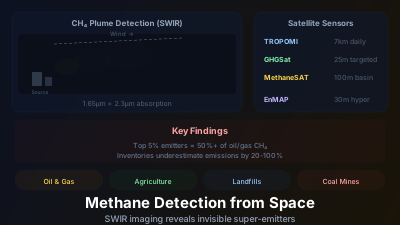
Quick Answer: Methane (CH₄) absorbs specific SWIR wavelengths, allowing satellite spectrometers to detect atmospheric concentrations from space. TROPOMI on Sentinel-5P maps global methane at ~7km resolution daily. GHGSat provides ~25m resolution for individual facility monitoring. Major findings include massive unreported emissions from oil/gas infrastructure, coal mines, and landfills, with top-down satellite estimates in major producing regions sometimes exceeding bottom-up inventories by a factor of two or more. The SWIR band ratio technique compares methane absorption at ~1.65μm against nearby non-absorbing wavelengths. TROPOMI resolves regions and basins rather than individual sites; facility-scale point sources need finer instruments such as GHGSat, whose stated detection limit is ~100 kg CH₄/hour.
Using TROPOMI observations from May 2018 to March 2019, researchers estimated methane emissions from oil and gas production in the Permian Basin at 2.7 ± 0.5 Tg per year — "more than two times higher than bottom-up inventory-based estimates," and equivalent to 3.7% of the gross gas extracted, a leakage rate roughly 60% above the U.S. national average (Zhang et al., Science Advances, 2020). The gas was simply leaking — from wellheads, processing plants, pipelines, and compressor stations across the vast oil-producing region. The scale only became clear once a satellite measured it from space.
Methane monitoring from satellites has gone from a scientific curiosity to a regulatory tool in less than a decade. Here's how it works.
Why does methane matter?
Methane is the second most important greenhouse gas after CO₂, roughly 80× more potent over a 20-year timescale, and because it breaks down in about 12 years rather than centuries, cutting methane is the fastest lever for slowing near-term warming. NOAA's Global Monitoring Laboratory, which has measured atmospheric methane since 1983 at a globally distributed network of air sampling sites, reports globally averaged monthly mean concentrations near 1,940 ppb as of 2026. About 60% of global methane emissions are anthropogenic:
- Oil and gas production and distribution (~22%)
- Livestock and rice agriculture (~27%)
- Landfills and waste (~16%)
- Coal mining (~11%)
Unlike CO₂, which persists in the atmosphere for centuries, methane breaks down in about 12 years. This means reducing methane emissions produces rapid climate benefits. How CO₂ itself is tracked from orbit is a separate problem, covered in CO₂ and carbon monitoring satellites.
How do satellites see methane?
Methane absorbs sunlight at specific wavelengths in the shortwave infrared (SWIR), particularly around 1.65 μm and 2.3 μm, and satellite spectrometers detect the gas by measuring how deeply those absorption features cut into reflected sunlight. When sunlight passes through the atmosphere, hits the ground, and reflects back to the satellite, methane molecules along the path absorb some of that light — the more methane in the column, the deeper the absorption.
The satellite measures the depth of these absorption features:
- More methane in the atmospheric column → deeper absorption → lower measured radiance at methane-absorbing wavelengths
- Background methane (roughly 1,900–1,940 ppb globally) creates a baseline absorption
- Enhanced concentrations from emissions create additional absorption above the baseline
The challenge is separating the methane signal from other factors that affect the measured spectrum: surface reflectance, aerosols, water vapor, and instrument noise.
Key Satellite Instruments
TROPOMI (Sentinel-5P)
The TROPOMI spectrometer aboard Copernicus Sentinel-5P is the current workhorse for global methane monitoring:
- Resolution: ~5.5 × 7 km (upgraded from initial ~7 km)
- Coverage: Global daily
- Precision: ~17 ppb (about 1% of background concentration)
- Launch: 2017
- Method: SWIR spectroscopy at 2.3 μm
TROPOMI provides the big picture — mapping regional methane concentrations, identifying emission hotspots, and tracking seasonal and inter-annual trends. Its resolution is too coarse to pinpoint individual facilities but sufficient to identify regions with anomalous emissions.
GHGSat
Commercial satellite constellation for targeted methane monitoring:
- Resolution: ~25 meters
- Coverage: Targeted (tasked observations)
- Detection limit: ~100 kg CH₄/hour for individual sources
- Method: SWIR spectroscopy at 1.65 μm
GHGSat can image individual wells, processing plants, and pipeline sections, quantifying their emission rates. This facility-level monitoring enables identification of "super-emitters" — the small fraction of facilities responsible for a disproportionate share of total emissions.
EnMAP and PRISMA (Hyperspectral)
Scientific hyperspectral satellites like EnMAP and PRISMA provide detailed spectroscopic measurements. Not designed specifically for methane but capable of detecting large plumes through their continuous spectral coverage in the SWIR — see our hyperspectral remote sensing guide for how these sensors work.
MethaneSAT (Environmental Defense Fund)
Launched in March 2024, MethaneSAT was designed to bridge the gap between TROPOMI's global coverage and GHGSat's point-source precision:
- Resolution: ~100 × 400 m
- Coverage: Targeted but wider swath than GHGSat
- Purpose: Quantifying emissions from entire oil and gas basins, resolving both diffuse area sources and individual large emitters
Status: MethaneSAT is no longer operating. Mission operations lost contact with the spacecraft on 20 June 2025; after 21 days and nearly 400 contact attempts the satellite was confirmed to have lost power and to be unrecoverable (MethaneSAT anomaly investigation). The data already collected remains in use, but the basin-scale niche it filled is currently vacant.
Satellite Methane Sensor Comparison
| Sensor | Operator | Resolution | Revisit | Sensitivity scale | Primary Use |
|---|---|---|---|---|---|
| TROPOMI (Sentinel-5P) | ESA / EU | ~5.5 × 7 km | Daily (global) | Regional / basin totals | Emission hotspot identification, national totals |
| GHGSat constellation | GHGSat Inc. | ~25 m | Targeted (tasked) | Individual facility plumes | Facility-level super-emitter detection |
| MethaneSAT (2024–2025, no longer operating) | Environmental Defense Fund | ~100 × 400 m | Weekly per basin | Basin-wide flux plus large point sources | Oil/gas basin-wide quantification |
| GOSAT / GOSAT-2 | JAXA / NIES | ~10 km (nadir) | 3-day (global) | Column concentration trends | Long-term trend monitoring, scientific |
| Carbon Mapper | Planet / JPL | ~30–60 m | Targeted | Individual facility plumes | Infrastructure surveys, regulatory support |
| Sentinel-5P follow-on (CO2M) | ESA | ~250 km swath | Daily | CO₂ primary; CH₄ secondary | National emissions verification |
The super-emitter distribution: The recurring finding across satellite surveys is that emissions are extremely skewed — a small minority of facilities accounts for a large share of the sector total, though the exact split varies by basin, by survey method, and by how long the observation window is (many super-emitters are intermittent). TROPOMI identifies the regions; higher-resolution instruments identify the specific facilities. This funnel from regional to facility scale is why multiple sensor types are needed — no single instrument covers both the global picture and the point-source detail.
What have satellites actually found?
The consistent pattern across sectors: real emissions exceed reported inventories, and a small number of super-emitters dominate the totals. Oil and gas fields, coal mine vents, and large landfills have all turned out to emit substantially more than official figures suggested — findings that were only possible because satellites measure independently of self-reporting.
Oil and Gas Super-Emitters
A small fraction of facilities account for a large share of emissions. Satellite surveys consistently find:
- A heavily skewed distribution — a minority of emitters dominates the sector total, so targeting the largest sources captures most of the achievable reduction
- Many of these super-emitters are intermittent — they emit heavily for days or weeks, then stop. This makes them difficult to catch with infrequent ground monitoring but detectable by repeated satellite overpasses.
- Top-down satellite estimates frequently exceed bottom-up national inventories in major producing regions, sometimes by a factor of two or more (see the Permian result above)
Landfill Emissions
Large landfills produce continuous methane from decomposing organic waste. Satellite detection has revealed:
- Measured emissions from individual landfills often exceed what the operator or the national inventory reports, in some cases by a large margin
- Emissions vary seasonally and with management practices
- Some of the world's largest methane point sources are landfills, not oil/gas facilities
Coal Mine Ventilation
Active coal mines vent methane through ventilation shafts. These concentrated point sources are well-suited to satellite detection. Major coal-producing regions (China, Russia, Australia, U.S.) show significant emissions from mining operations.
Natural Wetlands and Permafrost
Not all detected methane is from human sources. Satellite data helps distinguish anthropogenic from natural emissions:
- Tropical wetlands (Amazon, Congo) emit seasonally as flooding stimulates methanogenesis
- Arctic regions show increasing emissions potentially linked to permafrost thaw — a climate feedback under active investigation
From Detection to Action
Satellite methane monitoring is increasingly driving real-world emissions reductions:
Regulatory compliance: The EU Methane Regulation (2024) requires satellite monitoring of oil/gas imports, potentially restricting imports from high-emission producers.
Leak detection and repair (LDAR): Companies use satellite data to identify and fix the largest leaks in their operations — often low-cost repairs (closing a valve, replacing a seal) that eliminate significant emissions. This slots into the broader practice of industrial site monitoring from satellites.
Carbon market verification: Methane reduction projects selling carbon credits need independent verification that reductions actually occurred. Satellite monitoring provides that verification.
Diplomatic tool: Satellite data identifies national-level emissions discrepancies, informing climate negotiations and methane reduction pledges (like the Global Methane Pledge targeting 30% reduction by 2030).
Limitations
Cloud cover: SWIR measurements require clear skies. Persistent cloud cover in tropical regions limits observation frequency.
Surface reflectance: Dark surfaces (water, dense vegetation) provide insufficient reflected SWIR light for methane retrieval. Detection works best over bright surfaces (arid land, urban areas).
Wind dispersion: By the time satellite instruments measure a methane plume, wind has dispersed and transported it from the source. Source attribution requires wind modeling to trace the plume back to its origin.
Quantification uncertainty: Estimating emission rates from column concentration measurements involves assumptions about vertical distribution, wind speed, and plume geometry. Wind speed is usually the dominant error term, and uncertainty on a single-plume emission estimate is large enough that individual figures should be treated as order-of-magnitude rather than precise. Published estimates normally carry an explicit uncertainty range — read it.
Detection threshold: Small, distributed emissions (diffuse seepage, small agricultural sources) fall below satellite detection limits. Satellites see the big emitters clearly but may miss a substantial fraction of total emissions from numerous small sources.
Methane is one branch of a wider atmospheric monitoring toolkit — the same TROPOMI instrument also maps NO₂ and other air quality indicators. Despite these limitations, satellite methane monitoring has fundamentally changed the emissions transparency landscape. For the first time, emissions can be independently verified from space — creating accountability for sources that previously self-reported (or didn't report at all). The combination of TROPOMI's global coverage with facility-scale instruments such as GHGSat and Carbon Mapper creates a monitoring system that is reshaping climate policy and industrial practice — though the loss of MethaneSAT is a reminder that this capability depends on individual spacecraft that can and do fail.

Remote sensing specialist with 10+ years in satellite data processing and AI. Founder of Off-Nadir Lab. Ph.D. in Informatics (Yokohama National University, 2026). Master's in Earth System Science and Technology (Kyushu University). Co-author, Remote Sensing Encyclopedia. More about the author →