
Air Quality from Space: How Satellites Map NO₂, PM2.5, and Other Pollutants
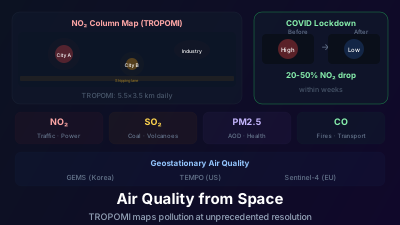
Quick Answer: Satellites measure atmospheric pollutant concentrations by analyzing how gases absorb specific UV/visible/IR wavelengths. TROPOMI on Sentinel-5P maps NO₂ at ~5km resolution daily, revealing pollution from traffic, power plants, and industrial zones. The COVID-19 lockdowns provided dramatic validation — satellite NO₂ over affected regions fell sharply within weeks and recovered as activity resumed, because NO₂ has a short atmospheric lifetime and tracks emissions closely in time and space, though the size of the drop varied widely by city and by the baseline period chosen for comparison. PM2.5 cannot be measured directly but is estimated from Aerosol Optical Depth (AOD) combined with meteorological models. Satellite air quality data complements ground monitors, providing spatial coverage where ground networks are sparse (most of the developing world).
When COVID-19 lockdowns emptied streets and shuttered factories in early 2020, TROPOMI captured what might be the most vivid satellite images of 2020 — not photographs, but maps of nitrogen dioxide over China, Europe, and the United States. Cities that normally appeared as bright red hotspots on NO₂ maps turned blue within weeks. It was pollution made visible from space, responding in near-real-time to human activity.
Those images did more to demonstrate the capability of satellite air quality monitoring than years of scientific publications. They showed that satellites don't just measure air quality — they reveal its direct connection to what we do on the ground.
What Satellites Can Measure
Nitrogen Dioxide (NO₂)
The best-measured pollutant from space. NO₂ has strong absorption features in the blue-violet region (400-465 nm), and its atmospheric lifetime is short (hours to a day), meaning elevated concentrations stay close to their sources.
TROPOMI retrieves NO₂ by comparing the measured spectrum against a reference clean-atmosphere spectrum. The difference reveals the total column abundance of NO₂ — the total amount in the atmospheric column from surface to satellite.
What the maps show: Bright spots over cities (vehicle emissions), shipping lanes (marine fuel), power plants, and industrial complexes. Background levels are low; sources are clearly identifiable.
Sulfur Dioxide (SO₂)
Detected through UV absorption features. Major sources visible from space include:
- Coal-fired power plants (reducing globally due to emission controls)
- Metal smelters
- Volcanic eruptions (massive plumes trackable across thousands of kilometers)
- Shipping emissions
Carbon Monoxide (CO)
Measured by TROPOMI in the SWIR region. CO has a longer atmospheric lifetime (weeks), so it spreads further from sources. Satellite CO maps reveal:
- Biomass burning emissions (wildfires, agricultural burning)
- Industrial emissions
- Long-range transport of pollution
Formaldehyde (HCHO)
A proxy for volatile organic compound (VOC) emissions. Detected in the UV-visible region. Biogenic emissions from forests (isoprene) and anthropogenic sources (petrochemical industry) are distinguishable by their spatial patterns.
Aerosol Optical Depth (AOD)
Not a gas measurement but a column-integrated measure of aerosol loading (particles in the atmosphere). MODIS and VIIRS retrieve AOD from the visible reflectance of the atmosphere:
- High AOD: Hazy, polluted conditions (dust storms, biomass burning, industrial smog)
- Low AOD: Clean air
AOD is the satellite measurement most closely related to surface PM2.5, though the relationship depends on particle properties, vertical distribution, and meteorological conditions.
From Column to Surface: The Translation Problem
Satellites measure total atmospheric columns — the integrated abundance of a pollutant through the entire atmosphere. What people breathe is the surface-level concentration. Converting one to the other requires:
Chemical transport models: Simulate the vertical distribution of pollutants based on meteorology, emissions inventories, and atmospheric chemistry. The model provides the fraction of the total column that's near the surface.
Statistical relationships: Correlate satellite column measurements with co-located ground monitor data to build empirical conversion functions. This approach works well where ground monitors are dense (North America, Europe) but poorly where they're sparse (Africa, much of Asia).
Hybrid approaches: Combine model-predicted vertical profiles with satellite column observations to produce surface concentration estimates. Agreement with ground monitors is moderate for individual days and improves substantially when the estimates are averaged to monthly or annual means, because much of the day-to-day error is random rather than systematic.
Applications
Urban Air Quality Monitoring
Satellite NO₂ maps reveal intracity pollution patterns:
- Highway corridors produce elevated NO₂ lines
- Industrial zones appear as bright spots
- Downwind dispersion follows prevailing wind patterns
- Weekend-weekday differences are detectable (reduced traffic)
This spatial detail complements ground monitors, which measure accurately at a point but can't capture the spatial variability across a city.
Health Exposure Assessment
The World Health Organization estimates that ambient (outdoor) air pollution caused 4.2 million premature deaths worldwide in 2019, predominantly through exposure to fine particulate matter. Estimating health impacts requires population-level exposure assessment:
Satellite-derived PM2.5 estimates provide global coverage at ~1 km resolution (the van Donkelaar dataset, widely used in health studies). While less accurate than ground monitors at any single point, they capture the spatial variation that health studies need — especially in developing countries where ground monitoring is sparse or nonexistent.
Emission Inventory Verification
Countries report emissions to international bodies under climate and pollution agreements. Satellite measurements provide independent verification:
- China's SO₂ reduction: Using the Ozone Monitoring Instrument on NASA's Aura satellite, Li et al. (2017) reported that China's SO₂ emissions declined by 75% since 2007 while India's rose by 50%
- India's NO₂ trends: Increasing industrialization and vehicle fleet growth visible as rising NO₂
- Ship emission controls: The 2020 IMO sulfur regulations produced a measurable decrease in SO₂ along major shipping lanes
Wildfire Smoke Tracking
Biomass burning produces CO, NO₂, aerosols, and formaldehyde. Satellite monitoring tracks:
- Smoke plume extent and trajectory
- Downwind air quality impacts on populated areas
- Total emissions estimation for fire management
Reading NO₂ Maps Against Health Guidelines
A TROPOMI map reports a column density — the total NO₂ in the air above each pixel — while air quality guidelines are written in terms of the surface concentration people breathe. There is no fixed conversion between the two. The fraction of the column that sits near the ground depends on the height of the boundary layer, the vertical profile assumed in the retrieval, and how far the air has travelled from the source, all of which change with season, time of day, and weather. Translating a column map into surface concentrations therefore requires a chemical transport model or a local calibration against ground monitors, not a lookup table.
What the maps read reliably is relative structure: which parts of a city are consistently elevated, where the gradients fall off downwind, and whether a given source is getting stronger or weaker over time. For regulatory comparison against a numeric guideline — such as the WHO annual NO₂ guideline — ground monitors remain the reference instrument.
The COVID-19 lockdowns were a natural experiment: when traffic and industrial activity collapsed in early 2020, satellite NO₂ over affected regions fell sharply within weeks and recovered as activity resumed. Because NO₂ has a short atmospheric lifetime, the signal tracks emissions closely in time and space, which is why the lockdown response appeared so quickly and so clearly. That episode is the most widely cited demonstration that satellite NO₂ responds to real changes in human activity rather than to measurement artefacts. The exact size of the drop varied widely by city and by the period and baseline chosen for comparison, so specific percentage figures should be taken from the study that produced them.
Limitations
Spatial resolution: TROPOMI's ~5 km pixels are too coarse for street-level air quality assessment. They can't resolve the difference between a busy intersection and a nearby park.
Temporal coverage: One overpass per day (around 13:30 local time for TROPOMI). Air quality varies throughout the day — morning rush hour, afternoon photochemistry, evening inversions. One snapshot doesn't capture this diurnal cycle.
Cloud interference: Like all passive optical sensors, TROPOMI can't see through clouds. In persistently cloudy regions, satellite air quality data has significant gaps.
Surface-level conversion: The column-to-surface conversion introduces substantial uncertainty, particularly for PM2.5 where the relationship between AOD and surface concentration depends on aerosol vertical profile, hygroscopic growth, and mixing height — all of which vary in time and space.
No direct PM2.5: Satellites measure optical effects of particles (AOD), not mass concentration directly. The conversion depends on assumptions about particle size, composition, and vertical distribution.
The Future
Geostationary air quality satellites: GEMS (Korea, launched 2020), TEMPO (US, launched 2023), and Sentinel-4 (Europe, planned) provide hourly observations over their respective continents — capturing diurnal air quality cycles for the first time from space.
Higher resolution: Next-generation instruments aim for 1-2 km resolution, approaching the scale needed for intracity pollution management.
Multi-pollutant synergies: Combining NO₂, SO₂, HCHO, CO, and AOD from a single platform enables comprehensive air quality characterization and source attribution.
Satellite air quality monitoring has evolved from a scientific research tool to a practical complement to ground-based monitoring networks. It can't replace ground monitors for regulatory compliance (the accuracy isn't sufficient), but it provides something ground monitors never will: wall-to-wall spatial coverage showing where pollution comes from, where it goes, and how it's changing.

Remote sensing specialist with 10+ years in satellite data processing and AI. Founder of Off-Nadir Lab. Ph.D. in Informatics (Yokohama National University, 2026). Master's in Earth System Science and Technology (Kyushu University). Co-author, Remote Sensing Encyclopedia. More about the author →