
Land Cover Change Detection: Methods for Tracking How Earth's Surface Evolves
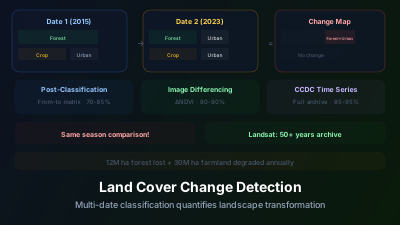
Quick Answer: Land cover change detection identifies where the surface has changed between two or more dates. The simplest method — post-classification comparison — classifies each date independently and compares the results, producing a 'from-to' change matrix but propagating classification errors from both dates. Image differencing (subtracting bands or indices) is more sensitive to change but doesn't tell you what changed to what. Continuous Change Detection and Classification (CCDC) uses the full Landsat/Sentinel-2 time series to detect change timing precisely. For multi-decadal studies, Landsat's 50+ year archive is irreplaceable. Published accuracies transfer poorly between studies because they depend on landscape, class definitions, and reference data — what does transfer is the ordering of the methods, and the fact that from-to accuracy is always lower than binary changed/unchanged accuracy, so the only figure worth quoting for your own map is one you measured on your own validation sample.
Every year, millions of hectares of forest are cleared, agricultural land is degraded, and cities expand into the landscapes around them. None of that would be quantifiable at global scale without satellite-based change detection — the figures that appear in national reporting and international assessments are, at root, derived from repeat satellite observation. It's the quantitative backbone of environmental monitoring.
But "change detection" isn't a single technique — it's a family of methods with different strengths, requirements, and failure modes. Choosing the right method for your application determines whether you get useful results or misleading artifacts.
The Fundamental Approaches
Post-Classification Comparison
The most intuitive approach:
- Classify image from Date 1 into land cover categories
- Classify image from Date 2 into the same categories
- Compare pixel by pixel: where categories differ, change has occurred
Output: A "from-to" change matrix showing exactly what changed to what — "forest to urban," "cropland to water," etc.
Advantages:
- Provides complete information about the nature of change
- Each date can use different sensors (useful for long time spans)
- Straightforward to interpret and communicate
Disadvantages:
- Errors from both classifications multiply. If each classification is 85% accurate, the change map accuracy could be as low as 72% (0.85 × 0.85). Every misclassified pixel in either date produces a false change.
- Requires consistent class definitions across dates
- Sensitive to seasonal and atmospheric differences between acquisition dates
Image Differencing
Subtract one date's pixel values from another: Change image = Image_Date2 − Image_Date1
Typically applied to a vegetation index (NDVI) or a single band (NIR):
- Large positive difference: Vegetation increase (regrowth, crop green-up)
- Large negative difference: Vegetation decrease (clearing, drought, fire)
- Near-zero difference: No significant change
Advantages:
- Simple and fast
- Highly sensitive to real change (not filtered through classification errors)
- Works with radiometrically consistent imagery
Disadvantages:
- Doesn't identify what changed to what (only that something changed)
- Requires radiometric consistency between dates (same atmospheric conditions, calibration)
- Seasonal differences can mask or mimic change (a comparison between summer and winter will show "change" everywhere due to phenology)
Change Vector Analysis (CVA)
An extension of differencing that uses multiple bands simultaneously. The "change vector" for each pixel has both a magnitude (how much change) and a direction (what kind of change) in multidimensional spectral space.
The magnitude is thresholded to identify changed pixels. The direction indicates the type of change — for example, a vector pointing toward higher SWIR and lower NIR suggests forest clearing (exposed soil is brighter in SWIR and darker in NIR than forest).
Continuous Change Detection and Classification (CCDC)
Instead of comparing two dates, CCDC analyzes the entire available time series (all Landsat and/or Sentinel-2 observations):
- Fit a harmonic model (seasonal pattern) to each pixel's time series
- Monitor for deviations from the expected pattern
- When observations consistently deviate beyond a threshold, declare a "break" — a change event
- Classify the land cover before and after the break
Advantages:
- Precise timing of change events (to within one observation)
- Robust to seasonal variation (the model accounts for phenology)
- Uses all available data, maximizing signal-to-noise
- Distinguishes abrupt change (clearing) from gradual change (degradation)
Disadvantages:
- Requires dense time series (at least 12-15 observations per year)
- Computationally intensive
- Complex to implement and parameterize
CCDC and similar time series approaches (BFAST, LandTrendr) represent the state of the art for change detection and are increasingly used in operational monitoring systems.
Practical Considerations
Image Selection
For bi-temporal change detection (comparing two dates):
Same season: The most critical requirement. Comparing July to July eliminates phenological differences. Comparing July to February will flag every deciduous pixel as "changed."
Similar atmospheric conditions: Hazy vs. clear images produce radiometric differences that mimic surface change. Use atmospherically corrected data (Sentinel-2 Level-2A, Landsat Collection 2 Level-2).
Anniversary dates: Exact anniversary dates (same month, same day ± a few weeks) minimize sun angle and phenological differences.
Thresholding
Image differencing produces a continuous change magnitude. Converting this to binary "change/no-change" requires a threshold. Setting the threshold is perhaps the most consequential decision in the entire analysis:
- Too sensitive (low threshold): Many false positives — natural variability, atmospheric effects, and sensor noise are flagged as change
- Too conservative (high threshold): Many false negatives — real but subtle changes are missed
Approaches to threshold selection:
- Statistical: Mean ± 2 standard deviations of the no-change distribution
- Empirical: Manual inspection of known changed and unchanged areas
- Automatic: Otsu's method or other distribution-based algorithms
- Multi-threshold: Classify change into categories (definite change, probable change, possible change, no change)
Minimum Mapping Unit
Very small changes (a single pixel) are often noise rather than real change. Applying a minimum mapping unit (e.g., 9 pixels = 0.08 ha at 30 m) removes isolated changed pixels, reducing false positives at the cost of missing very small change events.
Validation
Change maps are notoriously difficult to validate because:
- Ground truth for change requires observations at two dates
- High-resolution reference imagery may not be available for both dates
- Some changes are ambiguous (is a partially logged forest "changed" or not?)
Standard validation uses stratified random sampling with interpretation of high-resolution imagery (Google Earth, aerial photos) as reference. The USGS, ESA, and other agencies publish validation protocols specifically for land cover change products.
Accuracy Expectations
Published accuracies for change detection vary so much with landscape, class definitions, and reference data that a number from one study transfers poorly to another. What does transfer is the relative ordering of the methods:
| Method | Relative accuracy for binary change | Best For |
|---|---|---|
| Post-classification | Lowest — errors from both dates compound | Long time spans, different sensors |
| NDVI differencing | Higher, for the change types the index responds to | Forest/vegetation change |
| CVA | Comparable to differencing, across more change types | Multiple change types |
| CCDC/time series | Highest — uses every observation and models phenology | Precise timing, comprehensive monitoring |
These comparisons apply to binary change detection (changed vs. unchanged). "From-to" accuracy — correctly identifying both the original and the new land cover — is always lower than binary accuracy for the same method, because it requires two classifications to be right rather than one detection.
Whatever method you use, the only accuracy figure worth quoting for your own map is one you measured on your own validation sample.
The Landsat Archive: Change Detection's Foundation
The Landsat program has continuously imaged Earth's surface since 1972. This 50+ year archive, freely available since 2008, is the foundation of long-term change analysis:
- 1972-present: Continuous multispectral coverage, beginning with the MSS instrument at coarser resolution; the 30 m record starts with the Thematic Mapper on Landsat 4 in 1982
- Global coverage: Systematic, repeated acquisition of every land surface
- Calibration continuity: Cross-calibrated across Landsat 4, 5, 7, 8, and 9
No other satellite program provides this combination of temporal depth, spatial resolution, and consistency. For any study requiring multi-decadal change analysis, Landsat is indispensable.
Sentinel-2 (from 2015) provides better spectral and temporal resolution for current monitoring, but it can't look backward before 2015. The most powerful approach combines both: Landsat for historical context and trend analysis, Sentinel-2 for current high-frequency monitoring.
Change detection is where satellite remote sensing delivers its most tangible societal value — answering the fundamental question "what's changing?" across the entire planet. The methods continue to evolve, but the core principle remains: consistent, calibrated observations over time reveal changes that no single snapshot can capture.

Remote sensing specialist with 10+ years in satellite data processing and AI. Founder of Off-Nadir Lab. Ph.D. in Informatics (Yokohama National University, 2026). Master's in Earth System Science and Technology (Kyushu University). Co-author, Remote Sensing Encyclopedia. More about the author →