
Landslide Detection and Monitoring with Satellite Data
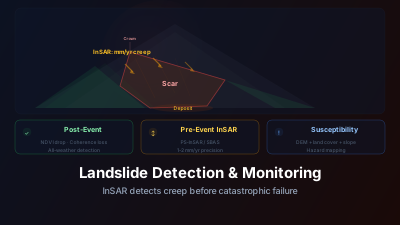
Quick Answer: Satellites detect landslides through two complementary approaches: (1) Post-event optical/SAR change detection identifies landslide scars — bare soil exposed where vegetation was removed, with characteristic elongated or lobate shapes. (2) Pre-event InSAR monitoring detects slow ground displacement (mm/year) on unstable slopes, potentially providing early warning before catastrophic failure. Sentinel-1 InSAR achieves mm/year displacement precision on bare rock and urban slopes. Optical detection works best for large landslides (>0.1 ha) that remove vegetation. Rainfall-triggered shallow landslides may be too numerous and small for systematic satellite detection.
In 2017, a slope above the village of Xinmo in Sichuan, China, collapsed catastrophically and buried much of the village. Retrospective InSAR analysis of the archived Sentinel-1 stack later showed that the source area had been creeping measurably for years before failure, and had accelerated in the weeks immediately preceding it. The displacement was there in the data all along — but nobody had been monitoring that particular slope.
This illustrates both the power and the challenge of satellite landslide monitoring: the technology to detect pre-failure displacement exists, but applying it systematically to the millions of potentially unstable slopes worldwide is an enormous undertaking.
Post-Event Detection: Finding Landslides That Already Happened
Optical Detection
Fresh landslides create distinctive features in optical imagery:
Spectral change: Vegetation is removed, exposing bare soil or rock. NDVI drops from 0.6-0.8 (forest) to 0.1-0.3 (bare soil). This spectral contrast is strong and easily detected through image differencing.
Morphological features: Landslide scars have characteristic shapes — elongated along the slope direction, with a concave source area (scarp) at the top and a lobate deposit zone at the bottom.
Size range: Satellite detection is most reliable for landslides larger than about 0.01-0.1 hectares, depending on sensor resolution:
- Sentinel-2 (10m): Detects landslides > ~0.1 ha
- Commercial satellites (1-3m): Detects landslides > ~0.01 ha
- Very high resolution (<1m): Individual debris flows detectable
SAR-Based Detection
SAR detects landslides through:
- Backscatter change: Removal of vegetation changes the scattering mechanism, altering both VV and VH backscatter
- Coherence loss: Surface disruption destroys coherence
- Advantage: Works through clouds — critical because landslides are typically triggered by heavy rainfall events, which produce cloud cover that prevents optical observation
Inventory Mapping After Major Events
After rainfall events, earthquakes, or typhoons that trigger hundreds or thousands of landslides simultaneously, satellite-based inventory mapping provides:
- Total number and area of landslides triggered
- Spatial distribution relative to triggering factors (rainfall, ground shaking)
- Road and infrastructure blockages
- Areas at risk of secondary hazards (landslide-dammed lakes)
The 2015 Nepal earthquake triggered tens of thousands of landslides, mapped from pre- and post-event satellite imagery — a catalogue that would have taken years to compile through field survey alone.
Pre-Event Monitoring: Catching Slopes Before They Fail
InSAR Displacement Monitoring
Many large landslides don't fail suddenly. They creep — moving millimeters to centimeters per year — before accelerating to catastrophic failure. InSAR detects this pre-failure creep:
PS-InSAR: Identifies stable radar targets (buildings, rock outcrops) on or near slopes and tracks their displacement over months to years. Typical precision: 1-2 mm/year.
SBAS: Provides broader spatial coverage than PS-InSAR, including natural terrain, but with lower precision per pixel.
What to look for: Persistent downslope displacement that accelerates over time is the classic precursor to catastrophic failure. The Fukuzono/Voight failure forecast model predicts failure timing based on the acceleration of displacement.
Practical Implementation
Systematic slope monitoring requires:
- Identify target slopes: From landslide susceptibility maps, geological surveys, or known problem areas
- Process InSAR time series: Using Sentinel-1 archive (typically 2-5 years of data)
- Identify anomalous displacement: Slopes moving faster than their geological context suggests
- Establish monitoring: Regular processing to track acceleration
Several countries have implemented or are implementing national-scale InSAR monitoring:
- Italy: Nationwide ground-motion mapping over known landslide-prone areas
- Norway: Sentinel-1-based monitoring of unstable rock slopes above fjords
- Japan: Monitoring of slopes destabilized by earthquakes and heavy rainfall
Limitations of InSAR for Landslide Monitoring
Vegetation: Dense vegetation causes rapid decorrelation at C-band, reducing InSAR measurement quality. Many landslide-prone slopes in tropical and temperate regions are heavily vegetated, limiting the effectiveness of Sentinel-1 InSAR. L-band systems (ALOS-2, NISAR) penetrate vegetation better.
Steep terrain: Slopes facing away from the satellite may fall in radar shadow; slopes facing toward the satellite may experience severe foreshortening or layover. Both reduce or prevent InSAR measurement.
Movement direction: InSAR measures displacement in the satellite's line-of-sight direction. A slope moving perpendicular to the look direction may show minimal InSAR signal despite significant actual displacement.
Rapid movement: InSAR loses coherence when displacement exceeds half a wavelength between acquisitions (~2.8 cm for Sentinel-1's 6-12 day revisit). Fast-moving landslides that displace more than this between passes are unmeasurable by standard InSAR.
InSAR Displacement Rates: Interpreting Slope Movement
Understanding what different displacement rates mean helps prioritize which slopes need urgent attention:
| Displacement Rate | Classification | InSAR Detectability | Risk Level |
|---|---|---|---|
| < 1 mm/year | Negligible / geological background | At noise level; typically not detectable | Negligible |
| 1–5 mm/year | Very slow creep | Detectable with PS-InSAR over 1–2 years | Low; long-term monitoring |
| 5–20 mm/year | Slow active landslide | Clearly detectable; 6-month time series sufficient | Moderate; monitor closely |
| 20–100 mm/year | Moderate movement | Reliably detected; accelerating trend critical | High; active management needed |
| 100–500 mm/year | Rapid movement | Near InSAR coherence limit (~3 cm/acquisition) | Very high; evacuation may be needed |
| > 500 mm/year | Very rapid / catastrophic | Exceeds InSAR coherence; amplitude change only | Catastrophic; ongoing failure |
The Xinmo case (2017 Sichuan): A pre-failure creep signal was present in the Sentinel-1 archive for years before the collapse, but it was identified only in retrospective analysis. Prospectively, the challenge is that a great many slopes across mountain regions sit in the slow-to-moderate bands of the table above — clearly detectable, and still not failing. Detection is not the hard part; deciding which of the detected slopes matters is.
Acceleration is the critical indicator: A slope that has been moving at 10 mm/year for years and suddenly accelerates to 50 mm/year is far more concerning than one that has been consistently slow. The Fukuzono model uses the inverse of velocity (1/v) to predict failure timing — when 1/v approaches zero, failure is imminent. InSAR time series make this acceleration visible at continental scale for the first time.
Susceptibility and Hazard Assessment
Satellites contribute to landslide hazard assessment even without detecting active landslides:
DEM-derived terrain variables: Slope angle, curvature, aspect, and flow accumulation from satellite-derived DEMs (SRTM, ALOS World 3D) are primary inputs to susceptibility models.
Land cover: Satellite-derived land cover maps identify destabilizing factors — deforestation, road cuts, urbanization on slopes.
Soil moisture: SAR-derived soil moisture indicates when slopes are approaching saturation — the condition that triggers many rainfall-induced landslides.
Historical inventory: Satellite-based landslide inventories provide the training data for statistical susceptibility models (logistic regression, Random Forest, neural networks).
Landslide Dam Monitoring
When landslides block river valleys, the resulting landslide-dammed lakes pose extreme flood hazards. Satellite monitoring provides:
Lake detection: SAR or optical imagery detects the growing lake behind the dam Lake volume estimation: From lake area (satellite) and valley geometry (DEM) Dam stability assessment: InSAR monitors deformation of the dam itself Outburst flood warning: Rapid lake level rise detected by satellite altimetry or area expansion
The 2018 Baige landslide in Tibet dammed the Jinsha River, creating a lake that threatened communities downstream. Repeat satellite acquisitions tracked the lake's growth through the emergency, contributing data to evacuation decisions.
From Research to Operations
Satellite landslide detection has matured significantly but faces a fundamental scaling challenge: there are millions of potentially unstable slopes worldwide, and systematic monitoring requires processing vast quantities of SAR data continuously.
Current operational status:
- Post-event detection: Operational at national and international agencies (Copernicus EMS, NASA, JAXA)
- Regional InSAR monitoring: Operational in several countries for known high-risk areas
- Global systematic monitoring: Still largely a research aspiration; computational requirements are being addressed through cloud computing and automated processing
The technology gap is closing. As SAR data volumes increase (Sentinel-1, NISAR, commercial SAR constellations) and processing becomes more automated, the vision of comprehensive global landslide monitoring moves closer to reality. For now, the most effective approach combines satellite-based susceptibility mapping to identify where monitoring is needed, InSAR for continuous displacement tracking of the most critical slopes, and rapid post-event detection to document triggered landslides and assess secondary hazards.

Remote sensing specialist with 10+ years in satellite data processing and AI. Founder of Off-Nadir Lab. Ph.D. in Informatics (Yokohama National University, 2026). Master's in Earth System Science and Technology (Kyushu University). Co-author, Remote Sensing Encyclopedia. More about the author →