
Hurricane and Typhoon Tracking with Satellites: From Formation to Landfall
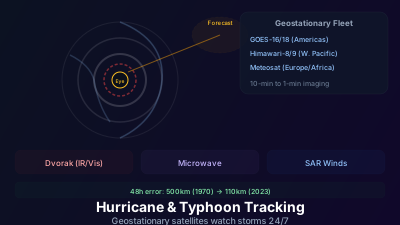
Quick Answer: Geostationary satellites (GOES, Himawari, Meteosat) provide continuous monitoring of tropical cyclones with 10-minute to 1-minute imaging intervals. The Dvorak technique estimates storm intensity from cloud pattern analysis. Microwave sensors penetrate the cirrus canopy to reveal the warm core and eyewall structure. SAR measures ocean surface wind speeds through the storm at high resolution. Satellite monitoring has virtually eliminated surprise landfall events — every significant tropical cyclone is now tracked from formation through dissipation, giving coastal populations days to weeks of warning.
Before weather satellites, tropical cyclones could approach coastlines with little warning. The 1900 Galveston hurricane killed 8,000 people partly because residents had no idea a major hurricane was approaching. Today, that scenario is nearly impossible — geostationary satellites watch every ocean basin continuously, detecting tropical disturbances days before they threaten land.
This is arguably the single greatest humanitarian contribution of satellite technology: the elimination of surprise tropical cyclone landfalls.
Continuous Monitoring: Geostationary Satellites
Geostationary weather satellites orbit at 35,786 km altitude, rotating with Earth to provide a fixed view of roughly one-third of the planet. The current constellation:
- GOES-16/18 (United States): Atlantic and eastern Pacific
- Himawari-8/9 (Japan): Western Pacific and Indian Ocean
- Meteosat (EUMETSAT): Europe, Africa, Indian Ocean
- FY-4 series (China): Western Pacific and Indian Ocean
- INSAT/GSAT (India): Indian Ocean
Together, these provide near-continuous coverage of all tropical cyclone basins.
Imaging Frequency
Modern geostationary imagers scan at remarkable speeds:
- Full disk: Every 10-15 minutes
- Regional sectors: Every 5 minutes
- Mesoscale targets (active storms): Every 30-60 seconds (GOES "meso" mode)
This temporal resolution captures the rapid structural evolution of tropical cyclones — eyewall replacement cycles, convective bursts, and intensity fluctuations that occur on timescales of minutes to hours.
Estimating Storm Intensity
The Dvorak Technique
Developed in the 1970s and still the primary method for estimating tropical cyclone intensity from satellite imagery. The technique analyzes cloud patterns in infrared and visible imagery:
- Pattern recognition: Identify the organizational stage (curved band, central dense overcast, eye)
- Cloud temperature: Colder cloud tops indicate stronger convection
- Eye characteristics: Size, shape, and temperature contrast between eye and surrounding convection
- Pattern trend: Intensifying, steady, or weakening
The Dvorak technique assigns a "T-number" (1.0-8.0) that maps to estimated maximum sustained winds. The method has been remarkably successful — it is the reason intensity can be estimated at all for the majority of the world's tropical cyclones, which no aircraft ever enters — but it is an inference from cloud appearance, and it carries meaningfully more uncertainty than a direct measurement (see the discussion of estimation error below).
Advanced Dvorak Technique (ADT)
An automated, objective version of the Dvorak technique that processes satellite imagery algorithmically. The ADT removes subjective analyst interpretation, providing consistent intensity estimates globally. It runs operationally at NOAA and other forecast agencies.
Microwave Imagery
Infrared imagery shows the cloud top — the cirrus canopy that can obscure the storm's internal structure. Microwave radiation penetrates this high-altitude ice, revealing:
- The warm core: Warm temperature anomaly at upper levels, diagnostic of tropical cyclone intensity
- Eyewall structure: The ring of intense convection surrounding the eye
- Eyewall replacement cycles: When a new eyewall forms outside the existing one, temporarily weakening the storm before re-intensifying
Microwave sensors on polar-orbiting satellites (AMSU, ATMS, GMI) don't provide continuous coverage but offer structural insights when they pass over a storm.
SAR for Surface Wind Measurement
SAR satellites measure ocean surface roughness, which correlates with wind speed. When a SAR image captures a tropical cyclone:
- Wind speed mapping at 1-3 km resolution across the storm
- Asymmetric wind field structure (the strongest winds aren't symmetric around the eye)
- Maximum wind estimation independent of the Dvorak technique
SAR provides ground truth for validating satellite intensity estimates, particularly for storms that aircraft reconnaissance doesn't reach (most typhoons in the western Pacific, all Southern Hemisphere cyclones).
Storm Surge and Rainfall Monitoring
Satellite Altimetry
Radar altimeters on satellites like Jason-3 and Sentinel-6 measure sea surface height. Storm surge — the dome of water pushed ashore by cyclonic winds — is detectable as a sea surface height anomaly along the coast before and during landfall.
Satellite Precipitation
GPM (Global Precipitation Measurement) and IMERG provide near-real-time precipitation estimates within and around tropical cyclones. These data help forecast flood potential — particularly for slow-moving storms where rainfall accumulation is the primary hazard (like Hurricane Harvey in 2017, which produced over 1.5 meters of rainfall in parts of Houston).
Post-Landfall Damage Assessment
After a cyclone makes landfall, satellite-based assessment shifts to damage documentation:
SAR flood mapping: Sentinel-1 maps flooded areas through post-storm cloud cover, identifying which communities are inundated.
Optical damage assessment: Once skies clear, high-resolution optical imagery assesses structural damage — roof damage, debris fields, vegetation stripping.
Vegetation damage: The "brown swath" of defoliated vegetation visible in NDVI differencing reveals the storm's wind damage footprint. This vegetation damage proxy can estimate wind speed patterns across the landfall zone.
Infrastructure assessment: Road blockages, bridge damage, and utility damage visible in post-storm imagery guide recovery logistics.
Forecasting Support
Satellites don't just observe cyclones — they improve forecasts:
Atmospheric Motion Vectors (AMVs): Tracking cloud features in geostationary imagery provides wind observations over data-sparse ocean regions. These winds are assimilated into numerical weather prediction models, improving track forecasts.
Sea Surface Temperature (SST): Satellite-derived SST maps identify warm ocean features (warm eddies, the Loop Current in the Gulf of Mexico) that can fuel rapid intensification. When a cyclone passes over anomalously warm water, intensity forecasts must account for this energy source.
Ocean Heat Content: Combining SST with satellite altimetry (ocean height anomalies indicate subsurface warmth) provides a better measure of the energy available to fuel a cyclone than SST alone.
The Forecast Improvement Record
Track forecast errors for Atlantic hurricanes have decreased dramatically over the satellite era. The National Hurricane Center publishes annual average official track errors for the Atlantic basin from 1970 onward, with trend lines — the long-run decline at every forecast lead time is one of the clearest documented improvements in operational forecasting.
Intensity forecasting has improved more slowly but consistently, with the largest remaining challenge being rapid intensification — storms that strengthen by 30+ knots in 24 hours, often surprising forecasters and coastal populations.
How Intensity Is Estimated, and How Much to Trust It
Understanding the precision limits of satellite-based tropical cyclone intensity estimation is critical for interpreting operational forecasts. The methods form a clear hierarchy, from direct measurement to inference:
| Intensity Estimation Method | What it actually measures | Best Use Case | Key Limitation |
|---|---|---|---|
| Aircraft reconnaissance | Winds and pressure, in situ | The reference other methods are calibrated against | Only Atlantic + eastern Pacific; expensive; snapshot in time |
| SAR surface winds | Sea surface roughness → wind speed, at high resolution | Direct wind field structure, including asymmetry | Infrequent overpasses; rarely catches peak intensity |
| Microwave warm core / structure | Emission from below the cirrus canopy | Seeing eyewall structure infrared cannot | Polar orbit — a few passes per day per satellite |
| Advanced Dvorak (ADT, automated) | Cloud-top pattern, algorithmically | Consistency and objectivity; runs continuously | Struggles with unusual or transitioning structures |
| Dvorak (analyst) | Cloud-top pattern, by trained interpretation | Every basin, continuously, for over 50 years | An inference from appearance; analyst-to-analyst variation |
Why the uncertainty matters operationally: Saffir-Simpson categories are threshold-based, so an estimate that sits near a boundary can fall on either side of it within the method's own error bars — and evacuation guidance is frequently keyed to category. A storm reported as a strong Category 2 by satellite alone may genuinely be a Category 1 or a Category 3. This is why the intensity uncertainty, and not just the track uncertainty, belongs in any decision made off a satellite estimate.
The rapid intensification problem: NOAA defines rapid intensification as a ≥30 kt increase in 24 hours. It remains the least well forecast aspect of tropical cyclones, and the failures are consequential — Hurricane Otis (2023) underwent extreme rapid intensification in the day before it struck Acapulco, Mexico, as a Category 5, far beyond what the forecasts had indicated. Crucially, the limitation there was in atmospheric modelling rather than observation: the satellites saw it happening; the models had not predicted it.
| Saffir-Simpson Category | Sustained Wind Speed |
|---|---|
| Category 1 | 64–82 kt |
| Category 2 | 83–95 kt |
| Category 3 | 96–112 kt |
| Category 4 | 113–136 kt |
| Category 5 | ≥137 kt |
The Saffir-Simpson scale is defined on wind speed alone. Storm surge was deliberately removed from it, because surge depends on the storm's size, forward speed, angle of approach, and the shape of the coastal shelf at least as much as on peak wind — a large Category 2 can produce a higher surge than a compact Category 4.
Challenges
Intensity estimation uncertainty: Satellite-only intensity estimates carry enough uncertainty to straddle a Saffir-Simpson category boundary. For a storm sitting near the Category 3/4 line, that matters directly for evacuation decisions.
Rapid intensification prediction: While satellites can detect rapid intensification as it happens, predicting it in advance remains difficult. Inner-core processes that trigger rapid intensification occur at spatial scales smaller than most satellite instruments can resolve.
Southern Hemisphere gap: No aircraft reconnaissance flies into Southern Hemisphere cyclones. Satellite-only intensity estimates have larger uncertainty than those calibrated against aircraft measurements.
Post-landfall tracking: Once a cyclone moves over land, the oceanic wind-wave signal that helps estimate intensity is lost. Inland wind and rainfall estimation relies more heavily on numerical models and ground observations.
Despite these challenges, the satellite contribution to tropical cyclone monitoring and forecasting is enormous. The combination of geostationary continuous monitoring, polar-orbiting microwave structural analysis, and SAR surface wind measurement provides a comprehensive view of every significant tropical cyclone on Earth. Days of warning before landfall, in every basin, is the difference this capability has made — and it continues to improve with each new satellite generation.

Remote sensing specialist with 10+ years in satellite data processing and AI. Founder of Off-Nadir Lab. Ph.D. in Informatics (Yokohama National University, 2026). Master's in Earth System Science and Technology (Kyushu University). Co-author, Remote Sensing Encyclopedia. More about the author →